

The hygiene schedule for next Tuesday has three open columns and one hygienist to cover six. You have had the job posting up for four months. You have raised the pay twice. You have called the temp agency so many times they know your voice. And every empty slot is production walking out the door, because a chair with no clinician in it bills nothing.
Here is the part nobody tells you: you probably cannot hire your way out of this fast, but you can stop the bleeding this month. The practices holding their production together are the ones who stopped losing the hygiene appointments they already had, filled the holes same-day, and pulled overdue patients back before the column went soft. This guide is the six-part system for doing exactly that, with the message copy you can steal and the compliance lines you cannot cross.
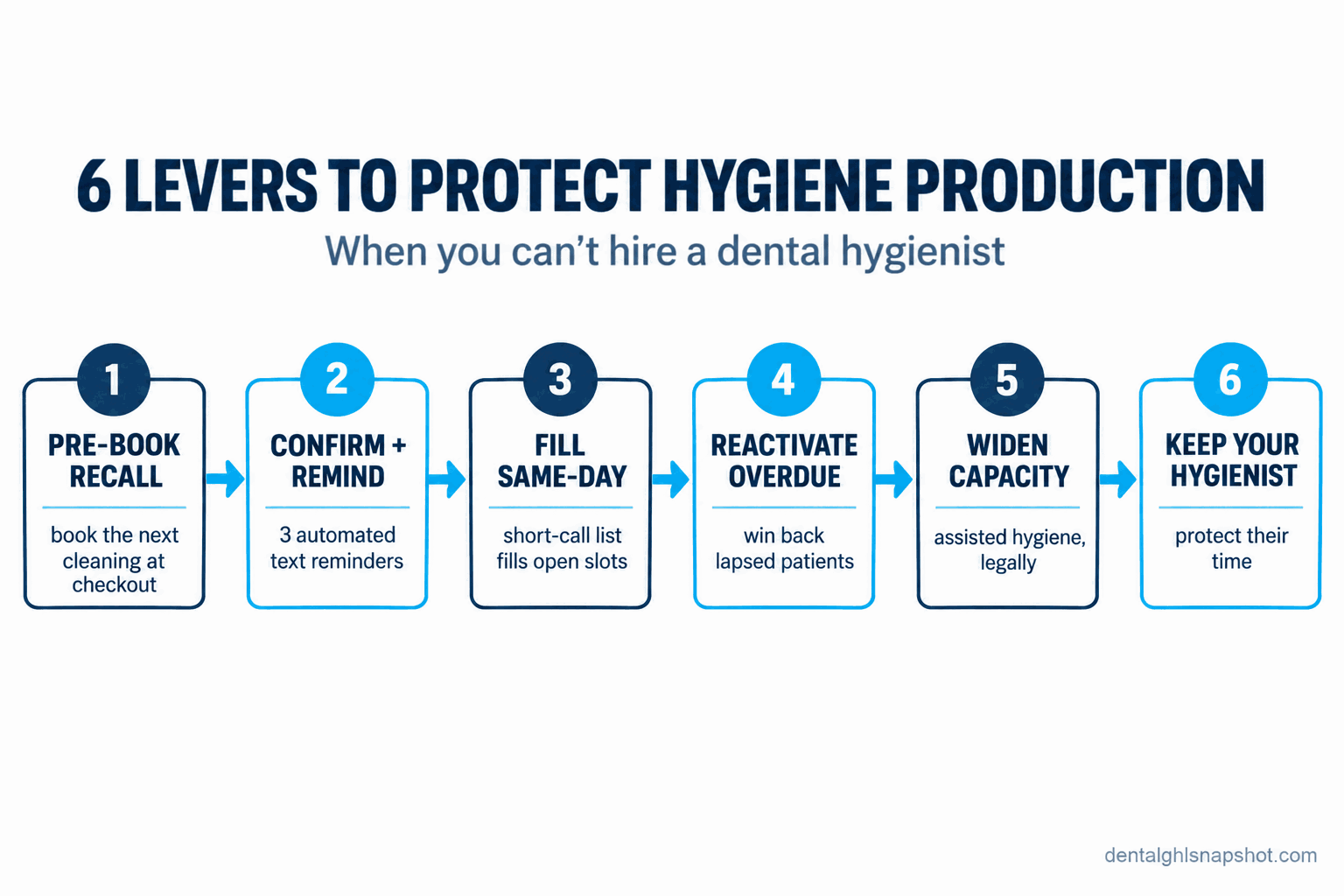
Table of contents
- Why the hygiene column leaks first
- Lever 1: pre-book recall at checkout
- Lever 2: stop the no-shows
- Lever 3: fill the hole same-day
- Lever 4: reactivate the overdue
- Lever 5: widen capacity legally
- Lever 6: keep your hygienist
- What to do first, by size
- The compliance lines
- Objections, answered
- FAQ
Why the hygiene column is where production leaks first
Hygiene is not a side department. It is the recurring-revenue backbone of a general practice and the pipeline that feeds the doctor’s schedule, because the exam that catches the crown, the perio case, and the night guard usually happens at a hygiene visit. When the column has holes, you are not just losing a cleaning fee, you are losing the diagnosis that would have filled the doctor’s column three weeks later.
The money at stake is not small. The average general dentist billed $965,660 in 2025 (ADA Survey of Dental Practice), and consultants commonly put the hygiene department at a quarter to a third of total production, around 30% (Dental Economics). So every open hygiene day is production you chose not to collect, plus the missed exams it would have generated.
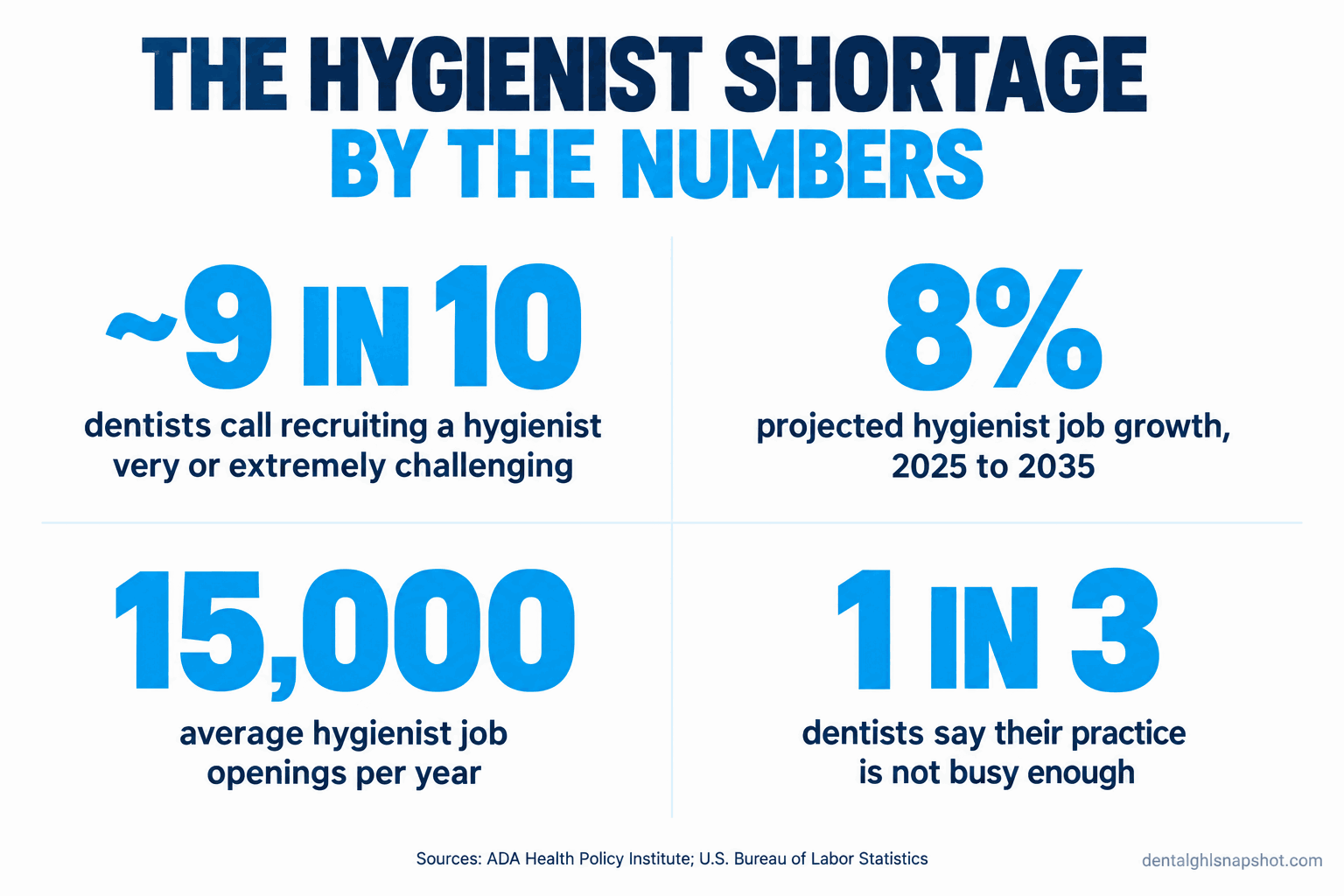
And the pressure is already on. About one in three dentists told the ADA Health Policy Institute in late 2025 that their practice was not busy enough, up from roughly one in four two years earlier (ADA HPI). A practice that is not busy enough cannot afford an empty producing chair.
The instinct is to hire, and you should keep trying. But be honest about the odds. About 9 in 10 dentists who recruited a hygienist in the last year called it very or extremely challenging, in the ADA HPI poll (via Becker’s Dental). The pool shrank during the pandemic and never fully refilled, with an estimated 8%, roughly 1 in 12 hygienists, leaving the workforce in 2020 (Journal of Dental Hygiene, 2021). And demand keeps climbing: the Bureau of Labor Statistics projects dental hygienist employment to grow about 8% from 2025 to 2035, much faster than average, with roughly 15,000 openings a year and a $98,100 median wage (BLS Occupational Outlook). More seats to fill, not fewer. Plan for the vacancy to last, and save the production you can.
There is a better frame than “find a hygienist”: stop losing the hygiene production you already book. Most practices lose more to no-shows, un-pre-booked recall, and an overdue list nobody works than to the vacancy itself, and those are leaks you can close this month. Here are the six levers, in order.
Lever 1: pre-book the next recall before the patient stands up
The cheapest way to protect hygiene production is to never let a patient leave without the next recall on the books. A patient who walks out “to call and schedule later” is one you now have to chase, and chasing is the work a short-staffed desk drops first.
How it works. The hygienist, not the front desk, cues it from the chair, the patient picks a slot before they stand up, the front desk confirms it on the way out, and the automated reminder sequence takes over. Target pre-appointment at 90% or better and the column mostly refills itself.
Steal this chairside line. Keep it warm and specific, and assume the yes.
“Your next cleaning is due the first week of April. I’ve got a Tuesday morning and a Thursday afternoon open that week. Which works better? Great, you’re set. We’ll text you a reminder a week out, and if anything changes you can reschedule right from the text.”
How it breaks. The hygienist runs behind, skips the ask to catch up, and pre-appointment quietly drops to 40%, so the column goes soft two months later. Fix it by making pre-booking a step in the room, not a hope at the desk, and tracking the day’s pre-appointment percentage on the huddle sheet. The deeper playbook is in our guide on automating dental hygiene recall without annoying patients.
Lever 2: stop the hygiene no-shows you already have
When you are short a hygienist, a no-show is not an annoyance, it is an unfillable hole in a column you cannot afford to have soft, so the confirmation system has to be tighter, not looser.
How it works. A pre-booked hygiene visit gets a short, automated sequence: a confirmation when it is booked, a reminder a week out, and a final reminder the day before with a one-tap confirm and an easy reschedule link. Patients prefer it. In a Phreesia survey of about 14,000 patients, nearly half said they would rather get a text reminder than a phone call.
How patients say they prefer to get appointment reminders, from a survey of roughly 14,000 patients. Source: Phreesia.
Steal these reminders. HIPAA-safe: name, date, time, provider, link. Nothing clinical.
7 days out: “Hi Dana, this is a reminder of your cleaning with Maria at Oakline Dental on Tue Apr 9 at 9:00 AM. Reply C to confirm or tap to reschedule: [link]”
1 day out: “See you tomorrow, Dana. Cleaning with Maria, Tue Apr 9, 9:00 AM. Reply C to confirm. Need to move it? [link] Reply STOP to opt out.”
How it breaks. You blast too many messages, or send them at 7 a.m., and patients tune out or opt out. Cap it at the three touches above, send inside business hours, and always offer reschedule instead of only “confirm,” so a patient who cannot make it tells you a day early instead of ghosting. A text that moves an appointment is a win, because it hands you a slot you can still fill. For the lines patients reply to, see our two-way texting playbook.
Lever 3: fill the hole the same day
Even with tight confirmations, holes happen, and during a shortage the speed you fill them is the whole game. An unfilled hygiene slot today is gone today.
How it works. You keep a running list of patients who said “sooner if anything opens up”: the overdue patient who wanted an earlier date, the one who took a later slot reluctantly, the treatment follow-up who needs to get in. The moment a slot opens, an automated message goes to that list, first come first served, and the first reply books it, so no one has to make ten calls between patients.
Steal this fill-the-hole text.
“Hi Dana, a cleaning spot just opened with us this Thursday Apr 11 at 2:00 PM. You asked to come in sooner, so you get first call. Want it? Reply YES and it’s yours. [link]”
How it breaks. The list goes stale, so you text people who already came in or moved away, and the real candidates stop trusting it. Keep it live by pulling from your schedule automatically instead of a sticky note, and remove a patient the moment they book. The mechanics are in our guide on filling last-minute dental cancellations.
Lever 4: reactivate the overdue list sitting in your software
Every practice is sitting on a list of patients who were active, fell off recall, and never came back. During a shortage that list is gold: you do not need new patients to fill the column, you need the ones who drifted.
How it works. Pull everyone whose last hygiene visit was more than seven to eighteen months ago with no future appointment. Work that list with a short, friendly reactivation sequence across text and email, spaced over a couple of weeks, with an easy way to book. The ones who were just busy come back with one nudge.
Steal this reactivation message.
“Hi Dana, it’s Oakline Dental. Our records show you’re due, maybe a little overdue, for a cleaning. We’d love to get you back on the schedule. Pick a time that works: [link] Reply STOP to opt out.”
How it breaks. You dump the whole list into one blast and the volume overwhelms a desk that is already short, or you keep messaging people who have clearly moved on. Trickle it out in small daily batches, capped at two or three touches. Done right, this is the closest thing to free production you have; the full approach is in our guide to the overdue-patient goldmine.
Lever 5: widen capacity legally
Once you have stopped the leaks, ask whether you can get more producing hours from the clinicians you already have. This is where the laws differ, so verify yours first.
Assisted hygiene pairs a hygienist with a trained dental assistant so the hygienist moves between two columns while the assistant handles setup, breakdown, and permitted tasks. Done well, it lifts the hours one hygienist produces. Done badly, it burns the hygienist out and quality slips, so it only works with a trained assistant, the extra chair, and a schedule built for it.
Direct-access and expanded-function rules vary by state. Most states allow some form of direct-access hygiene, where a hygienist sees patients without a dentist’s prior exam in defined settings, but a handful allow none, including Alabama, Delaware, Louisiana, Mississippi, North Carolina, and New Jersey (American Dental Hygienists’ Association). Know exactly what your team is allowed to do so you are not leaving legal capacity unused. Check your state dental board first.
Lever 6: keep the hygienist you have from leaving
The most expensive hygienist to replace is the one who just quit, so during a shortage retention is production protection, and much of what makes a hygienist leave is fixable and has nothing to do with pay.
How it works. Protect their time. A hygienist who spends twenty minutes a day chasing confirmations, hunting charts, or untangling an insurance mess that should have been handled before the chair is doing front-desk work in a clinical seat. Automate the reminders, recall, and pre-visit insurance check so the day is predictable and the column is full of confirmed, verified patients. A steady, respected day beats a chaotic one, and chaos pushes good clinicians out. The pre-visit side is in our guide to automating insurance verification.
How it breaks. You lean so hard on the remaining hygienist that you double-book them, skip their lunch, and treat the open req as their problem to absorb. That is how one vacancy becomes two. Build the schedule for the staff you have, and make the systems carry the overflow instead of the person.
What to do first, by practice size
The six levers are the same for everyone, but where you start depends on your size.
| Practice | The pain | Start here |
|---|---|---|
| Solo, 1 hygienist (or an open req) | One empty column closes the whole hygiene day. No slack to absorb a no-show. | Pre-book recall at 90%+ and run tight confirmations (Levers 1-2), then work the overdue list in small batches (Lever 4). Most production recovered for the least effort. |
| Mid-size, 2-3 hygienists, one vacancy | The remaining hygienists are stretched and at risk of leaving; holes appear daily. | Same-day fill list first (Lever 3), because you have the volume to keep it live. Then protect retention hard (Lever 6) so you do not lose a second hygienist. |
| Larger / multi-provider | Capacity is uneven across locations; one column has holes while another overflows. | Centralize the fill list and reactivation across locations (Levers 3-4), and evaluate assisted hygiene where your state and templates support it (Lever 5). |
The compliance lines every message has to respect
Everything above leans on texting and emailing patients, and three rulebooks decide whether you are doing it legally. None is optional, and a shortage is no excuse to get sloppy.
HIPAA. An appointment text can carry the patient’s name, date, time, provider, practice name, and a reschedule link, but nothing clinical: no procedure names, treatment plans, balances, or diagnoses, because anyone near the phone can read the lock screen. You also need a signed Business Associate Agreement with any vendor that touches patient information (U.S. Department of Health and Human Services).
TCPA and state texting laws. Get consent before you text, honor opt-outs immediately (every message needs a working STOP), and keep marketing messages inside reasonable hours. Several states layer stricter mini-TCPA rules on top, including Washington, Oklahoma, and Maryland, and they apply based on where the patient is, not where your practice sits (FCC).
FTC review rules. When you ask for reviews, ask every patient, not just the happy ones. Routing the request by satisfaction, sometimes called review-gating, is exactly what the FTC’s rule on fake and manipulated reviews targets (Federal Trade Commission). The full breakdown, with sample consent language, is in our guide on whether you can legally text your dental patients.
Objections, answered honestly
“Won’t automated recall and reminders annoy patients?” Not if you cap the volume and make every message useful. Three touches, business hours only, always with a one-tap reschedule, is the channel most patients already prefer (Phreesia). What annoys patients is a confusing phone tree and five voicemails, not a clean text.
“We still can’t hire. Does any of this actually move the needle?” Yes, because most of your lost hygiene production is not caused by the empty seat, it is caused by the appointments you book and then lose: no-shows, un-pre-booked recall, the overdue list nobody works. Those are the slots a fully staffed office keeps and a stretched one drops. Close those leaks and you recover a real share of a column’s production without a single new hire.
“Do I need to be technical, and isn’t this just more software to babysit?” No, and no. The sequences run without anyone at the desk touching them: someone sets them up once, and after that the system sends the reminder, offers the open slot, and nudges the overdue patient on its own. Your people do fewer manual tasks, not more, and spend their hours on the calls that actually need a human.
Frequently asked questions
Dental hygienist shortage: common questions
Why is there a dental hygienist shortage in 2026?
Demand keeps rising while the pipeline stays tight. The U.S. Bureau of Labor Statistics projects dental hygienist employment to grow about 8% from 2025 to 2035, with roughly 15,000 openings a year, and about 9 in 10 dentists who recently recruited a hygienist called it very or extremely challenging in the ADA Health Policy Institute poll. The pool also shrank during the pandemic, with an estimated 8% of hygienists leaving in 2020. More seats to fill than people to fill them means the vacancy can last.
How do I protect hygiene production if I can't hire a hygienist?
Stop losing the appointments you already book. Pre-book the next recall before the patient leaves the chair, confirm every hygiene visit with a short text sequence, fill same-day holes from a short-call list, and reactivate your overdue patients. Most lost hygiene production comes from those leaks, not from the empty seat, so closing them recovers real production without a new hire.
What can I legally put in an appointment reminder text?
Under HIPAA, a reminder can include the patient's name, date, time, provider, your practice name, and a reschedule link, but nothing clinical, so no procedure names, treatment plans, balances, or diagnoses, because the message shows on a lock screen. You also need consent to text, a working opt-out on every message, and a signed Business Associate Agreement with any vendor handling patient data.
How do I keep from losing the hygienist I still have?
Protect their time. Automate the reminders, recall, and pre-visit insurance checks so the day is predictable and the column is full of confirmed, verified patients instead of chaos, and don't cover the vacancy by double-booking the remaining hygienist, which is how one open position becomes two.
How fast can automation like this be set up?
The reminder, fill-list, and reactivation workflows go live quickly once the sequences are built. A done-for-you system like the Dental GHL Snapshot installs the whole set, pre-booking, confirmations, same-day fill, reactivation, and review requests, in your account in about 24 hours, so you are not building it during a staffing crisis.
The hygiene schedule for next Tuesday still has one hygienist for six columns, and you cannot change that this week. But you can make sure every slot that hygienist covers is pre-booked, confirmed, and backed by a live list ready to fill the first hole, and that the overdue patients are being pulled back right now. The vacancy is real. The lost production does not have to be.