

Short answer: The scary number on your aging report is rarely all stuck with insurance. A big slice of it is patient-responsibility balances, the part the patient owes after the plan pays, and most of it went cold because nobody followed up after the patient walked out. The fix is not a nastier phone call. It is a system that collects what it can at the chair, sends the statement fast, reminds the patient on text and email automatically, makes paying take ten seconds, and stops the moment they pay. Below is the whole five-stage engine, the copy you can steal, and the compliance line you cannot cross.
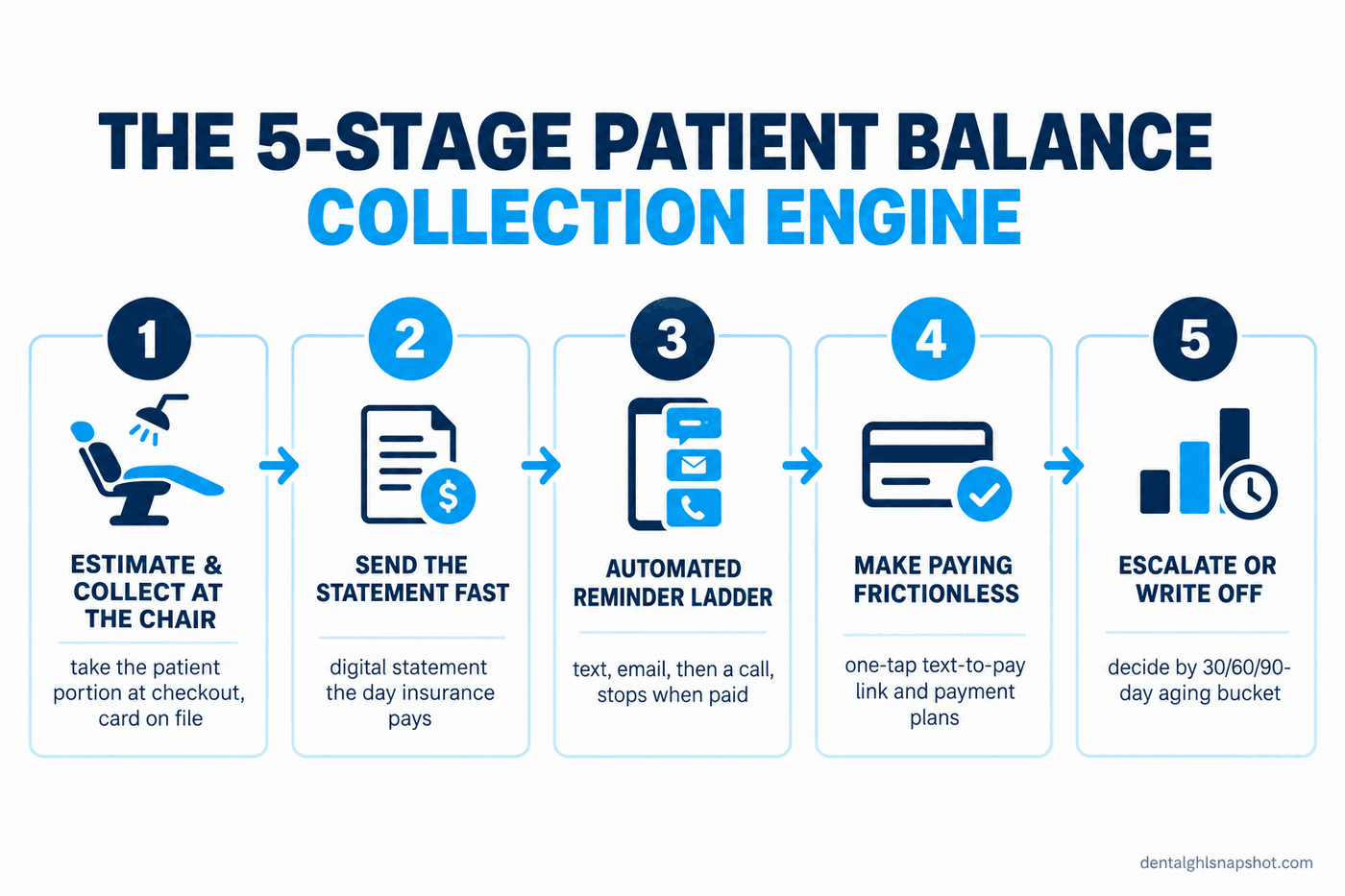
Table of contents
- Why your A/R report is scarier than it needs to be
- Insurance A/R vs patient A/R: know which problem you have
- The five-stage patient-balance collection engine
- Steal this: the exact statement and reminder copy
- Run it for your practice size
- The compliance line you cannot cross
- Objections and honest answers
- FAQ
Why your A/R report is scarier than it needs to be
It is the last day of the month. You pull the aging report, and there it is: a five-figure number, a long list of names, and a column that creeps from 30 to 60 to 90 days. You know how this goes: two afternoons of voicemails nobody returns, and most of those balances still sitting there next month.
That number is not a sign your patients are deadbeats. It is a sign the follow-up broke down between “the insurance paid” and “the patient paid,” and follow-up is the repeatable work software does better than a human who also has to answer the phone and verify benefits before lunch.
The money matters more than it used to. The average deductible for single coverage reached $1,886 in 2025, and about a third of covered workers are now in a plan with a general annual deductible of $2,000 or more (KFF 2025). More of what you produce now depends on the patient paying their part, and patient cost-sharing is exactly the money that often goes unpaid because practices, not payers, carry the burden of collecting it (Health Affairs).
Average annual deductible for single coverage, in dollars. The patient’s share of the bill keeps climbing, so patient A/R climbs with it. Sources: KFF 2024 (2019 and 2024) and KFF 2025 (2025) Employer Health Benefits Surveys.
Layer on the schedule. Plenty of practices have room in the book right now, with about one in three dentists reporting insufficient patient volume heading into 2026 (ADA). When a week is light, you cannot afford to let money you earned slip away because a statement never went out. The average general-practitioner dentist billed about $965,660 in 2025 (ADA Survey of Dental Practice), and a real slice of that flows through patient balances that are only as collectible as your follow-up.
Insurance A/R vs patient A/R: know which problem you have
The A/R report feels like one unsolvable mess because it is actually two different problems that need two different fixes.
Insurance A/R is money you are waiting on from the plan: a claim pending, rejected for a missing attachment, or stuck in a clearinghouse queue. You fix it inside your practice management software and clearinghouse with clean claims and a worklist you actually work. Automation helps only narrowly here. It does not pay the claim, and no honest system pretends to adjudicate insurance for you. That work stays with your biller.
Patient A/R is the balance the patient owes after the plan pays, or the full fee for anything not covered. This is where a follow-up system earns its keep, because the whole problem is contact: the right message, to the right patient, at the right time, repeated until they pay and shut off the moment they do. That is a workflow, not a judgment call, and exactly what you can automate.
So split the aging report before you touch anything. If most of that scary number is patient balances that have gone quiet, you do not have a billing problem, you have a follow-up problem. (If a lot is eligibility surprises, the fix starts earlier, when you verify benefits before the visit.)
The five-stage patient-balance collection engine
Think of patient-balance collection as five stages, not one monthly statement run. Four run as automations; one, the time-of-service collection, happens at the front desk and is the most important habit of all. Build them in order, and even the first three fix most of the leak. Here is each stage, with how it breaks.
Stage 1: Estimate and collect at the chair
The cheapest dollar you will ever collect is the one you take before the patient stands up. Run the estimate off verified benefits, tell the patient their estimated portion before treatment, collect it at checkout, and keep a card on file (with signed authorization) for the balance that lands after the plan processes.
How it breaks. Benefits were never verified, so the estimate is wrong and you under-collect. Or a slammed front desk lets the patient leave with “we’ll bill you,” and a collectible balance becomes a 60-day problem. Fix it by verifying benefits before the visit and making checkout collection non-negotiable.
Stage 2: Send the first statement fast
Speed is the quiet superpower of patient collections. A statement that goes out the day the insurance payment posts reaches a patient who still remembers the visit; one that goes out three weeks later reaches a patient who has closed the book, so the bill feels like a surprise. Trigger it off the event, not the calendar: the moment the payment posts and a balance remains, the system sends a digital statement by text and email, with the amount inside a secure portal, not the message body.
How it breaks. The practice batches statements once a month, so a balance created on the 3rd waits 28 days for first contact. Or the text shows the balance and procedure, which is both a bad experience and a HIPAA problem. Automate the trigger, lead with digital, keep the detail behind a login.
Stage 3: Run the automated reminder ladder
This is where most of the recoverable money lives, and where a human front desk cannot keep up. One statement is not a system. A sequence is: a friendly text a few days after the first statement, an email a few days later, a second text about a week after that, and then, only if the balance is still open, a real call. Each message points to the same secure pay link, spaced so it never feels like nagging, and suppressed the second the payment clears. If you already run two-way texting, this rides on the same rails.
How it breaks. The classic failure is no “stop on payment” rule, so a patient who paid still gets the next dunning text and calls angry. Next is firing all three channels the same day, which reads as panic. Cap the frequency, space the channels, keep the voice human, and wire the automation so a zero balance kills every pending message. Most of this lives in your SMS and workflow automation, where a paid invoice shuts the sequence off.
Stage 4: Make paying frictionless
You can run a perfect ladder and still lose the money at the last inch if paying is a hassle. The patient opens the text, wants to pay, then hits a portal demanding a password, and never gets back to it. Remove every step: the pay link should open to a page that already knows who they are and what they owe, and take a card or digital wallet in seconds. For balances a patient cannot clear at once, offer a payment plan right there, auto-charged to the card on file with consent. For the uninsured and self-pay patients, an in-house membership plan turns a one-time balance problem into predictable monthly revenue.
Patients also pay faster this way. In a 2023 consumer survey, 59% preferred a bill text to a call or email and 51% said it would prompt them to pay sooner (Salucro, via Chief Healthcare Executive).
How it breaks. Payment requires a login, so friction wins. Or there is no payment-plan option, so a patient facing an $800 balance pays nothing. Make the link one tap, offer the plan, and get written consent for anything recurring.
Stage 5: The escalation and write-off decision
Some balances survive the whole ladder. That does not mean chase them forever, or let them drift until they die. It means decide, on a schedule, by aging bucket. A workable cadence: 0 to 30 days stays on the automated ladder; at 60 days a human makes one real call and offers a plan; at 90 days a final notice goes out with a clear deadline; past that, decide per account between a third-party agency and a write-off.
How it breaks. No buckets and no cadence, so balances age without anyone deciding anything. Or the practice jumps to a collections agency over $90 and a good patient, torching the relationship. Set the buckets, call at 60, decide at 90, and treat collections as a last resort. One note: once you send an account to a third-party agency, the FDCPA fully governs it, a good reason to keep most of the work in-house.
Steal this: the exact statement and reminder copy
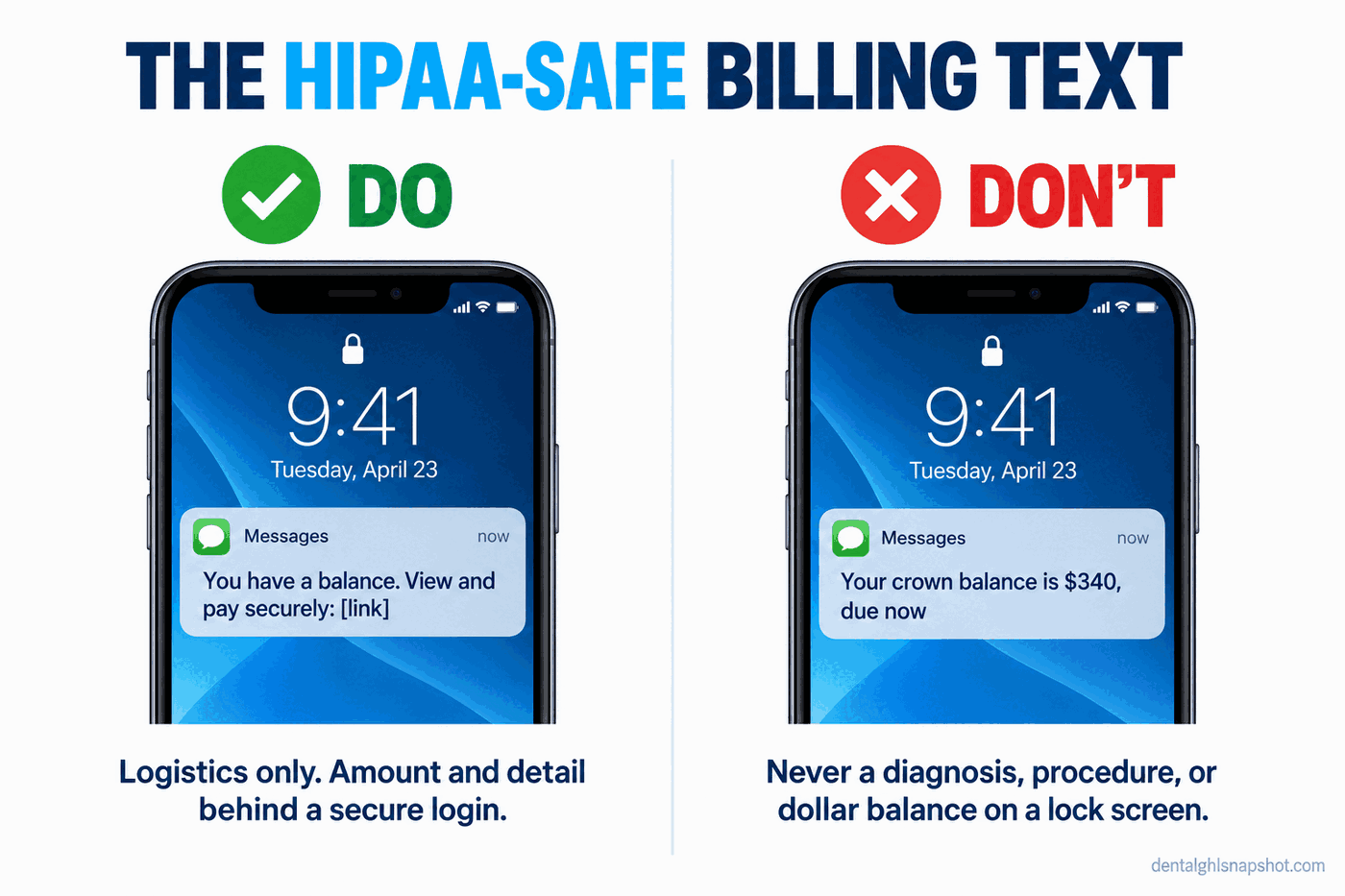
Your messages just need to be short, warm, and clean on a lock screen. Notice what every one leaves out: no dollar amount, no procedure, no diagnosis in the body. The number and the detail live behind the secure link, and the compliance section explains why.
Statement-ready text (day 0, the day insurance pays and a balance remains):
Hi [First name], this is [Practice name]. Your recent visit is all processed and you have a small balance. You can view the details and pay securely here: [secure link]. Questions? Just reply or call us at [number]. Thanks!
Reminder text (day 4, friendly nudge that offers the plan):
Hi [First name], just a friendly reminder that your [Practice name] statement is ready whenever you have a minute. You can pay it or set up a monthly plan right here: [secure link]. Whatever works best for you is fine with us.
The 60-day phone script (a person, not an automation):
“Hi [First name], this is [Name] from [Practice name]. Just checking in on the balance from your visit. I know things get busy. I can take a payment right now over the phone, or set you up on a simple monthly plan, whichever is easier. Which would you prefer?”
Two rules make this work. Every message points to the same secure link. And the moment the balance is paid, the automation suppresses every remaining message, so a patient who pays on day 4 never gets the next one. For the tone and legal grounding of patient texting, the HIPAA and TCPA rules for texting patients go deeper.
Run it for your practice size
The framework is the same for everyone. What changes is how much you automate and who owns the exceptions.
The patient-balance system by practice size
| Plan | Solo practice (1 dentist) | Growing practice (2-3 ops) | Large / multi-provider |
|---|---|---|---|
| Price | You own it all | Shared ownership | Dedicated role |
| Feature 1 | Card on file plus auto-statement does most of the work; the ladder runs itself, and you only take the 60-day calls | Assign one patient-balance owner, even part-time; automate the full ladder and run a weekly 20-minute A/R huddle | A dedicated coordinator owns both A/R piles; full automation plus dashboards, payment-plan tiers, and a collections policy |
| Feature 2 | Biggest risk: busy days where checkout collection gets skipped | Biggest risk: insurance and patient A/R get lumped together again | Biggest risk: automation runs but nobody owns the exceptions it kicks out |
The through-line: the smaller you are, the more the time-of-service habit matters, because no one cleans up later. The bigger you are, the more someone must own the exceptions the automation flags. For the numbers worth tracking, see the 2026 dental practice statistics.
The compliance line you cannot cross
The rules are clear once you separate two questions: are you allowed to contact the patient about money, and what are you allowed to put in the message.
Are you allowed? Yes. Communicating with a patient to collect payment is a permitted “payment” use of their information under the HIPAA Privacy Rule, so no separate authorization is needed to send a patient their own statement or a payment reminder (45 CFR 164.506).
What can you put in it? Keep it minimal. The catch is the minimum-necessary principle and the fact that a text lands on a lock screen anyone can read. HHS guidance on appointment reminders sets the pattern: a reminder can carry logistics, not clinical detail (HHS). Apply the same to billing: the body should never show a diagnosis, procedure, or dollar balance. Say “you have a balance, view and pay it securely here,” and keep everything else behind a login.
Three more lines to respect:
- Consent and STOP for texting. Get consent to text, honor STOP immediately, and know that state mini-TCPA laws in Washington, Oklahoma, Maryland and others can apply no matter where your practice sits. The patient texting compliance guide covers this in full.
- The FDCPA. A practice collecting its own debts in its own name is generally not a “debt collector” under the Fair Debt Collection Practices Act, so its strict rules usually do not bind your front desk. That changes the moment you hand an account to a third-party agency, which the FDCPA fully governs.
- A BAA with any vendor that touches the data. If a vendor handles patient information to send statements or process payments, you need a signed Business Associate Agreement. No BAA, no PHI.
Objections and honest answers
“Won’t patients feel nagged if a system texts them about money?” They feel nagged by volume and tone, not by a reminder. A single friendly text, capped, that stops the instant they pay, reads as helpful. What actually annoys patients is a dunning text the day after they already paid, because the system had no stop-on-payment rule.
“I already have billing in Dentrix / Open Dental / Eaglesoft. Why add anything?” Your practice management software is excellent at producing a statement and tracking a ledger. It is usually not built to run a timed, multi-channel reminder ladder with text-to-pay, payment plans, and automatic shut-off when a balance clears, so most practices do that follow-up by hand, which is the labor that leaks. The automation layer sits on top of your PMS and handles the contact; it does not replace your ledger. For what the big platforms include, see the real dental software cost teardown.
“What about patients who truly cannot pay?” That is what payment plans are for, and offering one early beats a harder line later. A patient on a $50-a-month plan pays you; a patient facing an $800 wall pays nothing. For the uninsured, an in-house membership plan often solves affordability before a balance is created. And none of this requires you to be technical: the automation is set up once, and your daily job stays the human parts.
Frequently asked questions
Dental accounts receivable FAQ
What is a healthy level of accounts receivable for a dental practice?
There is no single magic number, and be skeptical of any vendor who quotes one as gospel. The useful habit is to separate insurance A/R from patient A/R and watch how much of your total sits past 90 days and whether that share is growing or shrinking month over month. A rising 90-plus bucket is the real warning sign.
How is patient A/R different from insurance A/R?
Insurance A/R is money you are waiting on from the plan, worked as claims inside your practice management software and clearinghouse. Patient A/R is the balance the patient owes after insurance pays, or the full fee for anything not covered, and you collect it through contact: statements, reminders, and easy payment.
Can I legally text my dental patients about an unpaid balance?
Yes. Contacting a patient to collect payment is a permitted payment communication under the HIPAA Privacy Rule (45 CFR 164.506). The limits are on content and consent: do not put a diagnosis, procedure, or dollar balance in the message body where a lock screen shows it, get consent to text, and honor STOP.
Is my practice a 'debt collector' under the FDCPA when it collects its own balances?
Generally no. The FDCPA defines a debt collector as someone collecting debts owed to another, so a practice collecting its own debts in its own name is usually outside the Act's strict rules. That protection disappears when you hand an account to a third-party agency, which the FDCPA fully governs.
What is the single fastest way to lower my patient A/R?
Collect more at the time of service. A balance you take at checkout never becomes A/R, never ages, and never needs a statement. Accurate estimates off verified benefits, plus a card-on-file policy, shrink your aging report faster than any after-the-fact effort.