

Short answer: The morning huddle is not someone reading the schedule out loud to adults who can read. It is a tight 15 minutes where the whole team walks today’s schedule looking for what is about to go wrong and what money is sitting there unclaimed: the appointment nobody confirmed, the hygiene hole at 2:00, the patient with $1,800 of unscheduled treatment who is coming in anyway. Run it as a system with a fixed agenda and a quick data pull, and a day that would have leaked production fills itself instead. Below is the whole thing: the agenda to steal, what to pull before you start, how to run it by practice size, and the ways it quietly falls apart.
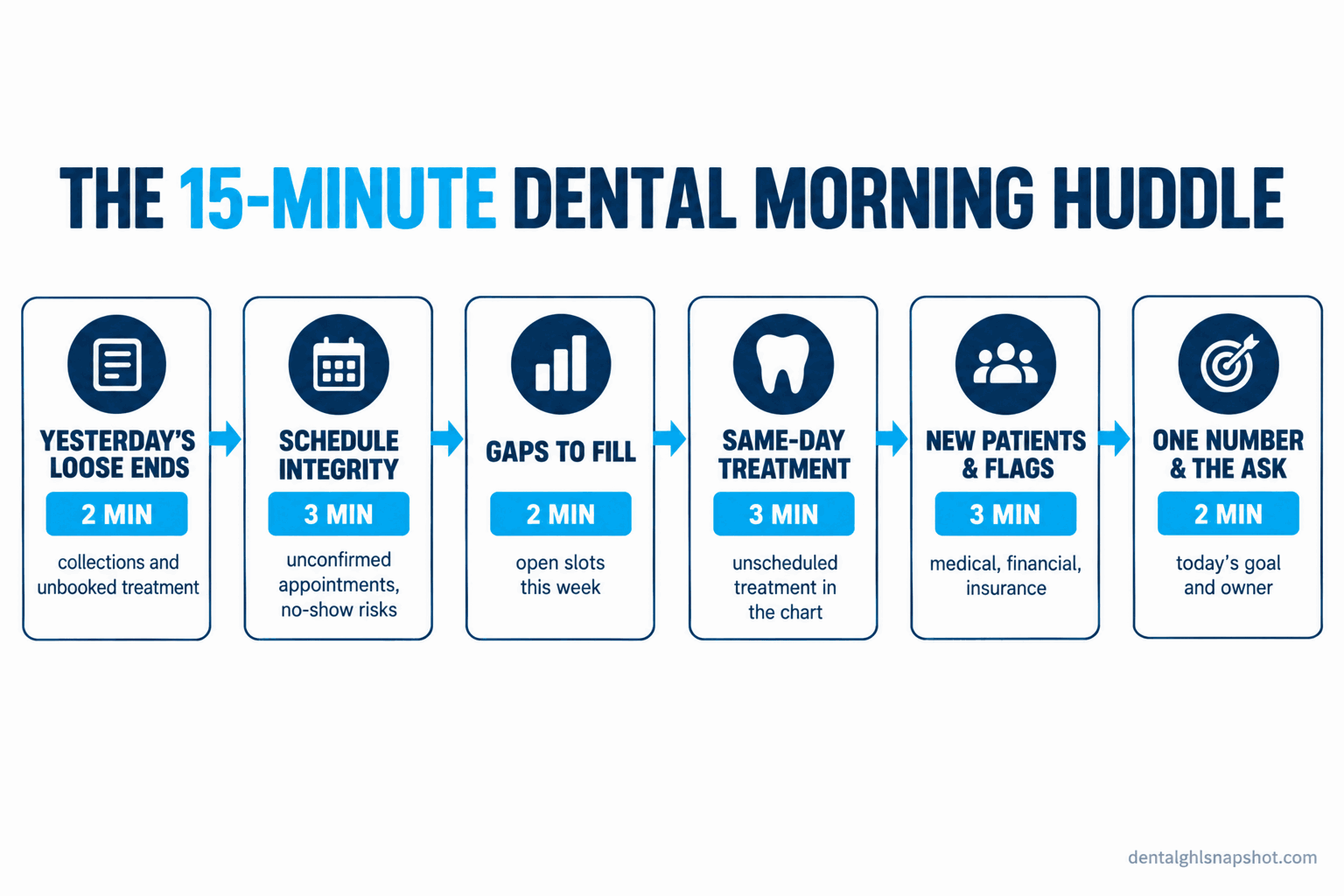
Table of contents
- What a huddle-less morning quietly costs you
- What the morning huddle actually is (and what it is not)
- The six segments of a huddle that finds money
- Steal this: the 15-minute agenda and the data pull
- Run it for your practice size
- The compliance line inside your own huddle
- Objections and honest answers
- FAQ
What a huddle-less morning quietly costs you
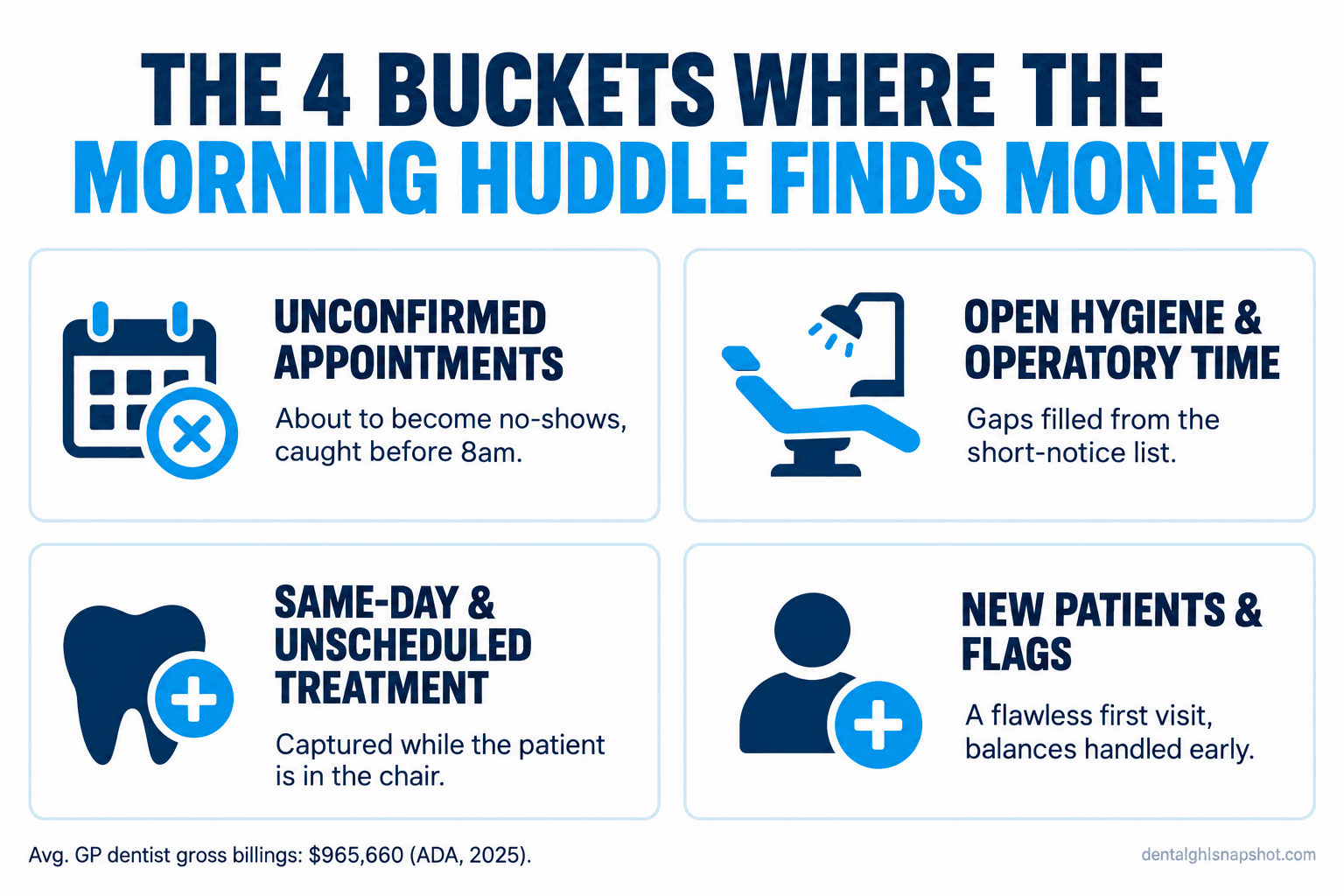
It is 7:52 on a Tuesday. You are counting the drawer, the first hygiene patient is in the parking lot, and the day is about to happen to you. At 10:00 there is a crown seat nobody confirmed, and the patient is not coming, you just do not know it yet. At 2:00 there is a 60-minute hygiene hole because a recall patient rescheduled last week and nobody backfilled it. And your 9:00 is here for a cleaning with $2,100 of accepted-but-unscheduled treatment in her chart that she will walk out without anyone mentioning. None of those are emergencies. They are money leaving the building quietly, one chair at a time.
That leak matters more right now than it used to. The ADA Health Policy Institute found that in late 2025 roughly one in three dentists reported insufficient patient volume (ADA News). When the schedule is not overflowing, the practices that win squeeze every dollar from the patients who do show up. And there is real money per chair: the average general-practice dentist billed $965,660 in 2025, up from $942,290 the year before (ADA Survey of Dental Practice). A single open operatory hour is worth hundreds of dollars you will not get back.
You cannot fix any of this at 7:52 if the first time the team looks at the day together is when the patient is in the chair. The unconfirmed crown, the open hygiene slot, the unscheduled treatment: all three were catchable this morning if someone had looked. That is the point of the huddle. It is not a motivational meeting; it is the last checkpoint before the day starts spending your production for you.
What the morning huddle actually is (and what it is not)
Most huddles fail the same way, and the trade press is blunt about it. A 2026 Dentaltown piece describes the dead version: “Someone reads the schedule out loud. Production numbers are announced,” and the day “unfolds however it wants to anyway.” It mocks reading the schedule “to adults who can read” (Dentaltown). If that is your huddle, your team is right to resent it: it costs them ten minutes and gives them nothing.
A real huddle asks one question of every hour on the schedule: what could go wrong here, and what is being left on the table? You are not narrating the day; you are hunting for the gap, the risk, and the opportunity, then assigning who handles each before 8:00. Practice consultants have pushed this for years. A long-running DentistryIQ guide recommends a 10 to 15 minute huddle led by the dentist or scheduling coordinator, with the clinical team reviewing records beforehand and flagging “unscheduled treatment or re-care appointments needed,” plus the reminder that if a patient is already in the office, that treatment can sometimes be done the same day (DentistryIQ).
So the test is simple. If your huddle only tells the team what is on the schedule, it is a ritual. If it changes what the team does in the next eight hours, it is a system. Everything below keeps it a system.
The six segments of a huddle that finds money
Break the 15 minutes into six short segments, in this order: clear yesterday’s loose ends first so they do not hijack the meeting, then protect today’s schedule, then go hunting for what you can add.
- Yesterday’s loose ends (2 min): slipped collections, presented-but-unscheduled treatment, callbacks owed.
- Today’s schedule integrity (3 min): unconfirmed appointments, no-show risks, existing holes.
- Open slots and gaps to fill (2 min): who you call or text to fill a known opening today.
- Same-day and unscheduled treatment (3 min): patients coming in with treatment still in the chart.
- New patients and medical or financial flags (3 min): first visits, medical alerts, insurance and balance issues.
- One number and the ask (2 min): the single goal for the day and who owns it.
Steal this: the 15-minute agenda and the data pull
Print this and tape it next to the schedule: the prep, the meeting, then the words that keep it moving.
The data pull (done before the huddle, by one owner)
One person, usually the scheduling coordinator or office manager, pulls this one-page sheet before everyone gathers. It takes about ten minutes once you know where everything lives, and it is the difference between a huddle and a hallway chat.
Morning huddle prep sheet
- Today’s schedule by provider and operatory, gaps highlighted.
- Unconfirmed appointments for today and tomorrow.
- Patients scheduled today with unscheduled or accepted-but-unbooked treatment.
- Patients scheduled today with an outstanding balance.
- New patients today: source, insurance, forms done yes or no.
- Open hygiene and operatory time this week to backfill.
- Yesterday’s presented-but-unscheduled treatment and missed collections.
The 15-minute agenda (read it as actions, not announcements)
7:45 to 8:00, every clinical day
- Yesterday (2 min). Who owes a callback? What was presented and not booked? Give each one a name and a time to handle it today.
- Schedule integrity (3 min). Walk today hour by hour. Every unconfirmed appointment gets an action now, text or call, and you decide what fills the slot if it falls through.
- Gaps to fill (2 min). Name every open slot today and this week. Who texts the short-notice list? Who calls the overdue recall list? Assign it.
- Same-day treatment (3 min). For every patient coming in with treatment in their chart, decide who mentions it: “while you’re here today, we have time to take care of that filling.” The biggest money line.
- New patients and flags (3 min). Review each new patient and anyone with a medical alert, a balance, or an insurance question. Decide who handles the awkward part before the chair.
- The number and the ask (2 min). State today’s one goal (“fill the 2:00 hygiene hole and book two same-day treatments”) and name who owns it.
The words that keep it a system, not a sermon
The facilitator uses action language, not narration. Not “Mrs. Garcia is at 10, she’s a crown seat,” but “Mrs. Garcia, 10:00 crown seat, not confirmed. Dana, text her now and tell me by 8:30. If she’s out, the slot goes to the short-notice list.” Every line ends with a name and a next step. That habit separates a huddle people respect from one they endure.
How each segment breaks (and the fix)
Knowing the agenda is not the same as it surviving a real Tuesday. Here is where each segment fails.
Yesterday’s loose ends turn into a blame session. The moment “who didn’t book the treatment” sounds like an accusation, people stop volunteering problems. Keep it about the next action, never the last mistake: “who’s calling Mr. Ruiz back today,” not “why didn’t anyone call him yesterday.”
Schedule integrity becomes a recap instead of a plan. You read out that the 10:00 is unconfirmed and move on, and nothing changes. Every unconfirmed appointment needs an owner and a deadline inside the meeting. For the deeper reasons patients confirm and then vanish, see why patients no-show after confirming.
Gaps get noticed but not filled. Everyone agrees the 2:00 hole is a problem, the huddle ends, and the hole stays. Assign the fill in the room and keep a short-notice list ready to text. The mechanics are in our guide to filling last-minute cancellations.
Same-day treatment gets skipped because it feels like selling. This is the one that costs the most. A patient with accepted treatment in the chart is not a cold pitch; they already said yes and never got on the schedule. The huddle decides who offers it, so it does not depend on someone remembering mid-appointment. For the chairside side, see lifting case acceptance.
New-patient and financial flags get discovered at checkout. If the first time anyone notices a $1,400 balance is when the patient is leaving, you get an awkward conversation and probably no payment. Catch it in the huddle and decide who raises it before the appointment. If insurance questions eat the front desk alive, here is how to automate the verification workflow.
Minutes per segment in the recommended 15-minute agenda. Source: the agenda in this article, built to keep the two money segments longest.
Run the arithmetic on one bucket. If the huddle surfaces one same-day treatment worth $400 and you capture it twice a week, that is about $38,000 a year from a meeting you were already holding. Add the hygiene slots you backfill and the no-shows you catch early, and it is the highest-return quarter hour on the schedule. (An illustration, not a benchmark; your numbers depend on your fees and capture rate.)
Run it for your practice size
The agenda does not change with size. What changes is who is in the room and how formal the follow-up is.
The morning huddle by practice size
| Plan | Solo (1 dentist, 2 ops) | Group (2-3 dentists, 1-3 hygienists)Recommended | Multi-location |
|---|---|---|---|
| Price | Fast + informal | Full 15-minute system | Standardized + measured |
| Feature 1 | 5 to 8 minutes, standing, every clinical day | The full six-segment, 15-minute agenda | Same agenda and prep sheet at every office |
| Feature 2 | Dentist plus front-desk and assistant | Scheduling coordinator owns the data pull | A location lead runs each huddle |
| Feature 3 | Office manager pulls a one-page prep sheet | Each provider flags their unscheduled treatment | Shared dashboard pulls data automatically |
| Feature 4 | Focus on same-day treatment and gaps | Named owners for confirms, fills, callbacks | Confirm, fill, and same-day rates tracked |
| Feature 5 | One owner handles follow-up calls | A daily goal stated and tracked | Weekly roll-up across the group |
A solo office sometimes thinks it is too small to huddle. It is the opposite: with two operatories, a single no-show is a much bigger share of your day. Keep it to five minutes and standing, but keep it.
The compliance line inside your own huddle
The huddle is an internal meeting, so people assume HIPAA does not apply. It does. The privacy rule’s minimum-necessary standard says you should share only the protected health information needed for the task at hand (HHS). That translates into a few concrete habits.
Keep the screen and the whiteboard out of patient sightlines. A monitor showing full names, procedures, and balances that is visible from the waiting room is a disclosure waiting to happen, so angle it, move it, or use a privacy filter. If you write on a board, use first names or initials and erase it after.
Talk about clinical detail only to the degree the plan needs it. The huddle needs to know a patient has unscheduled treatment and who will mention it; it rarely needs the full diagnosis announced across the room. The same rule you follow for patient texts applies to the board behind the front desk: a date, a time, and a provider are fine in the open, the same detail HHS allows in an appointment reminder, but a diagnosis or balance is not. Our guide on whether you can legally text your patients covers the rules in full.
Objections and honest answers
“We don’t have time for a meeting every morning.” You do not have time for the day to run you instead. The huddle is 15 minutes that prevent an hour of scramble: the no-show you catch at 7:50 instead of 10:00, the hole you fill before it becomes dead time. If 15 feels like too much, run the five-minute version. The floor is doing it at all, not perfectly.
“We tried huddles and they fizzled out.” They fizzled because they were a schedule reading, exactly the version the trade press says to kill. A meeting that only tells people what they can already see on the screen earns resentment. Switch to the action format where every line ends with a name and a next step, pull real data first, and keep it to 15 minutes. People show up for a meeting that makes their day easier.
“My team already knows the schedule, so what’s the point?” Knowing the schedule and having a plan for it are different things. The team can see that the 10:00 is a crown seat; what they lack, without the huddle, is a shared decision about who confirms it, what fills it if it falls through, and who mentions the treatment in that patient’s chart. The point is the plan, not the list.
“Can’t software just do this?” Software should do the hard part, the data pull: surfacing unconfirmed appointments, open slots, unscheduled treatment, and overdue recall, and firing the follow-up texts without anyone working a list. But the 15 minutes of human judgment, who handles the awkward balance and how you offer same-day treatment, is still yours. A dashboard that gathers and a short huddle that decides is the best setup. For the front-desk side that pairs with it, see the front-desk phone scripts.
The bottom line
Back to that 7:52 Tuesday. In a huddled practice, the 10:00 crown seat got a text at 7:48 and confirmed by 8:15. The 2:00 hygiene hole got filled from the overdue recall list before the morning was out. And the 9:00 cleaning left with her $2,100 of treatment finally on the schedule, because the huddle decided at 7:49 that the hygienist would hand off and the dentist would spend two minutes on it while she was already in the chair.
That is the promise of the morning huddle: the day stops happening to you. You spend 15 minutes finding the money and the trouble before patients arrive, then run a practice that fills its own schedule. Print the agenda, pull the sheet, and run it tomorrow.
How long should a dental morning huddle be?
Ten to fifteen minutes is the range most practice consultants recommend, and that covers the full six-segment agenda. Smaller offices can run a tighter five-to-eight-minute version. The length matters less than the format: if it is a schedule reading, even five minutes is too long; if it is an action plan, fifteen is well spent.
Who should lead the morning huddle?
Usually the office manager or scheduling coordinator, because they own the schedule and the data pull, with the dentist present and engaged. DentistryIQ recommends the dentist or scheduling coordinator facilitate. What matters is that one person owns the agenda and keeps every line ending in a name and a next step.
What should be on a morning huddle agenda?
Six segments: yesterday's loose ends, today's schedule integrity (unconfirmed appointments and no-show risks), gaps to fill, same-day and unscheduled treatment for patients already coming in, new patients and medical or financial flags, and one daily goal with an owner. Each item should produce an action assigned to a person, not an announcement.
What data do I need to pull before a huddle?
A one-page prep sheet with today's schedule by operatory, unconfirmed appointments, patients coming in who have unscheduled treatment or an outstanding balance, new patients with their source and insurance status, and open hygiene or operatory time to backfill. One person pulls it before the team gathers so the meeting is about decisions, not data entry.
Is the morning huddle worth it for a small or solo practice?
Yes, arguably more than for a large one. In a two-operatory office a single no-show or open hour is a larger share of your day, so catching it early protects more of your production. Keep it short and standing, but a solo practice that huddles catches the same leaks a big group does.
Does HIPAA apply to a dental morning huddle?
Yes. The minimum-necessary standard means sharing only the patient information the plan requires, and keeping any screen or whiteboard showing names, procedures, or balances out of patient sightlines. Discuss clinical detail only to the degree the huddle needs it, and erase a shared board afterward rather than leaving patient data on the wall.