

Short answer: A patient tapping “Confirm” is not the same as a patient deciding to show up. Confirming is a two-second reflex people do without really reading. The appointment still no-shows when too much time passes before the visit, when the reason for it fades, when rescheduling feels harder than disappearing, when reminders hit the wrong channel, and when missing costs the patient nothing. None of that is fixed by one more “reply C to confirm.” It is fixed by a confirm-to-kept-chair system: reminders that restate the value and make rescheduling a one-tap choice, the right channel and cadence, and a calm short-notice policy so a freed chair gets backfilled. Below are the six real reasons and the fix for each, with the exact messages you can steal.
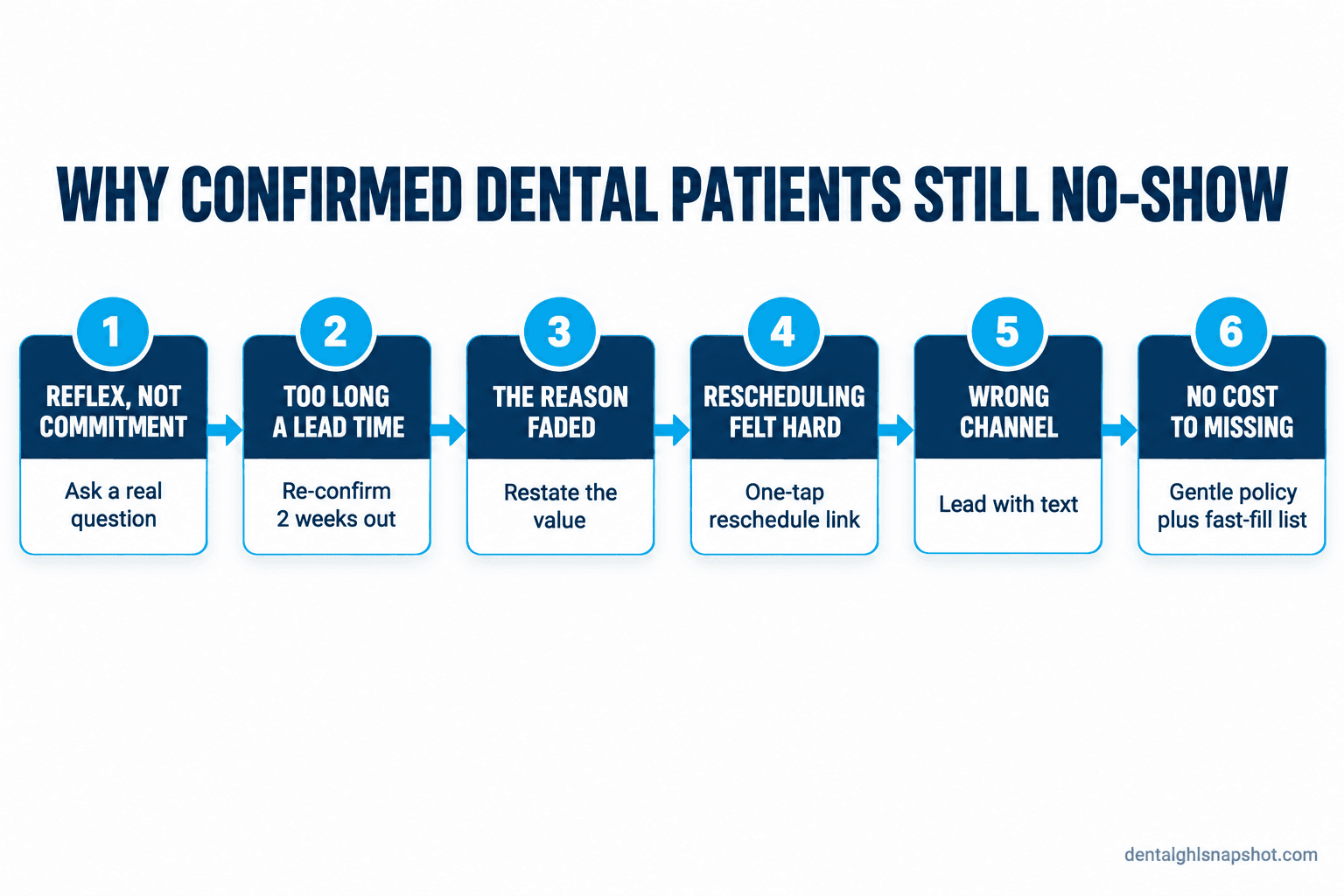
Table of contents
- What no-shows actually cost your practice
- Why “confirmed” is not “committed”
- The six real reasons confirmed patients no-show
- Steal this: the confirm-to-kept-chair message sequence
- Run it for your practice size
- The compliance line you cannot cross
- Objections and honest answers
- FAQ
What no-shows actually cost your practice
It is 8:10 on a Tuesday. The 8:00 hygiene patient confirmed by text on Sunday. The chair is set, the hygienist is standing, and the parking lot is empty. By 8:20 you are calling a cell that goes to voicemail. That hour is gone.
Here is the part that stings: that patient did everything your reminder asked. They read the text, tapped “Confirm,” and still are not here. So the honest question is not “why don’t patients confirm,” it is “why do they no-show after they confirm.”
Start with the size of the leak. A 2021 systematic review in the British Journal of General Practice pooled 19 studies and found missed-appointment rates ran from 3.3% to 48.1%, with a mean of 15.2% and a median of 12.9% (BJGP, 2021). Dental practices are not identical to GP clinics, but the behavioral pattern travels, and even a rate in the low teens is real production walking out.
Put a dollar figure on it. If a hygiene hour is worth $150 to $250 and you lose two a day, that is $1,500 to $2,500 a week, or tens of thousands a year against an average general practice that grosses $942,290 (ADA, 2024). It hurts most when chairs are already hard to fill: as recently as late 2025, roughly one in three dentists told the ADA Health Policy Institute they were not busy enough, easing to about one in four by mid-2026 (ADA HPI).
Missed-appointment rate (%) across 19 studies of general practice. Source: British Journal of General Practice systematic review, 2021.
Why “confirmed” is not “committed”
Think about what happens when your reminder hits. The patient is mid-commute or mid-dinner. The phone buzzes, they glance, they tap the reply that stops the buzzing. It costs nothing and commits them to nothing. In their head the appointment is still a vague “sometime Tuesday,” not a block they have arranged their day around.
That gap between a reply and a real intention is where confirmed no-shows live. The research on who misses appointments keeps landing on the same drivers: plain forgetting, the time between booking and the visit, prior no-show history, and access friction like transportation and work (systematic review, 2020). Notice what is missing: “did not receive a prompt” is rarely the problem. The prompt is the easy part; keeping the appointment real in the patient’s life is the hard part. The goal is not more confirmations. It is to close the gap between the tap and the day, one cause at a time.
The six real reasons confirmed patients no-show
1. Confirming is a reflex, not a commitment
A one-word reply is a habit, not a plan. Patients confirm to clear a notification, the way they tap “Not now” on an app update. It never asks them to picture Tuesday, arrange a ride, or move a meeting. The fix: use the reminder to trigger a tiny active choice. Ask a question that needs a real answer (“Will 8:00 still work, or should we find a better time?”). A patient who types “yes, 8 works” has done a sliver more mental work, and that sliver correlates with showing up. Where it breaks: if you ask a question and never read the answers, patients learn it is theater, so route replies to someone who acts on “no.”
2. Too much time between booking and the visit
Book a cleaning six months out and the patient’s future self is a stranger. Life reorganizes around that slot, and longer lead times are one of the most consistent predictors of non-attendance (systematic review, 2020). The fix: re-establish the appointment as it gets close. Do not rely on the old booking; send a “we’re holding Tuesday for you” note two weeks out that lets them reconfirm or move it. Where it breaks: cancelling six-month pre-books entirely just trades a manageable problem for an empty hygiene column. Keep the pre-book, add the reactivation touch.
3. The reason for the visit faded
A patient in pain shows up. A patient with a symptomless cleaning, or a crown they agreed to months ago while numb, has nothing pulling them in. The value was clear at booking and invisible by the day. The fix: put the “why” back into the reminder, inside the compliance line. You cannot text a diagnosis, but you can note that the visit protects work they already paid for, or that year-end benefits reset and do not roll over. Where it breaks: “Crown prep on #14” names a procedure on a lock screen. Keep it to value and logistics, never clinical detail.
4. Rescheduling felt harder than ghosting
Most no-shows are not defiant. Something came up, the office was closed or the line was busy, and calling to reschedule felt like a chore for “later.” Later never came. The fix: make moving the appointment the easiest action there is, with a one-tap reschedule link to your live calendar in every reminder. When rescheduling is easier than ghosting, patients reschedule and you free the slot early enough to fill it. Where it breaks: a link that dumps them on a generic contact form, or a calendar with nothing open for three weeks, teaches them ghosting was faster. The link has to work and show real availability.
5. Wrong channel, or reminder fatigue
Email reminders get buried and a midday voicemail goes unheard, but the opposite failure is just as real: five texts for one cleaning trains people to swipe your practice away. SMS reminders reliably lift attendance versus no reminder (Cochrane, 2013), but volume is not the lever, relevance is. The fix: lead with the channel patients read, which for most is text, and keep the cadence tight: a confirmation at booking, a reminder a few days out, and a nudge the day before. Where it breaks: the same reminder blasted on three channels reads as spam. One clear message on the right channel beats three on the wrong ones.
6. Missing costs the patient nothing
If a no-show carries no consequence, the appointment ranks below almost everything competing for that hour. The perceived cost is a lever: a two-trial randomized study of nearly 20,000 hospital appointments found that simply stating the cost of a missed slot in the reminder measurably reduced no-shows versus a standard message (PLoS ONE, 2015). The fix: add a gentle short-notice policy and a fast-fill list so a late cancellation becomes a booked slot. The point is not to punish, it is to signal the time is reserved for them. Our ASAP-list playbook covers the backfill side. Where it breaks: a heavy-handed fee over one honest mishap costs more than the hour, so waive the first slip and lead with rescheduling, not the penalty.
Steal this: the confirm-to-kept-chair message sequence
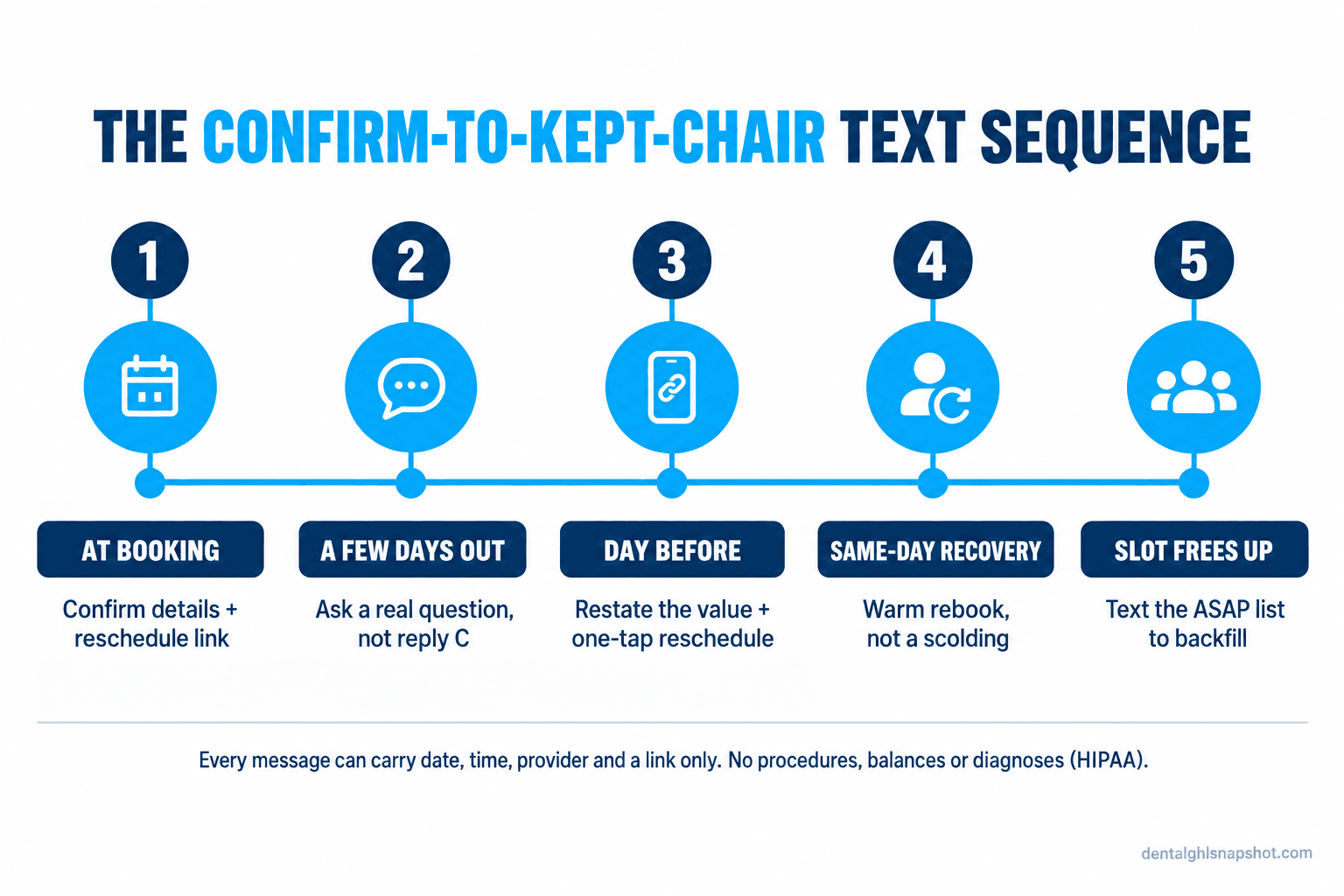
Copy this sequence today. One clear ask per message, a reschedule link every time, and it stays inside the HIPAA line (date, time, provider, link, nothing clinical). Swap in your own booking tokens.
At booking (immediately):
Hi [First Name], you’re booked with [Practice] on Tue Oct 14 at 8:00 AM with [Dr./Hygienist Name]. Need to change it? Tap here: [reschedule link]. Reply STOP to opt out.
Reminder, a few days out (asks a real question):
Hi [First Name], quick check for Tue at 8:00 AM at [Practice]. Will that still work, or should we find a better time? Reply YES to keep it, or tap [reschedule link] to move it.
Day-before nudge (restates the value, adds one-tap reschedule):
Reminder: your visit at [Practice] is tomorrow, Tue at 8:00 AM with [Name]. This visit keeps your care on track. Running late or need to move it? Tap [reschedule link].
Same-day no-show recovery (kind, not scolding):
Hi [First Name], we missed you at 8:00 today and hope everything’s okay. Let’s get you rebooked, no problem. Grab a new time here: [reschedule link], or reply and we’ll help.
When a slot frees up (to your ASAP list):
Hi [First Name], a spot just opened at [Practice] on Tue at 8:00 AM. You asked to hear about earlier openings. Want it? Reply YES and it’s yours, first to reply gets it.
Two rules make these work: every message offers a reschedule, because a moved appointment is a win and a ghost is a loss; and the tone stays warm, so the patient feels cared for, not chased.
Run it for your practice size
The same six causes hit every practice, but the build depends on your team.
The confirm-to-kept-chair system by practice size
| Plan | Solo (1 dentist, 2 ops) | Mid (2-3 dentists) | Group / multi-location |
|---|---|---|---|
| Price | Lean + automated | Provider-aware | Centralized |
| Feature 1 | Two-way SMS reminders on autopilot | Reminders tagged by provider and visit type | One system across locations, local sender IDs |
| Feature 2 | One-tap reschedule link in every message | Recare re-confirmation two weeks out | Cross-location ASAP fill for same-day openings |
| Feature 3 | Automated same-day no-show recovery text | Channel preference honored per patient | Consistent opt-out handling everywhere |
| Feature 4 | Simple ASAP list to backfill openings | Weekly no-show rate by provider | Location-level no-show dashboards |
For a solo practice the win is time: the automation is the staffer you cannot hire. For a mid-size team the win is precision: tag reminders by provider and watch no-show rate by provider to see where the leak actually is. For a group the win is consistency: centralize the system, keep local sender identity, and run location-level dashboards so a problem at one site does not hide in the average.
The compliance line you cannot cross
Reminders are allowed. Careless ones are a liability. Three rules keep you safe.
HIPAA: logistics only, never clinical detail. Appointment reminders are expressly permitted under HIPAA without separate authorization (HHS). A reminder can carry the date, time, provider name, and a link, and nothing else. A procedure name, tooth number, balance, or diagnosis is exposed on a lock screen where anyone can read it. “See you Tuesday at 8:00 with Dr. Lee” is fine; “Crown prep on #14, balance $340” is not. Any vendor sending these messages handles protected health information, so get a signed Business Associate Agreement.
TCPA and consent: get it, honor STOP. Automated texts require prior consent and a working opt-out, and STOP has to actually stop the messages. Several states run stricter mini-TCPA laws, including Washington, Oklahoma, and Maryland, and those apply based on where the patient is, not where your practice sits. Get clear written consent at intake and log it.
FTC: do not gate your reviews. Your recovery flow often feeds a review request later, so know this one. In 2024 the FTC finalized a rule banning fake and manipulated reviews, effective October 21, 2024, with penalties reaching tens of thousands of dollars per violation (FTC). Asking only happy patients for a public review, or routing unhappy ones to a private form to keep them off Google, is the review suppression the rule targets (Federal Register). Ask every patient the same way. For the full breakdown, see whether you can legally text your dental patients.
Objections and honest answers
“Won’t more messages just annoy patients?” More messages would. This is not more, it is better: one clear text on the channel they read, each with a real purpose and an easy out. A text reminder lifts attendance versus nothing at all (Cochrane, 2013); the annoyance comes from volume and irrelevance, both of which you control.
“We already send reminders and still get no-shows.” Almost every practice does, which is the whole point. A one-way “reply C” blast confirms taps, not intentions. The fix is the parts most setups skip: a real question, a reschedule link in every message, a same-day recovery touch, and an ASAP list to backfill. That is the difference between a reminder and a system.
“Isn’t a no-show fee the real answer?” A fee helps at the margin, but on its own it punishes loyal patients for one mistake and does nothing to fill the chair. Lead with easy rescheduling and fast backfill, and use a gentle policy as a signal, not your main tool.
“Do I need to be technical to run this?” No. The replies, reschedule links, recovery message, and ASAP list run as automations your front desk manages from one inbox, touching only the replies that need a human. If you would rather not build it, it comes pre-built in the Dental GHL Snapshot and installs in a day.
Frequently asked questions
Why do patients no-show even after they confirm by text?
Confirming is a two-second reflex, not a real commitment. People tap the reply to clear a notification without arranging their day around the visit. No-shows still happen when too much time passes before the appointment, when the reason for the visit fades, when rescheduling feels harder than ghosting, and when missing carries no cost. A reply-to-confirm system alone addresses none of those.
Do text reminders actually reduce no-shows?
Yes. A 2013 Cochrane systematic review found mobile phone text reminders increased attendance compared with no reminder, with a similar effect to phone calls at a lower cost. The lift comes from a relevant, well-timed message, not from more messages, so keep the cadence tight and let patients pick their channel.
What is the single most effective change to cut confirmed no-shows?
Put a working one-tap reschedule link in every reminder. Most no-shows are not defiance; the patient had a conflict and calling to move the appointment felt like a chore. When rescheduling is easier than ghosting, patients reschedule, you keep the relationship, and you free the slot early enough to backfill it.
What can a reminder text legally say about the appointment?
The date, time, provider name, and a booking or reschedule link. Appointment reminders are permitted under HIPAA without separate authorization. It cannot include a procedure name, tooth number, diagnosis, or balance, because that information is exposed on a lock screen. You also need consent, a working STOP opt-out, and a signed Business Associate Agreement with any vendor sending the messages.
How far ahead should we book recare so patients still show up?
Keep the six-month pre-book, but do not rely on it. Longer gaps before the visit are a consistent predictor of non-attendance, so re-establish the appointment about two weeks out with a short 'we're holding your slot, keep it or move it' message that turns a stale booking into a live decision.
Is charging a no-show fee a good idea?
Use it carefully and as a secondary tool. A fee can signal that the time is reserved, but on its own it punishes loyal patients for one honest mistake and still leaves the chair empty. Lead with easy rescheduling and a fast-fill ASAP list, waive the first slip, and keep any policy humane.
Can we ask only our happy patients for a Google review?
No. Soliciting reviews only from patients you expect to rate you well, or routing unhappy ones to a private form to keep them off public sites, is the review suppression the FTC's 2024 fake-reviews rule targets, with penalties reaching tens of thousands of dollars per violation. Ask every patient the same way.
The bottom line
Back to that empty 8:00 chair. The patient who confirmed and vanished was not lying to you. They tapped a reply on autopilot, the visit stopped feeling real, life got in the way, and calling to move it felt like more work than saying nothing. Every one of those is fixable, and none is fixed by one more “reply C to confirm.”
Close the gap between the tap and the day: ask a real question, restate the value inside the compliance line, put a one-tap reschedule link in every message, use the channel patients read, and make sure a freed slot gets backfilled. Do that and confirmed no-shows stop being a mystery and become a number that goes down.