

Short answer: The four names you keep landing on when you shop for a Weave alternative are Solutionreach, NexHealth, Lighthouse 360+, and Weave itself. None of them publishes a real price, so every dollar figure below is what practices report paying, not a rate you can pull off a website. In plain terms: Weave runs a reported $400 to $700 a month per location plus a $750 setup, Solutionreach around $329 to $800, NexHealth from a reported $350 a month with the deepest real-time link to your practice management system, and Lighthouse 360+ from about $329, aimed at bigger offices and groups. The right pick depends less on the feature list and more on your contract, your setup fee, and whether the tool writes back into Dentrix, Eaglesoft, or Open Dental in real time. Here is the honest breakdown.
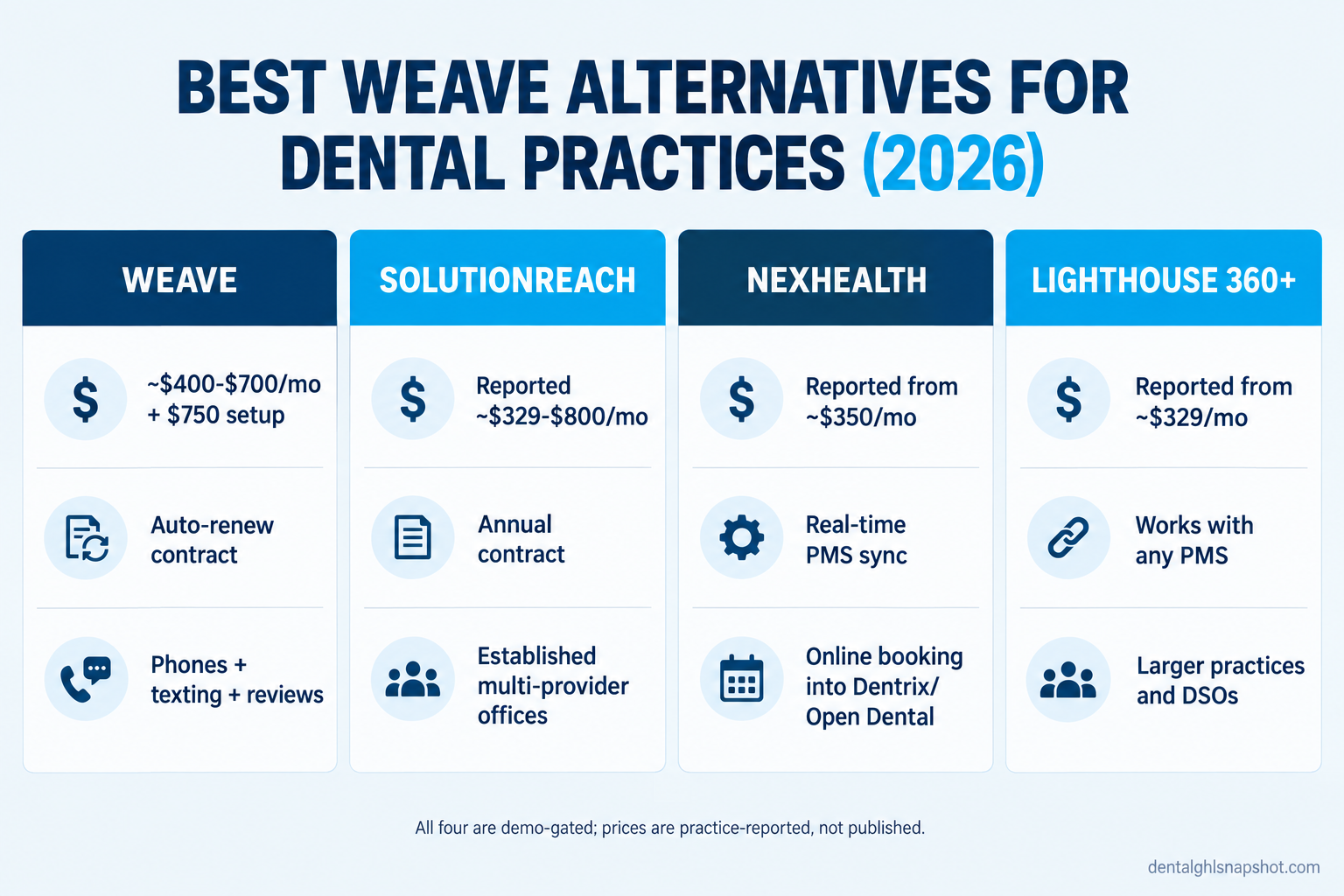
Table of contents
- Why office managers go looking for a Weave alternative
- What “Weave alternative” actually means
- The four platforms, head to head
- The eight things that actually decide it
- Who each one is actually right for
- What it costs: three real scenarios
- The compliance line nobody puts in the demo
- Steal this: the switch-vendor checklist and copy
- Objections and honest answers
- FAQ
Why office managers go looking for a Weave alternative
It is 4:50 on a Thursday. You are trying to close out the day, and the Weave renewal email is sitting in your inbox next to a text from a patient who wants to reschedule. You open the invoice, and the number is bigger than you remembered. A texting bundle you barely use got moved to a higher tier at renewal. The phone hardware line is still there. And somewhere in the fine print is the word “auto-renew.”
That is the moment most people start typing “Weave alternative” into Google. It is rarely because the product stopped working. It is the price creep, the contract you cannot cleanly exit, and the feeling that you are paying for a bundle when you wanted two or three pieces of it.
You are not imagining the pressure, either. As of the fourth quarter of 2025, roughly a third of dentists (33%) told the ADA Health Policy Institute they were not busy enough to fill the schedule, up from about a quarter a year earlier (ADA HPI, State of the U.S. Dental Economy). When chairs are harder to fill, every recurring bill gets a second look, and the communication tool is near the top of the pile because it is easier to switch than your whole practice management system. The goal here is not to talk you out of Weave. It is the honest comparison the vendors will not give you.
What “Weave alternative” actually means
Before you compare anything, get clear on which job you are replacing, because “Weave alternative” means two very different shopping trips.
Job one is the phones. Weave started as a VoIP phone system with texting bolted on. If your practice relies on Weave for the actual phone lines, replacing it means replacing hardware and a number, which is a bigger project than swapping software.
Job two is the patient-communication layer. This is the texting, reminders, recall, review requests, forms, and online scheduling that sit on top of your practice management system. This is the part most practices actually want to fix, and it is where Solutionreach, NexHealth, and Lighthouse 360+ compete hardest.
Most people shopping for a Weave alternative want job two solved without the job-one lock-in. That is the frame for the rest of this piece. For how the communication layer stacks up against your core system bill, the dental software price teardown breaks down the two-bill problem.
The four platforms, head to head
Here is the honest read on each, including the failure mode nobody puts in the demo. Remember the ground rule: none of these companies publishes a price, so every figure is reported by practices through review sites, not quoted by the vendor.
Weave: the all-in-one you are trying to leave
Weave bundles VoIP phones, two-way texting, reminders, reviews, payments, and scheduling into one interface, and for a lot of practices it does the job. Reported pricing lands around $400 to $700 a month per location for the core bundle, plus a one-time $750 setup, with add-ons pushing it higher (The Molar Report, NoShowCost).
The failure mode: the contract. Practices repeatedly report that Weave auto-renews, and that features get reclassified into higher tiers at renewal, which is exactly the price creep that sent you shopping (Emitrr). Before you sign or resign, get the renewal price, the tier definitions, and the cancellation window in writing.
Solutionreach: the mid-market veteran
Solutionreach is one of the oldest names in dental patient communication and targets established, multi-provider practices. It is fully demo-gated. Reported pricing runs about $329 a month at the low end up to $400 to $800 for a mid-size office, with multi-location groups reporting $1,000 to $2,500 a month (NoShowCost, ITQlick). Expect an implementation fee of roughly $500 to $2,500 depending on your system.
The failure mode: the commitment. Solutionreach is reported to require an annual, sometimes multi-year, contract (Software Finder). It is a capable platform, but for a solo or two-operatory office it can feel like buying a truck to haul groceries. Match the contract length to how sure you are, not to the discount they offer for locking in longer.
NexHealth: the one built on real-time PMS sync
NexHealth positions itself as a modern patient-experience platform, covering online scheduling, reminders, forms, reviews, and payments. Its real selling point is the Synchronizer, a bi-directional, real-time read-write link into your practice management system, including Dentrix, Eaglesoft, Open Dental, Curve, and Denticon (Capterra). When a patient books online, it can write straight into your schedule rather than dropping a request your front desk has to key in by hand.
Reported pricing starts around $350 a month and commonly lands in the $300 to $600 range by module, with a one-time implementation of about $500 to $3,000 to activate the sync (The Molar Report).
The failure mode: you pay for that deep integration in setup time and cost, and pricing scales by the modules you turn on. If all you need is reminders and a review request, you may be buying a scheduling engine you will not fully use. Great fit if online self-booking that writes back to your PMS is the thing you actually want.
Lighthouse 360+: the Henry Schein One option that works with any PMS
The original Lighthouse 360 was a reminders-and-recall workhorse. Henry Schein One has since launched Lighthouse 360+, an all-in-one patient-experience platform that, notably, works with any practice management system rather than only Henry Schein products, and adds online scheduling, digital forms, a phone system with missed-call text, payments, and reputation tools (Dental Products Report). Reported pricing starts around $329 a month (SelectHub).
The failure mode: it is built for medium-to-large practices and DSOs, and reviewers describe the interface as feature-rich but complex, with a price that feels steep for a small shop. If you are a single dentist with two operatories, you may be paying for scale you do not have. It also means a new platform from the same parent company that owns Dentrix, so weigh how much you want your PMS and communication layer under one roof.
Reported starting monthly cost per location for a small single-location practice, in US dollars. All four vendors are demo-gated, so these are practice-reported figures, not published rates. Sources: SelectHub, NoShowCost, The Molar Report, The Molar Report (Weave).
The eight things that actually decide it
The feature grids on vendor sites all look the same, because everybody has texting and reminders now. These eight questions are the ones that actually separate them for a small practice.
Weave alternatives compared on what matters to a small practice
| Plan | Weave | NexHealthRecommended | Solutionreach | Lighthouse 360+ |
|---|---|---|---|---|
| Price | ~$400–$700/mo + $750 setup | reported from ~$350/mo | reported ~$329–$800/mo | reported from ~$329/mo |
| Feature 1 | Contract: auto-renews, watch tier creep | Contract: reported flexible for non-enterprise | Contract: annual, sometimes multi-year | Contract: quote-based, get terms in writing |
| Feature 2 | Two-way texting + reminders: yes | Two-way texting + reminders: yes | Two-way texting + reminders: yes | Two-way texting + reminders: yes |
| Feature 3 | Real-time PMS write-back: limited | Real-time PMS write-back: yes, its whole pitch | Real-time PMS write-back: on a sync schedule | Real-time PMS write-back: any PMS supported |
| Feature 4 | Reviews: yes (keep it FTC-safe) | Reviews: yes | Reviews: yes | Reviews: yes |
| Feature 5 | VoIP phones: yes, core strength | VoIP phones: no (not a phone system) | VoIP phones: no | VoIP phones: yes, integrated |
| Feature 6 | Online scheduling + forms: yes | Online scheduling + forms: strong | Online scheduling + forms: yes | Online scheduling + forms: yes |
| Feature 7 | Best for: offices that want the phones too | Best for: online self-booking into your PMS | Best for: established multi-provider offices | Best for: larger practices and DSOs |
Read that table for the row that fixes your actual problem, not the one with the most checkmarks. If online bookings do not land in the schedule automatically, the PMS write-back row decides it. If your phone rings out during hygiene, the VoIP row does. A tool that wins six rows you do not care about and loses the one you do is the wrong tool.
Who each one is actually right for
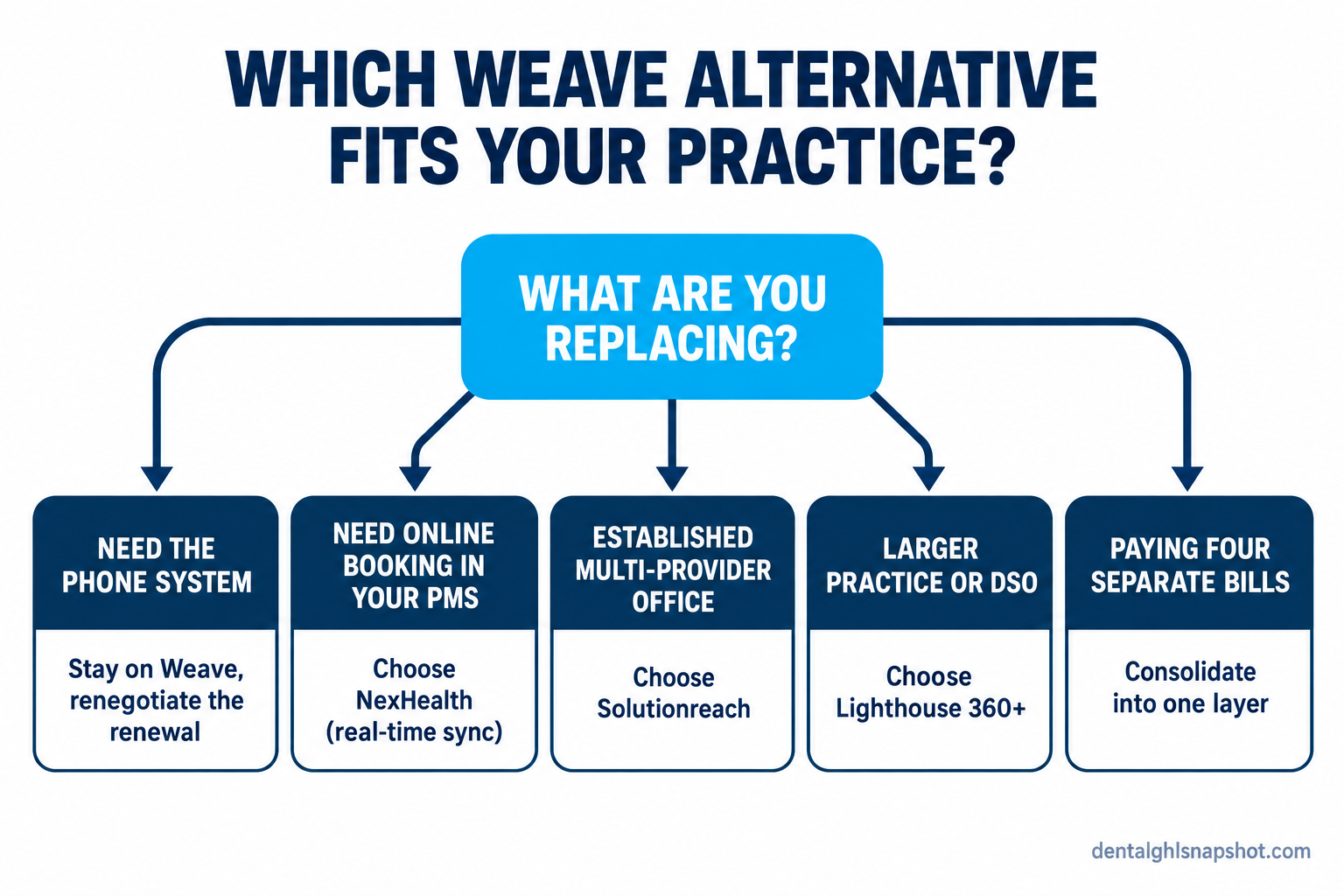
- Stay on Weave if it is genuinely running your phones and the renewal price, in writing, is fair. Ripping out a phone system to save $100 a month is rarely worth the disruption. Renegotiate first.
- Choose NexHealth if what you most want is patients booking online and having it land in Dentrix, Eaglesoft, or Open Dental without anyone re-keying it. Nobody else in this group leans on real-time sync as hard.
- Choose Solutionreach if you are an established practice with several providers and an annual contract does not scare you. It is overkill for a one-dentist shop.
- Choose Lighthouse 360+ if you are a larger office or group and want phones and communication under one roof, alongside a Henry Schein One product.
- Consolidate instead of switch if your real problem is paying four separate bills for phones, texting, reminders, and reviews. The win there is fewer line items, which is the next section.
What it costs: three real scenarios
You budget in real dollars, not ranges. Here is the year-one math for three practices, built from the reported numbers above. Your quote will vary, but the shape holds.
Estimated year-one cost of a patient-communication layer, by practice size
| Plan | Solo (1 dentist, 2 ops) | Mid-size (3–4 providers, 5 ops)Recommended | Growing group (2–3 sites) |
|---|---|---|---|
| Price | ≈ $4,700–$9,150 | ≈ $7,000–$12,000 | ≈ $12,000–$30,000+ |
| Feature 1 | Weave: ~$500/mo core = $6,000 + $750 setup | Weave: ~$700/mo = $8,400 + $750 setup | Billed per location, so multiply everything by sites |
| Feature 2 | NexHealth: ~$350/mo = $4,200 + ~$500 setup | NexHealth: ~$500/mo by modules = $6,000 + setup | Solutionreach groups report $1,000–$2,500/mo |
| Feature 3 | Solutionreach: ~$329/mo = $3,948 + ~$750 | Solutionreach: ~$600/mo = $7,200 + ~$1,500 | Lighthouse 360+ built for this scale |
| Feature 4 | The setup fee lands in your tightest month, the first | Module and provider count are the swing factors | Per-location pricing is where the bill runs away |
Now put those totals against the average general practice’s $942,290 in annual gross billings (ADA Health Policy Institute, 2024 data). Even the heavy scenarios are one to two percent of production. That is the point most switching decisions miss: you do not win by shaving $50 off the monthly, you win by picking the tool that keeps chairs full and no-shows down. A cheaper platform that lets recall slip is the expensive one.
Estimated year-one total for a solo practice (2 operatories): subscription plus setup fee, in US dollars, built from reported pricing. Actual quotes vary. Sources: The Molar Report, The Molar Report (NexHealth), NoShowCost.
Disclosure: the link above is an affiliate link. If you start a GoHighLevel account through it, we may earn a commission at no extra cost to you.
The compliance line nobody puts in the demo
There is a cost to getting patient communication wrong that never shows up on a quote. Any tool on this list sends texts and emails for you, which means it touches protected health information, and that pulls three hard rules into the decision.
A reminder text or email may carry the appointment date, time, provider name, and a reschedule link. That is the whole list. Appointment reminders themselves are permitted under HIPAA as treatment communications (HHS guidance), but the minimum-necessary rule means you never put a procedure name, a balance, a diagnosis, or a treatment plan in a message that sits on a lock screen where anyone can read it. That exposure is on the practice, not the vendor.
Any vendor that stores or sends that data must sign a Business Associate Agreement (BAA). No BAA, no deal. It is a free document to ask for and a red flag if a rep hesitates. You also need patient consent to message and a working STOP opt-out, and state texting laws in places like Washington, Oklahoma, and Maryland apply wherever your practice sits.
Do not let any tool “gate” your reviews. Filtering so only happy patients get asked, or routing people to Google by a satisfaction score, runs straight into the FTC rule that took effect in October 2024, which bans suppressing or selectively displaying reviews and carries civil penalties of up to $51,744 per violation (FTC). Plenty of practices are set up this exact way without realizing it, which makes it an easy thing to fix while you are switching tools anyway. Put “signs a BAA” and “asks every patient, not just the happy ones” on your checklist next to the price.
Steal this: the switch-vendor checklist and copy
You will still sit through demos, and you may have a current contract to exit. Here is the exact language and the exact questions, so you leave every call with real numbers and no surprise renewal.
Send that first. It does two things: it starts the clock on any notice window, and it forces the terms into writing so a rep cannot move the goalposts at renewal.
And because the whole reason reminders exist is to protect the schedule, here is a HIPAA-safe reminder text you can hand any vendor as your template. Notice what it does not say.
If you are switching partly to fix recall or no-shows, the tool is only half of it. The recall and reactivation playbook and the missed-call text-back approach cover the workflows that make any of these platforms pay for themselves, and the insurance-verification workflow is the one most tools bury in an add-on tier.
Objections and honest answers
“Isn’t switching patient-communication tools a huge project?”
Less than you think, and far less than switching your practice management system. Your PMS holds the schedule, chart, and ledger, and moving it is a real conversion. The communication layer sits on top of it, so switching it mostly means porting your contact list, rebuilding a handful of reminder templates, and reconnecting the sync. That is why this bill, not the PMS bill, is the one most practices should shop first. The software price teardown explains why the two bills are separate.
“We already pay for Weave. Why not just stay?”
You might. If Weave is running your phones and the renewal price is fair once it is in writing, staying and renegotiating beats a disruptive switch. The trigger to actually leave is a contract you cannot exit cleanly, a renewal that keeps creeping, or a stack of features you pay for and never use. Run the five-question script on your own rep before you run it on anyone else.
“Do I need to be technical to choose well?”
No. You need to be organized. Get an all-in annual figure from each vendor in writing, confirm the contract and exit terms, and check the two compliance boxes. That is a front-office skill, the same one you use on every other vendor in the building. The person comparing these tools is almost always the office manager, not the dentist, and that is exactly the right person for the job. If your real problem is bill sprawl rather than a missing feature, the consolidation path (texting, reminders, recall, reviews, and booking in one system, like our done-for-you setup) is worth a look, held to the same checklist: real numbers, a BAA, and no review gating.
The bottom line
The honest truth about Weave alternatives is that you cannot get a straight price from any of them, so stop hunting for a published rate and start demanding one. Anchor every quote against the reported ranges here, get the contract and exit terms in writing before you sign, and pick by the one job you are actually replacing: the phones, real-time online booking, or simply four bills you want to make into one. Against nearly a million dollars in annual production, the difference between these tools is not the monthly price. It is which one keeps your chairs full without charging you three times to do it.
If you would rather have the reminder, recall, review, and online-scheduling pieces handled as one flat-priced system that sits on top of whatever practice management software you keep, that is what our setup is built to do.
Frequently asked questions
What is the best alternative to Weave for a small dental practice?
It depends on the job you are replacing. If you want online self-booking that writes into your practice management system in real time, NexHealth is built around that. If you want a proven mid-market platform and do not mind an annual contract, Solutionreach fits. Lighthouse 360+ suits larger offices and groups. If your real issue is paying several bills for phones, texting, and reviews, consolidating into one platform usually beats swapping one demo-gated vendor for another.
How much does Weave cost per month for a dental office in 2026?
Weave does not publish pricing, but practices report roughly $400 to $700 per month per location for the core bundle, plus a one-time setup fee around $750, with add-ons for texting volume and payments pushing it higher (The Molar Report, NoShowCost). Get your renewal price and tier definitions in writing, because features are reported to move to higher tiers at renewal.
Does NexHealth integrate with Dentrix and Open Dental?
Yes. NexHealth's Synchronizer provides a bi-directional, real-time read-write connection with major practice management systems including Dentrix, Eaglesoft, Open Dental, Curve, and Denticon, which is its main advantage over tools that sync on a fixed schedule (Capterra). Expect a one-time implementation fee, reported around $500 to $3,000, to activate that sync.
Is Lighthouse 360 being discontinued?
Henry Schein One has launched Lighthouse 360+, an all-in-one patient-experience platform that works with any practice management system, as the successor to the original Lighthouse 360 (Dental Products Report). There is no publicly confirmed shut-off date for the original product, so if you use it, ask your rep directly about the migration path and timeline before you renew.
Are these tools HIPAA compliant for texting patients?
They can be, but compliance is shared. The vendor must sign a Business Associate Agreement and handle the data securely, and your practice must keep messages to the minimum necessary: date, time, provider, and a reschedule link only, never a procedure, balance, or diagnosis (HHS guidance). You also need patient consent, a working STOP opt-out, and you must not gate reviews by satisfaction score under the FTC rule.
Can I switch communication tools without changing my practice management software?
Yes, and that is the point. Your practice management system holds the schedule and chart, while the communication layer sits on top of it. Switching the communication tool means porting your contact list, rebuilding a few reminder templates, and reconnecting the integration, which is far less disruptive than a full practice management conversion.