

It’s 6:15 on a Tuesday and you’re the last one in the office, because the server in the back closet needed a reboot before anyone could close out the day. The Dentrix support renewal is sitting in your inbox. And the dentist keeps forwarding you ads for “cloud dental software” with a note that says “thoughts?” You run the software, so the research lands on your desk. Here it is.
Short answer: If you want a price you can read before you book a demo, and your data in a database you actually hold, Open Dental is the only major system that gives you both ($199 a month per location year one, $149 after, published on the website). The cloud-native products, Curve Dental, Dentrix Ascend and CareStack, are demo-gated and priced per user or per month, climbing fast as you add seats. Denticon is real, but built for multi-location groups and DSOs, not a solo office. Here’s the head-to-head across the eight things that decide it.
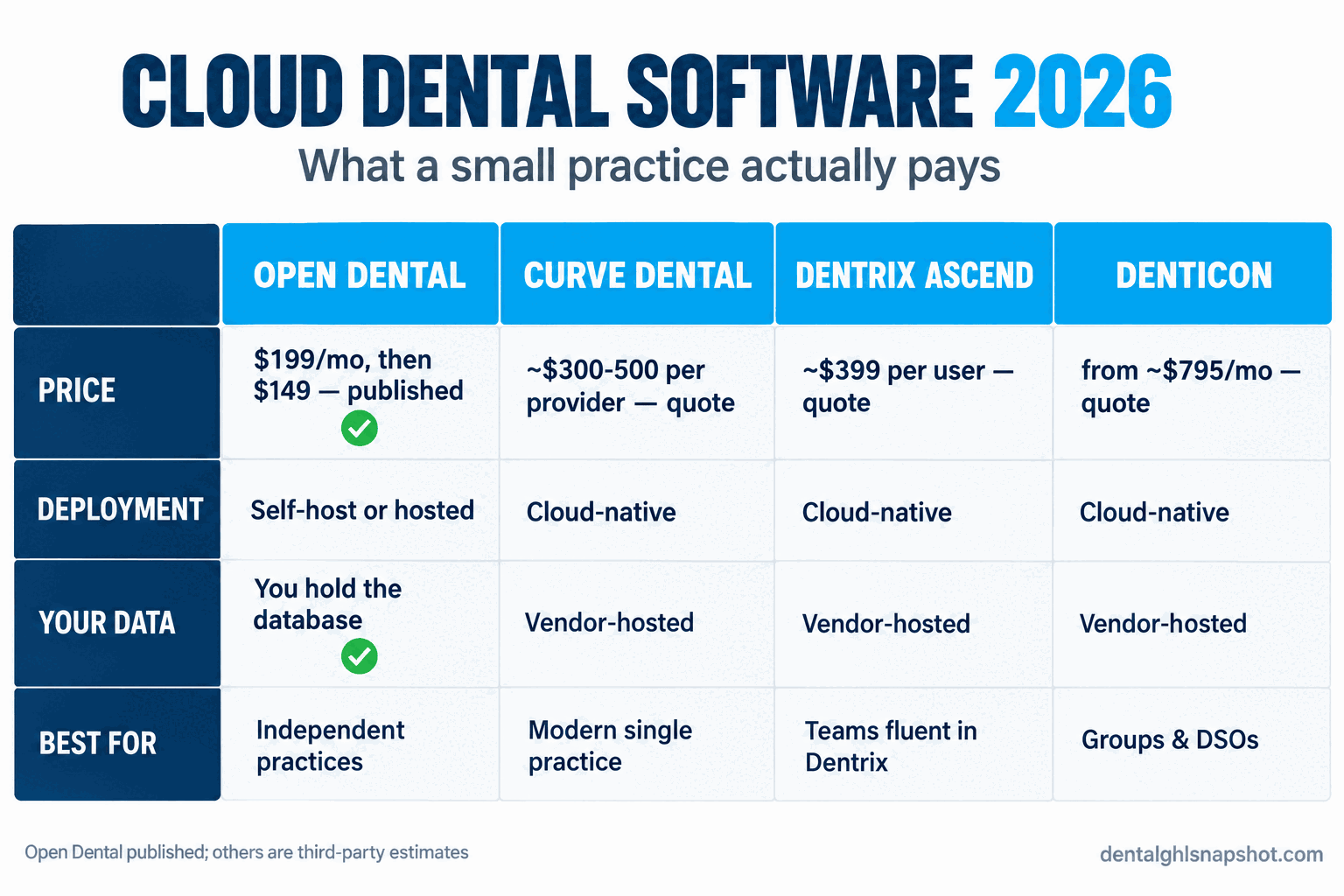
Table of contents
- Why “cloud” is suddenly on your desk
- What empty chairs actually cost
- The eight things that actually differ
- Cloud dental software at a glance
- What it actually costs: three scenarios
- The compliance line nobody quotes you
- Steal this: the demo-call script and switch checklist
- Objections, answered honestly
- FAQ
Why “cloud” is suddenly on your desk
For years there was no choice: you bought Dentrix or Eaglesoft, a server lived in the office, and that was that. On-premise software still held about 44% of the U.S. dental PMS market in 2025, but cloud is now the fastest-growing part of the market (ResearchAndMarkets, 2025), and the reasons are on your desk: an aging server, a slow imaging bridge, a renewal that stings.
Cloud-native means the software runs in a browser and the vendor owns the servers, backups and updates. The catch is the sales model: priced per user or per location, quoted only after a demo. So the real question isn’t “cloud good, server bad,” it’s which cloud system fits a one-dentist, two-to-three-operatory practice without pricing you like a DSO.
What empty chairs actually cost
As of the third quarter of 2025, 35% of dentists said they weren’t busy enough, up from 25% a year earlier (ADA Health Policy Institute, Q3 2025, via Dentaltown). The average general practice works against roughly $965,660 a year in gross billings (ADA, 2025), so every unfilled slot is lost production.
Share of U.S. dentists reporting they are “not busy enough.” Sources: ADA HPI, Q1 2024, ADA HPI, Q3 2025.
Software won’t fix a soft schedule on its own, but the wrong system makes it worse. Shop through that lens, not the feature grid the rep wants to walk through.
The eight things that actually differ
1. Pricing: a published fee vs a quote you pry loose
Open Dental charges $199 a month per location for the first 12 months, then $149, covering the software, full phone support, every update and all the office computers for up to three providers (hygienists don’t count), with a fourth and beyond at $20 a month each, all readable before you book a demo (Open Dental fees).
Everyone else makes you ask. Reported figures put Curve Dental around $300 to $500 per provider (CostBench, Monetizely), Dentrix Ascend from about $399 per user (ITQlick), CareStack near $698 a month (Capterra), and Denticon from around $795 a month (FitGap). Every number is a third-party estimate, because none of these vendors publish a price.
Entry-level reported monthly cost, per location, user or provider as noted. Open Dental is vendor-published; every other figure is a third-party estimate because the vendor is demo-gated. Sources: Open Dental, ITQlick, CostBench, Capterra, FitGap.
How this breaks: Per-user pricing looks fine at one chair and ugly at six. A “$399 a user” number is one dentist, and it climbs as you add associates. Ask for the all-in monthly at your provider count, in writing.
2. Cloud-native vs cloud-capable: where it runs
Curve, Dentrix Ascend, Denticon and CareStack run in a browser, with the vendor handling backups and updates. Open Dental is traditionally self-hosted, so it keeps working when your internet drops, but it also offers Open Dental Cloud if you’d rather not own hardware.
How this breaks: The cloud-versus-server choice quietly sets your IT bill. Self-hosted puts backups and patching on you; cloud-native hands your uptime to someone else’s servers and your internet connection, so a cloud-only system goes dark in an outage. Price the IT support and uptime guarantee, not the license.
3. Who owns your data, and can you leave?
With Open Dental your records, ledgers and schedule live in a MySQL database you hold, with direct access and an open API, so you can switch or run your own reports without asking permission (Open Dental license). The cloud-native systems keep your data in their environment, so a clean export runs through the vendor, on their timeline.
How this breaks: Data ownership feels abstract until you want to leave, when the export becomes a project with a price tag. Before you sign, get your right to a complete export, in a usable format, in writing.
4. Who each one is actually built for
Not every cloud system wants your business. Open Dental and Curve Dental fit a solo or small general practice cleanly, and Dentrix Ascend fits a practice that wants the familiar Dentrix workflow in the browser. Denticon is the odd one out: built for multi-location groups and DSOs, with onboarding and pricing scaled to match, reported with implementation around $1,500 per training day on a two-day minimum (FitGap). With DSO affiliation now at 16% of U.S. dentists and climbing (ADA, 2024), it has a real market, just probably not you if you run one office.
How this breaks: Buying enterprise software for a solo practice means paying for group features you’ll never open. Match the tool to your size, not to the flashiest demo.
5. Imaging, integrations, and the open API
Dentrix Ascend leans on the Henry Schein ecosystem and partner catalog. Curve and CareStack bundle imaging and patient tools into one suite, tidy but able to lock you into their stack. Open Dental supports broad third-party imaging and, through its open API, lets a developer wire up almost anything, from an AI chatbot to a GoHighLevel communication layer. The tradeoff is you sometimes arrange the connection yourself.
How this breaks: Imaging is the sneaky lock-in. If your sensors and software are tied to one ecosystem, switching cost isn’t just the PMS, it’s re-validating every bridge. Inventory your imaging first.
6. Insurance claims and eligibility
All of these send electronic claims through the usual clearinghouses. For an office fighting an insurance accounts receivable backlog, the real question isn’t “does it send claims,” it’s how many clicks a claim takes and how good the eligibility response is. Test that flow in a live demo with your real carriers.
How this breaks: Eligibility is only as good as the feed behind it, and none removes the need for a human to read a benefits breakdown before a big case. Treat it as a first pass, or you’ll bill a patient for a benefit that was never there.
7. Migration and the switching cost
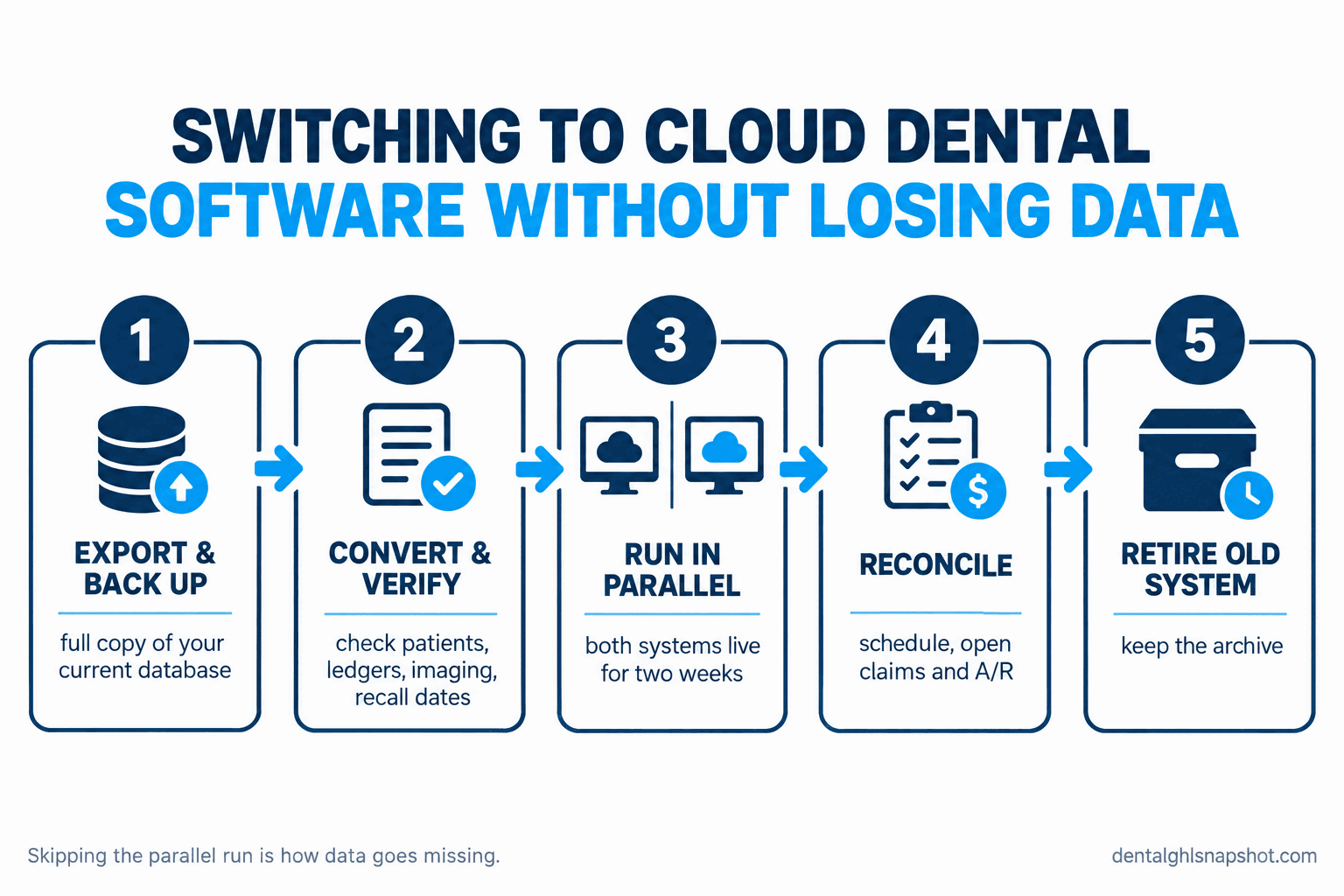
Moving to any new system is a project: export, convert, verify that patients, ledgers, imaging and recall dates came across, run both in parallel for two weeks, then reconcile before retiring the old one. A cloud-native system adds a wrinkle, because your data converts into the vendor’s environment, so confirm the conversion cost and timeline. Open Dental doesn’t include conversion either; the cost depends on what you’re coming from (Open Dental fees).
How this breaks: The top way a migration fails is going live before verifying the conversion. A dropped ledger balance surfaces weeks later as an angry patient or a missed hygiene visit. Never skip the parallel run.
8. Support, training, and the learning curve
Open Dental includes full phone support in its fee, Dentrix Ascend has the familiarity advantage because more temps already know it, and Curve and CareStack are modern browser interfaces most front desks pick up quickly. Check support quality with current users, not the vendor’s reference.
How this breaks: Team adoption sinks more switches than the software does. If three of four staff run your current system in their sleep, retraining is a line item. Pair the switch with hands-on training and an internal champion, or it reverts to sticky notes.
Cloud dental software at a glance
| Open Dental | Curve Dental | Dentrix Ascend | Denticon | |
|---|---|---|---|---|
| Published price | Yes, on the website | No, quote only | No, quote only | No, quote only |
| Reported entry cost | $199/mo, then $149/mo | ~$300 to $500/provider | ~$399/user | from ~$795/mo |
| Deployment | Self-host or hosted | Cloud-native | Cloud-native | Cloud-native |
| Your data | You hold the MySQL database | Vendor-hosted | Vendor-hosted | Vendor-hosted |
| Best for | Independent practices | A modern single practice | Teams fluent in Dentrix | Groups and DSOs |
Sources: Open Dental, CostBench, ITQlick, FitGap. Every figure except Open Dental’s is a third-party estimate.
What it actually costs: three scenarios
Here’s the year-one shape for three sizes. Quotes vary, but the pattern holds: the published option is predictable, the per-user options climb with your team.
Estimated year-one software cost by practice size
| Plan | Solo (1 dentist, 2 ops) | Growing (3 providers, 4 ops)Recommended | Multi-location (3 sites) |
|---|---|---|---|
| Price | ≈ $2,400 vs $3,600+ | ≈ $2,400 vs $14,000+ | ≈ $5,400 vs quoted |
| Feature 1 | Open Dental: ~$2,388 year one, ~$1,788 after | Open Dental: ~$2,388, still under the 3-provider cap | Open Dental: ~$149/mo x 3 ≈ $5,364/yr after yr 1 |
| Feature 2 | Curve / Ascend: ~$3,600 to $4,800 + setup | Per-user cloud: 3 x ~$399/mo ≈ $14,000/yr + setup | Denticon: enterprise, quoted per location + setup |
| Feature 3 | Open Dental covers all 3 provider slots free | Per-seat pricing is the swing factor here | A flat per-location fee vs a custom DSO contract |
Those totals are Open Dental’s base fee only; add-ons stack per location, so ask for the all-in number too. For a fuller teardown, see what dental software actually costs in 2026 and the Dentrix vs Open Dental deep dive.
The compliance line nobody quotes you
HIPAA is the hard line, and it doesn’t care which system you picked. The practice owns the protected health information, so three rules hold on any platform.
First, any vendor that touches patient data needs a signed Business Associate Agreement: your PMS, your imaging host and any communication tool you bolt on. A cloud-native vendor stores your PHI, so the BAA is what makes the arrangement legal.
Second, where your data lives changes your risk surface. A self-hosted server puts backup and breach responsibility on you; a cloud product shifts some of that to the vendor under the BAA, but you still own patient consent and access controls.
Third, and this is where offices slip: a reminder should carry the appointment date, time, provider name and a reschedule link, and little else. No procedure names, no balances, no treatment details, because a lock screen is a public screen. HHS treats appointment reminders as a normal part of treatment you can send without separate authorization, while expecting you to limit the information under the minimum-necessary standard (HHS HIPAA FAQ). The full playbook is in the HIPAA and TCPA dental texting guide.
How this breaks: Practices assume the software is “HIPAA compliant” and stop thinking. Compliance is shared: the vendor provides the safeguards, but you sign the BAA, configure the settings, train the team and keep PHI out of plain messages.
Steal this: the demo-call script and switch checklist
Every option except Open Dental hides its price, so you extract one. Use this on the sales call, close to word for word.
“I need five numbers in writing to compare fairly against Open Dental’s published $199 a month. One: the all-in monthly for [X providers] and [Y operatories], every module included. Two: the one-time implementation, training and data-conversion fee. Three: contract length and early-termination penalty. Four: what a full export of my data costs if I leave, and in what format. Five: your uptime guarantee and what happens to my access during an outage. Can you email those five, itemized, today?”
If the rep won’t put those in writing, that tells you how the relationship will go. When you do switch, run it as a project.
- Export and back up a full copy of your current database before anyone touches anything.
- Convert and verify that patients, ledgers, A/R, imaging and recall dates came across, on a record-by-record sample.
- Run both systems in parallel for two weeks, so a conversion gap surfaces while the old system is live.
- Reconcile the schedule, open claims and outstanding A/R before you cut over.
- Train the team with hands-on sessions and name one internal champion.
- Retire the old system only after a clean reconciliation, and keep the archive somewhere you can reach.
Objections, answered honestly
“Isn’t cloud always better than a server in the office?” Not automatically. Cloud removes the hardware, backups and patching, a win if your server is aging. But a cloud-only system goes dark when your internet drops, and you rent access to your own data forever. With reliable IT, a self-hosted Open Dental setup can be cheaper over three years. Price both.
“We already run Dentrix on a server. Is switching worth the hassle?” Maybe not this year. If your team knows the system cold and the renewal is reasonable, negotiate first, and price a move only if the renewal stings or the server is failing. The familiar path is Dentrix Ascend, quote-only too, so make them put the number in writing.
“Is Open Dental risky because it used to be open source?” A common misconception, now doubly wrong. Open Dental is no longer open source as of version 24.4; it’s proprietary, with published pricing and phone support in the fee (license). You still hold your own database.
“Will I lose patient data if I switch to the cloud?” Not if you run the migration correctly. The risk isn’t the move, it’s going live before verifying the conversion. Follow the parallel run, reconcile before cutover, keep the archive. Data loss comes from rushing, not switching.
Frequently asked questions
What is the best cloud dental software for a small practice in 2026?
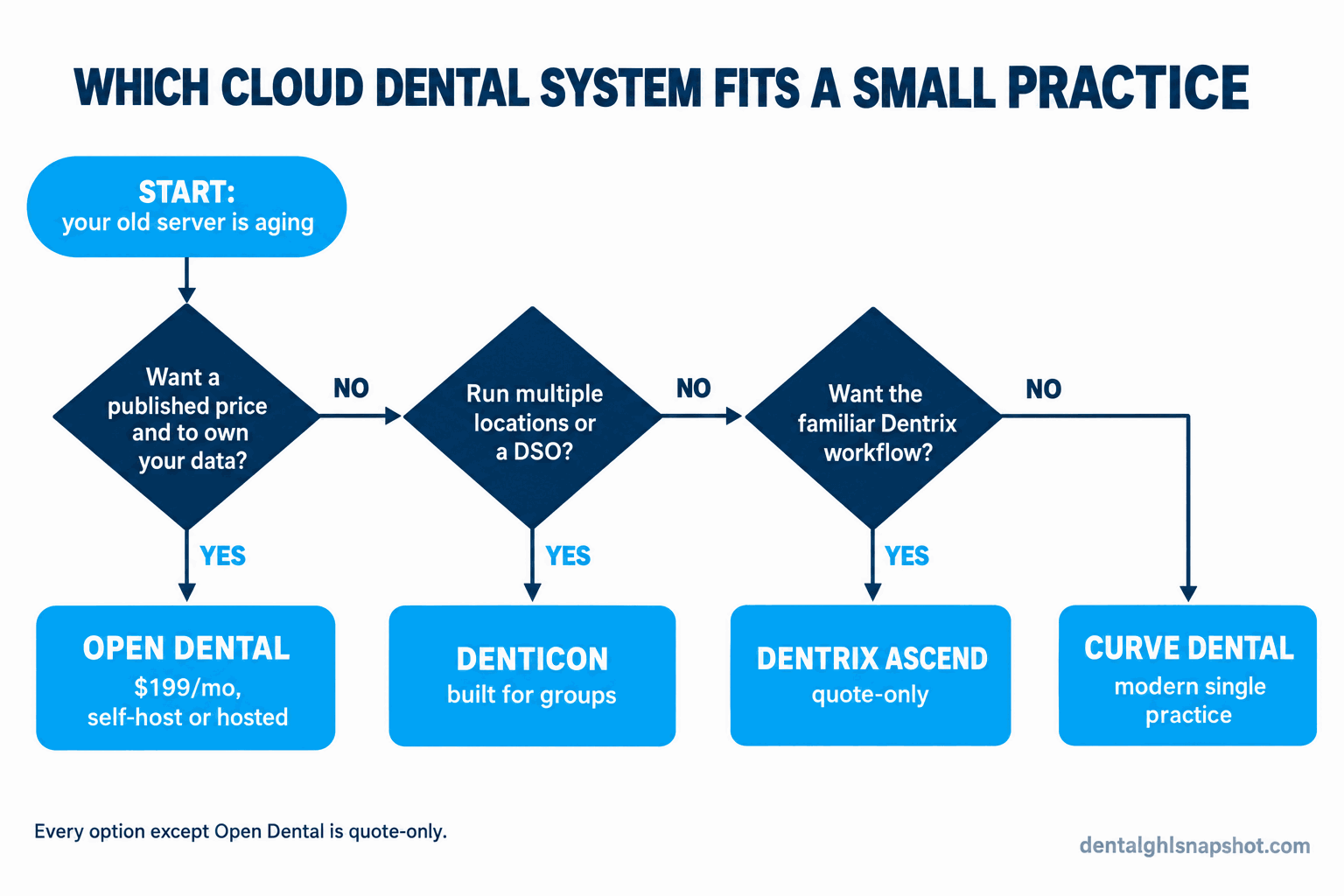
For a cost-conscious solo or small practice, Open Dental is the strongest value: it publishes its price ($199 a month per location year one, $149 after) and hands you your own database. Among the cloud-native options, Curve Dental and Dentrix Ascend fit a single practice, while Denticon is built for groups and DSOs. All three cloud-native systems are quote-only.
How much does Curve Dental cost per month?
Curve Dental does not publish a price; it is demo-gated. Third-party aggregators report roughly $300 to $500 per provider per month, with one source listing tiers near $299, $399 and $599 per user, plus implementation around $1,500 to $3,000. Treat those as estimates and get a written quote at your provider count.
Is Denticon good for a single-location practice?
Usually not. Denticon, from Planet DDS, is built for multi-location groups and DSOs, reported starting around $795 a month. A one-office practice tends to pay for group features it never uses, so Open Dental or Curve Dental fit better.
Does Open Dental run in the cloud?
Open Dental is traditionally self-hosted on a server you control, which keeps running during an internet outage, but it also offers Open Dental Cloud. It is cloud-capable rather than cloud-only, unlike Curve, Dentrix Ascend, Denticon and CareStack.
Do any of these systems handle patient texting and recall?
Only at a basic reminder level. These are systems of record for charting, billing and scheduling, not a full communication layer. Two-way texting, missed-call recovery, review requests and lifecycle recall usually come from a separate tool that connects to your PMS.
The bottom line
Back to 6:15 and that “thoughts?” email. If you want a price you can read and your data in your own hands, Open Dental is the strongest pick for a small practice, and the cost gap over the per-user systems widens as you add providers. If you want the hardware gone, Curve Dental is the cleanest cloud-native fit for a single office, and Dentrix Ascend is the move if your team is already fluent in Dentrix. Denticon is real and good, just built for groups. Whatever you shop, make every vendor put the five numbers in writing.
And remember the part none of these systems do: your PMS won’t answer the phone at 7:40am, text the patient who no-showed, or ask the happy one for a review. That’s the layer that fills the schedule, a separate decision. If you’d rather have it handled for you, see what the done-for-you snapshot includes.
Keep reading: what dental software actually costs in 2026, Dentrix vs Open Dental for a small practice, and two-way texting patients actually reply to.