

Short answer: Verify every patient’s benefits before they sit in the chair, not after. Capture the subscriber details at booking, confirm the plan is active, pull the full breakdown (annual maximum, deductible, frequency limits, waiting periods, downgrades), then write the patient’s estimated portion in the chart with a reference number. Do it 2 to 3 days out, and re-verify anyone whose plan rolled over on January 1. Skip it and you get denied claims, surprise balances, and an A/R pile that eats your Fridays. Below is the exact checklist, the carrier script, and how each stage breaks when you rush it.
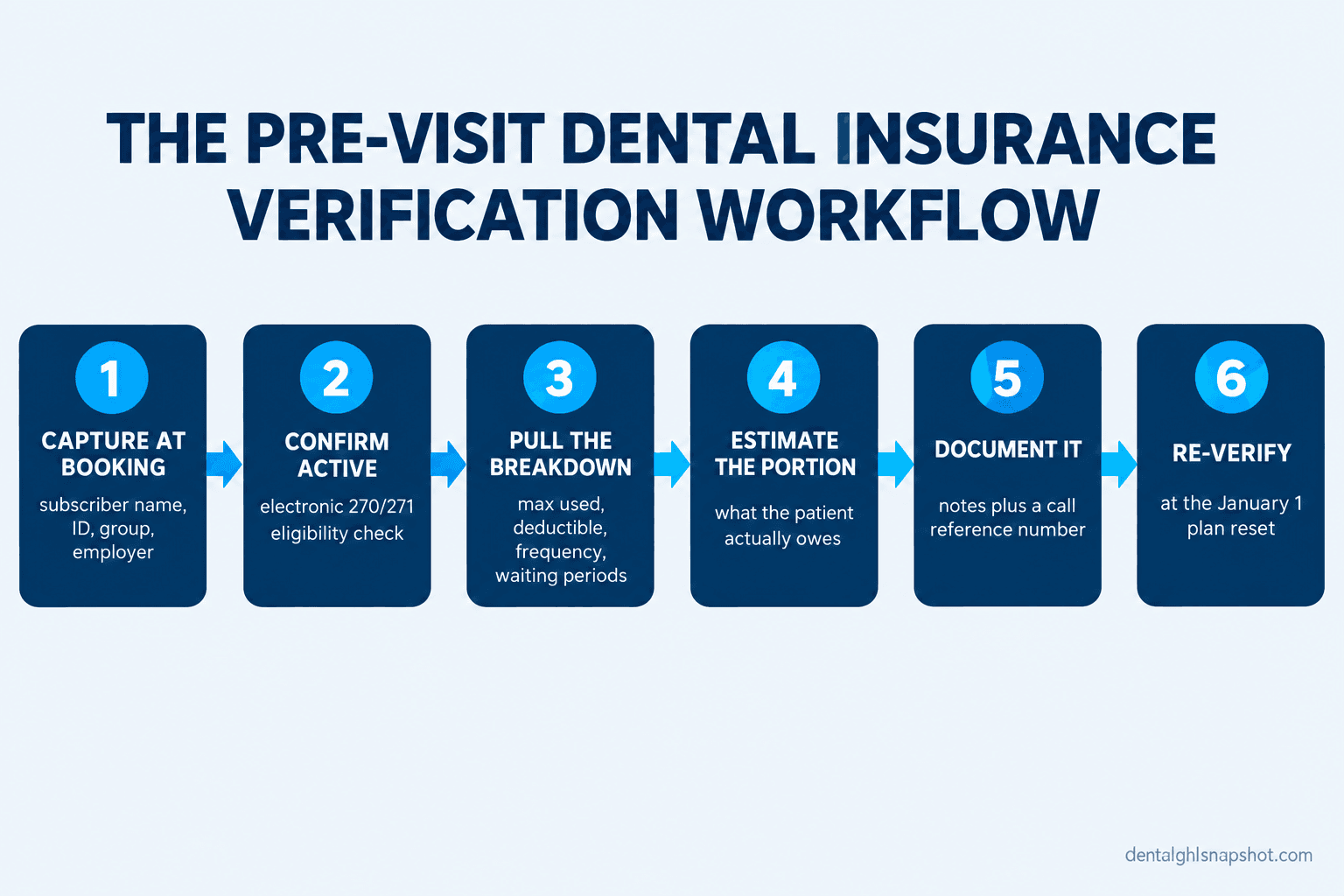
Table of contents
- What skipping verification actually costs you
- The six stages of a clean verification
- The fields that cause denials (the real checklist)
- Steal this: the payer-call script and patient messages
- Run it for your practice size
- The compliance line you cannot cross
- Objections and honest answers
- FAQ
What skipping verification actually costs you
It is 8:05 on a Monday. The first hygiene patient is in the chair, and you realize nobody confirmed her plan. You assume it is fine; she has been a patient for years. Three weeks later the claim bounces: she switched employers in August, and her new plan has a six-month waiting period on the crown she is now scheduled for. Now you are calling a loyal patient to tell her she owes $1,100 she thought was covered. That conversation costs you the goodwill and often the balance itself.
That is the real price of a skipped verification. Not the twenty minutes you saved, but the denied claim, the rework, the awkward call, and the balance that slides into 90-day A/R where some of it never gets collected. Most of that A/R is self-inflicted: the claim was clean, the coverage was not what you assumed.
The money matters more than it used to. The average general practice grosses about $942,290 a year (ADA Survey of Dental Practice), and in Q2 2026 about 26% of dentists still said they were not busy enough, down from roughly a third the quarter before (ADA Health Policy Institute). When production is tight, you cannot afford to do the work and not collect for it.
The method costs you too. A manual eligibility check, a staffer on hold with a carrier, runs about $6.78 per transaction; the same check done electronically costs about $0.34 (2024 CAQH Index). Dental is moving the wrong way: the ADA reports benefit-verification spending in offices is climbing, partly because carriers push them into portals that each work differently (ADA News, March 2025). Every hour on hold is an hour your coordinator is not booking patients or working recall.
Average cost of one eligibility check, manual versus the HIPAA-standard electronic 270/271 transaction. Source: 2024 CAQH Index.
Remember what you are verifying against. The typical PPO annual maximum sits at $1,000 to $1,500, a number that has barely moved since 1973 (NADP, via ADA). Patients walk in thinking “I have insurance, I am covered,” and the cap runs out halfway through a single crown. If you have not checked how much of that maximum is already spent, you are quoting a number you cannot stand behind.
The six stages of a clean verification
Stop thinking of verification as “calling the insurance company.” It is six distinct stages, and a denied claim almost always traces to one you skipped.
Stage 1: Capture the right subscriber info at booking
Verification starts when the appointment is made, not two days before it. Get all of it at booking: the subscriber’s full legal name and date of birth (not the patient’s, if they are a dependent), the carrier, the member or subscriber ID, the group number, and the employer. A 9-year-old’s coverage lives under a parent’s ID, so the relationship matters.
How it breaks: the patient reads the ID off an old card from a plan they no longer have, and the carrier returns “not found.” The fix: collect insurance at booking through a digital intake form the patient fills out from their phone, with a photo of the front and back of the card, so the numbers come off the card, not out of memory. That is the piece we break down in automating the insurance verification workflow.
Stage 2: Confirm the plan is active
Before you pull a single benefit detail, confirm coverage is live for the date of service. This cheap check catches the job-change and lapsed-plan surprises that cause the ugliest denials. Do it electronically: the HIPAA-standard 270/271 eligibility transaction returns active-or-not in seconds (CMS), and at roughly $0.34 a check there is no reason to spend a phone call on it.
How it breaks: you confirmed eligibility at booking six weeks ago, the patient left their job since, and the plan terminated at month-end. The fix: run the active-coverage check again inside your window, 2 to 3 days out, not just at booking.
Stage 3: Pull the full breakdown of benefits
This is where the phone call or detailed portal lookup earns its keep. “Active” is not “covered.” You need the specifics for the procedures planned: maximum and amount used, deductible, coverage percentage by category, frequency limitations, waiting periods, downgrade clauses, any missing-tooth clause, and coordination of benefits if there is a second plan. The checklist below spells out the trap each one hides.
How it breaks: the coordinator confirms “crowns are covered at 50%” and stops, missing that the patient already used $1,200 of a $1,500 maximum at another office in March. Only $300 of max is left, so the real share is far bigger than the quote. The fix: never quote a percentage without checking remaining maximum and deductible in the same lookup.
Stage 4: Calculate the patient’s estimated portion
Turn the breakdown into one number the patient can act on: their estimated out-of-pocket for this visit. Apply the deductible, the coverage percentage, and the remaining maximum to the planned procedures, and flag anything the plan will downgrade. That number lets the front desk collect at check-out instead of chasing a balance later.
How it breaks: you present the “insurance pays” figure and never translate it into “you pay,” so the patient is blindsided by the statement. The fix: present it as an estimate, in writing, with the deductible and remaining maximum shown, and get the patient’s signature. An estimate the patient understood is a conversation; a surprise bill is a fight.
Stage 5: Document everything, with a reference number
A verification that lives in someone’s memory is worth nothing when a claim is denied. Every benefit you confirmed goes in the record: what you verified, the date, the method, and, for phone calls, the reference number and the rep’s name. The reference number is how you win the appeal.
How it breaks: the claim denies, you call to appeal, and your notes just say “verified, OK.” The fix: use a verification template in your practice CRM with a required field for the reference number. If a rep will not give one, get the quote in writing through the portal instead.
Stage 6: Re-verify at the right cadence
Benefits reset and plans change on a calendar you do not control. The big one is January 1: annual maximums reset, deductibles start over, and employers switch carriers at the plan year. A patient you verified in November is a different coverage picture in January.
How it breaks: you carry last year’s verification into a January visit, quote a deductible that has reset, and under-collect. The fix: re-run active coverage and benefits for every patient’s first visit of the new plan year, and treat any verification older than about 90 days as expired. We put the January reset to work on revenue in the year-end insurance benefits playbook.
The fields that cause denials (the real checklist)
When a clean claim comes back denied, it is almost always one of these fields. Pull every one, every time.
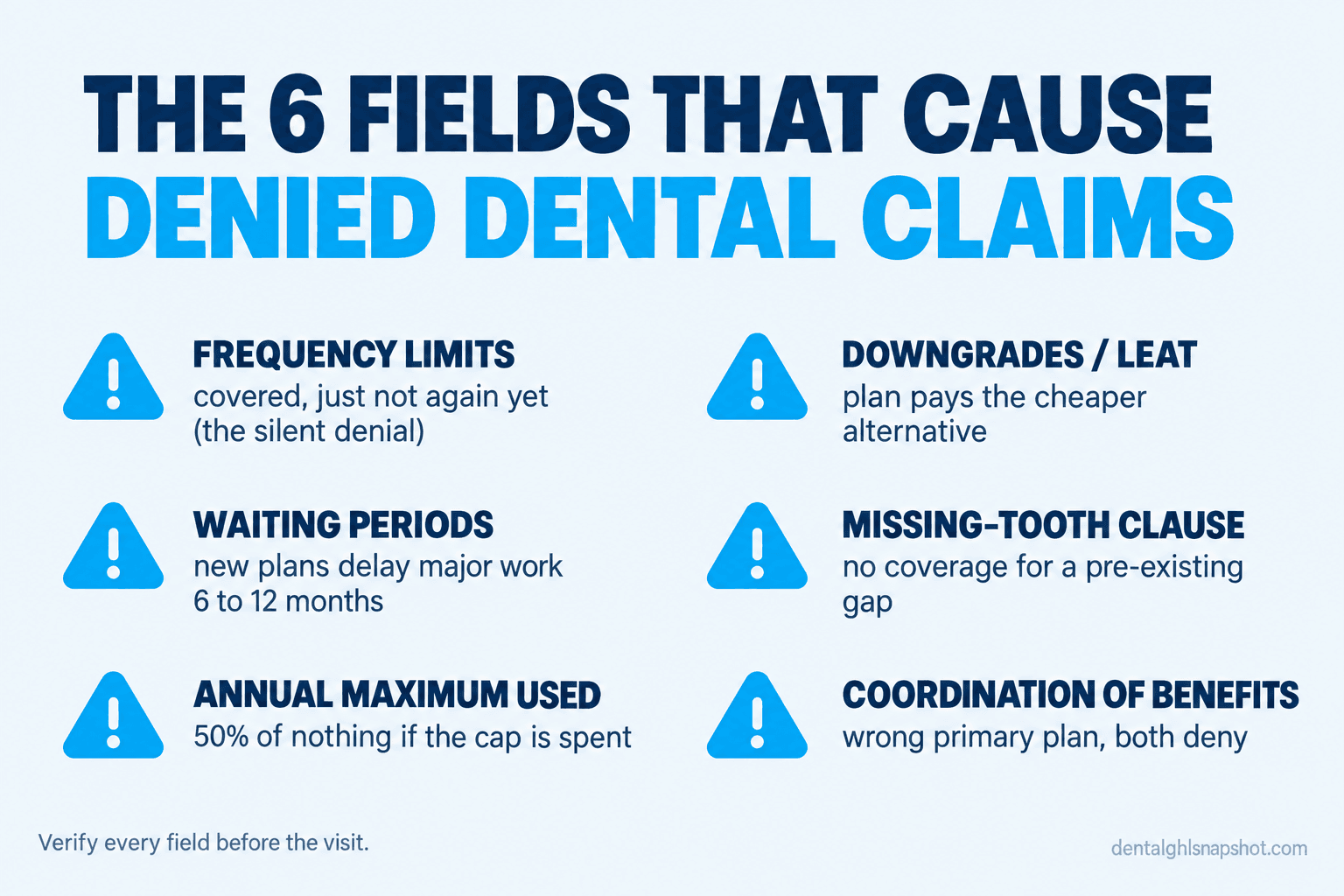
Two cause more trouble than the rest. Frequency limits are the silent killer: the procedure is covered, just not again yet, and nothing in “covered at 100%” tells you the patient already used it. Downgrades are the quiet margin-eater: the plan “covers” the crown, but at the rate of the cheapest acceptable alternative, so the patient owes a difference nobody warned them about.
Steal this: the payer-call script and patient messages
Here is the actual language, so one call gets the complete breakdown instead of three.
The payer-call script (work top to bottom, do not hang up until every line is filled):
“Hi, I’m calling from [Practice Name], Tax ID [], NPI [], to verify benefits. Subscriber [], date of birth [], member ID [], group number [].
Is the plan active for today’s date of service? … What is the annual maximum, and how much has been used this year? … Is the deductible met? Individual and family deductible? … For procedure codes [D___, D___], what is the coverage percentage, and is each classed as preventive, basic, or major? … Frequency limitations on these codes, and when was each last paid? … Any waiting periods in effect, and when do they end? … Does the plan downgrade or apply an alternate benefit on [the composite / the crown]? … Is there a missing-tooth clause? Does the patient have other coverage, and is this plan primary? … Can I get a reference number for this call, and your name?”
The patient intake text (sent at booking, consent first):
“Hi [First Name], this is [Practice Name]. To check you in fast, reply with a photo of the front and back of your insurance card, or tap this secure link: [link]. Reply STOP to opt out.”
The confirmation text (2 to 3 days out, no PHI):
“Hi [First Name], you’re confirmed for [Day] at [Time] with [Practice Name]. We’ve verified your benefits ahead of time so check-in is quick. Questions about coverage? Call us at [number]. Reply C to confirm, or tap to reschedule: [link].”
Notice what the confirmation text does not say: no procedure, no dollar amount, no “covered at 50%.” Coverage details are a phone call or an in-person conversation, never a text.
Run it for your practice size
The same six stages apply everywhere, but who does them and how much you automate changes with your size.
Solo or two-operatory practice (one front-desk person)
With no dedicated coordinator, the enemy is interruption. Lean on electronic active-coverage checks to clear most patients in seconds, and reserve phone breakdowns for the handful with real treatment planned. Batch the next day’s verifications into one quiet block, and automate card collection at booking. The trap: the one person gets pulled onto the phone and the block never happens, so protect it.
Mid-size practice (3 to 6 operatories, a dedicated coordinator)
Now one person owns verification, but the risk is it becomes a black box only she understands. Standardize the template so anyone can cover when she is out, make the reference number a required field, and verify everything 2 to 3 days out. This is the size where a practice CRM that logs verifications against each appointment pays for itself, because coverage lives in the system, not in one person’s notebook.
Large or multi-provider practice (6+ operatories)
At this volume manual phone verification does not scale; you need electronic eligibility running in batch and a real queue. The coordinator’s job shifts from “make the calls” to “work the exceptions” the electronic check flagged. Run a daily “unverified for tomorrow” report that has to hit zero before the day closes. At hundreds of checks a week, the gap between $6.78 and $0.34 is real money.
The compliance line you cannot cross
Verification touches protected health information, so how you communicate about it is regulated. Two rules matter most for the front desk.
Keep PHI out of text and email. A reminder may carry the appointment date, time, provider name, and a reschedule link. It may not carry a procedure, a diagnosis, a balance, or a benefit amount, because anyone who glances at a lock screen sees it. That is the line we walk through in the 2026 rules on texting dental patients.
Sign a BAA with anyone who touches the data. Any vendor that handles patient information, your texting platform, verification service, or CRM, needs a signed Business Associate Agreement, plus patient consent and an easy opt-out. No BAA, no PHI.
Objections and honest answers
“We already verify. Why do I need a checklist?” Most offices verify active coverage and a category percentage, then stop. The denials come from the fields underneath: the frequency limit, the downgrade, the used-up maximum, the waiting period. If your A/R is heavier than you would like, the gap is almost always in the fields you are not pulling.
“My team does not have time to verify everyone 2 to 3 days out.” They do not have time to rework denied claims and chase 90-day balances either, and that is where the hours actually go. Verification moves the work earlier, where it is cheap, instead of later, where it is expensive. Electronic checks clear most patients in seconds, so the human time goes only to visits that need a breakdown.
“Can’t I just verify the morning of the appointment?” You can, and it beats nothing, but it is the version that misses things. Done in a rush between seating patients, the breakdown gets skipped and you catch “active, 50%” and little else. It also leaves no time to warn the patient about a balance before they sit down.
Frequently asked questions
Dental insurance verification, answered
How far in advance should we verify dental insurance?
Verify 2 to 3 business days before the appointment: late enough that coverage is current, early enough to fix a bad card number or warn the patient about a balance. Re-verify anything older than about 90 days, and always re-verify a patient's first visit of a new plan year, since maximums and deductibles reset on January 1.
What is the difference between checking eligibility and verifying benefits?
Eligibility is the yes/no question: is this plan active for this patient on this date? Benefit verification is the detailed picture: maximum and amount used, deductible, coverage percentages, frequency limits, waiting periods, and downgrades. Eligibility says the patient is covered; the breakdown says what they actually owe.
Why do clean claims still get denied after we verify?
Almost always because a field was not pulled: a frequency limit (covered, just not again yet), a downgrade (the plan pays the cheaper option), a maxed-out annual benefit, a waiting period on a new plan, or a missing-tooth clause. Active coverage and a category percentage are not enough; check the specific procedures planned against every one of those fields.
Can we text patients their insurance coverage details?
No. A text or email may carry the appointment date, time, provider name, and a reschedule link only, never a procedure, diagnosis, balance, or benefit amount, because of lock-screen exposure and HIPAA. Coverage conversations happen by phone or in person, and any vendor handling patient data needs a signed Business Associate Agreement plus consent and an opt-out.
Is electronic eligibility verification worth it for a small practice?
Yes, for the basic active-coverage check. A manual phone check costs the industry about $6.78 in staff time; the electronic 270/271 version costs about $0.34 and returns in seconds. Reserve the phone for the detailed breakdown on real treatment visits.
It is 8:05 on a different Monday now. The first patient sits down, and you already know her plan is active, her cleaning is still covered, and her estimated portion is zero. Nothing bounces in three weeks. That is what a checklist buys you: not more effort, just the effort moved to the five minutes where it is cheap.