

Short answer: In a market as crowded as Pittsburgh — Pennsylvania has 7,036 dentists competing for attention (ADA Health Policy Institute, 2023) — the practices that win new patients aren’t the ones buying the most ads. They’re the ones that have already answered the question a patient is searching. That matters more than ever because search itself has changed: 58% of U.S. adults ran at least one Google search that returned an AI-generated summary in March 2025, and when that summary appears, clicks to ordinary results fall from 15% to 8% (Pew Research Center, 2025). The only way to show up now is to be the source Google and the AI engines quote — and that is built one researched article at a time. This is the data behind why, and the done-for-you content engine that runs it for a busy Pittsburgh practice.
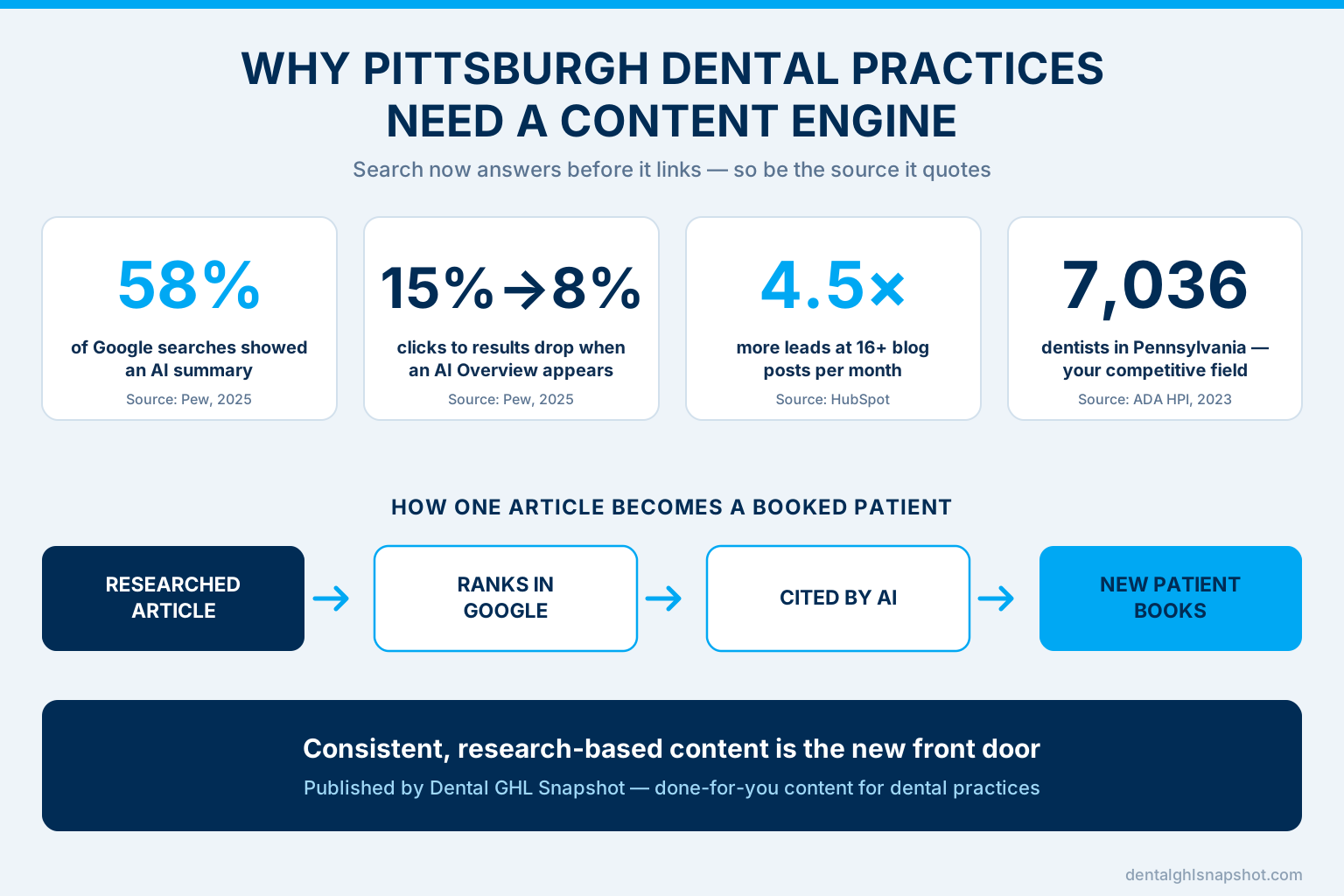
Table of contents
- Why “getting found” changed for Pittsburgh dentists
- What content marketing actually means for a dental practice
- The data: does blogging actually bring in patients?
- Why AI answer engines favor content like this
- The Pittsburgh angle: local content that ranks
- In-house vs. a done-for-you content engine
- How to tell if it’s working
- FAQ
Why “getting found” changed for Pittsburgh dentists
For a decade, “getting found” meant ranking on page one of Google. A patient searched dentist in Squirrel Hill, scanned ten blue links, and clicked one. That page is disappearing.
Google now answers a huge share of searches on the results page itself, inside an AI Overview, before a patient clicks anything. Pew Research Center’s 2025 study of real browsing behavior found that 58% of U.S. adults ran at least one search that produced an AI-generated summary in March 2025. And the summary changes behavior: when one appeared, users clicked a traditional search result in just 8% of visits, versus 15% when there was no summary — and they clicked a source link inside the AI Overview only 1% of the time (Pew Research Center, 2025).
Share of search visits that end in a click. Source: Pew Research Center, 2025.
The wider trend is just as stark: by early 2026, analysts reported that fewer than one-third of Google searches still send a click to the open web (SparkToro / Datos, 2026). Organic clicks are scarce. The practices that still get found are the ones whose content is good enough to be the answer the AI reads aloud — not the tenth link nobody scrolls to.
This is not a reason to give up on search. It’s a reason to change what you publish. A neglected website with a homepage and a “Services” list gives Google nothing to quote. A practice that has answered “How much do dental implants cost in Pittsburgh?” or “What happens at a first visit if I haven’t seen a dentist in years?” in a thorough, sourced article has given both the search engine and the AI engine something to cite — and your name rides along with the answer.
What content marketing actually means for a dental practice
Content marketing isn’t “posting more.” It’s answering, in public and in depth, the questions your future patients are already asking — so that when they search, your practice is the one that shows up with the answer.
For a dental practice it usually looks like three kinds of pages:
- Treatment-decision content. What does Invisalign cost in Pittsburgh? Veneers vs. bonding — which lasts longer? Is a crown or an implant right for a cracked molar? These are the questions people research for weeks before they ever call.
- First-visit and anxiety content. What happens at a new-patient exam? I’m nervous about the dentist — what are my options? This is where trust is won, and trust is what turns a reader into a booked appointment.
- Local and practical content. Emergency dentist open today near me. Do you take my insurance? Where do I park? High-intent, local, and frequently skipped by competitors.
The common thread: each page answers one real question completely, cites its sources, and links to the next logical step. That is what earns rankings, and — as the research below shows — it’s also what AI engines prefer to quote. A bot-assembled 600-word post does neither; a 2,500–3,200-word researched piece does both, which is why that length is the standard for a serious dental content engine.
The data: does blogging actually bring in patients?
Yes — and the gap between practices that publish consistently and those that don’t is not subtle.
HubSpot’s analysis of thousands of businesses found that those publishing 16 or more blog posts per month earned about 3.5× the traffic and 4.5× the leads of companies publishing zero to four. Blogging businesses generate roughly 67% more leads per month than non-blogging ones, and websites with active blogs have dramatically more indexed pages and inbound links — because every article is another page a search engine can rank and another page another site can link to (HubSpot).
Relative monthly leads by publishing frequency (0–4 posts/month = 1×). Source: HubSpot.
It’s also the efficient channel. Demand Metric’s widely cited analysis found content marketing costs about 62% less than outbound marketing while generating roughly three times as many leads (Demand Metric). For a single-location practice weighing another month of Google Ads against building a library of pages that keep working after you stop paying, that math is hard to ignore.
The catch is the word consistent. One article does little. A page published every few days, each answering a real patient question, compounds — because one page ranks for one thing, so every week you add another door a patient can walk through. The practices that struggle aren’t the ones with bad content; they’re the ones that published four posts in 2023 and stopped.
Why AI answer engines favor content like this
Here’s the part most dental marketing hasn’t caught up to: the format of good content is exactly what AI search engines reward.
Researchers at Princeton and allied universities tested how to make content more likely to be cited by generative engines like the ones powering AI Overviews, Perplexity and ChatGPT. In their “GEO: Generative Engine Optimization” paper (KDD 2024), the tactics that worked weren’t keyword tricks — they were the hallmarks of genuinely useful writing. Adding relevant statistics, including quotations from credible voices, and citing authoritative sources boosted a page’s visibility in generative responses by up to 40% (Princeton et al., arXiv 2311.09735).
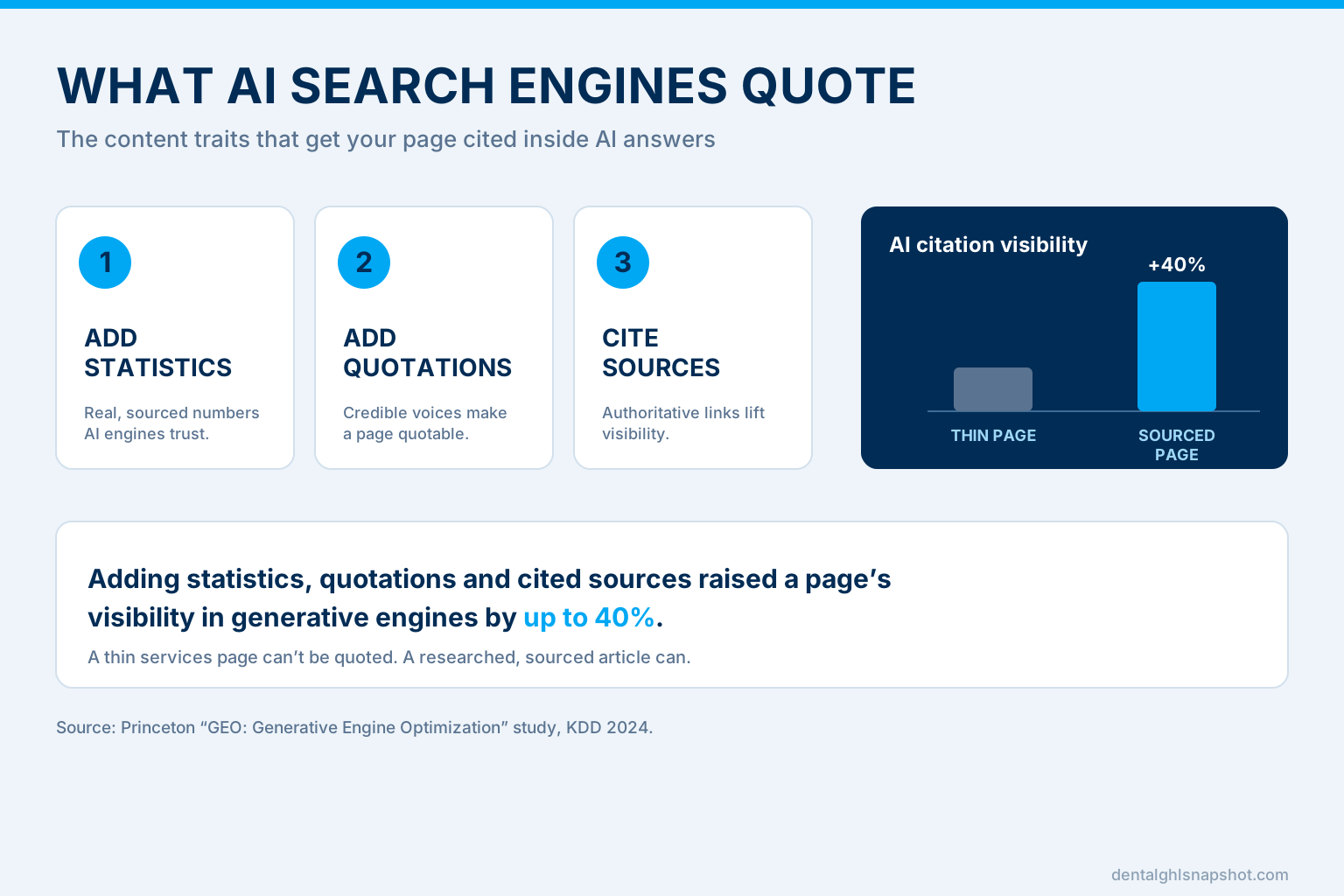
Read that again next to the Pew data. AI Overviews are intercepting clicks, and the way to survive that is to produce the kind of stat-backed, sourced, question-answering content the engines are most likely to quote. A thin services page can’t be quoted. A researched article on implant cost ranges in your area — with real numbers and cited sources — can. That’s the entire thesis of our AI search playbook for dental practices: show up inside the answer, not just under it.
The Pittsburgh angle: local content that ranks
National stats set the stage; local intent closes the patient. Pittsburgh is a city of about 307,668 people inside a county of 1.23 million (U.S. Census Bureau, 2024), and the patients you want aren’t searching “dentist.” They’re searching “pediatric dentist in Mount Lebanon,” “cost of a crown in the South Hills,” “emergency dentist open Saturday Shadyside.”
Those neighborhood- and treatment-specific queries are where a content engine earns its keep, for three reasons:
- “Near me” intent is exploding. Mobile “near me” searches (including “near me today/tonight” and “open now”) have grown over 900% in recent years (Think with Google). A practice with real location and treatment pages captures that intent; one without them is invisible to it.
- Local pages feed the AI answer. When someone asks an AI assistant “what do veneers cost in Pittsburgh,” it assembles an answer from pages that actually state local specifics. If your article names the ranges, the considerations and the sources, you’re a candidate to be cited. We go deep on the mechanics in our guide to local SEO for dentists.
- Reviews and content work together. About 72% of patients read online reviews when choosing a new provider (Software Advice). Content builds the awareness and answers the question; your Google reviews close the trust gap. One without the other leaks patients.
There’s a catch worth naming: local content only converts if the site it lives on is fast and findable. Mobile bounce probability rises 32% as a page goes from one to three seconds to load, and 90% by five seconds (Google / Think with Google). A content engine on a slow, clunky site is a bucket with a hole in it — which is why, on our builds, the articles sit on fast Astro pages with schema and a clean sitemap from day one.
In-house vs. a done-for-you content engine
The strategy is simple to describe and hard to sustain. That’s the real decision a Pittsburgh practice faces — not whether to publish, but who does it every single week.
Doing it in-house means someone on your team must research a topic, write 2,500–3,200 accurate words, add sourced statistics, build the internal links, handle the schema and meta, generate the images, and get it on the site — then do it again next week, forever. Most front desks are already juggling a ringing phone and an insurance backlog. The content that was going to fill the schedule quietly never gets written.
A done-for-you content engine removes that failure point. Here’s how the managed option compares to the realistic in-house alternative:
| Front desk / “we’ll get to it” | Done-for-you content engine | |
|---|---|---|
| Cadence | A burst, then months of silence | 2–3 researched articles every week, indefinitely |
| Depth | 400–800 rushed words | 2,500–3,200 words, sourced, AEO-ready |
| Technical SEO | Often skipped | Schema, meta, sitemap, robots and llms.txt on every post |
| Who reviews it | Nobody, or you at midnight | Informational content comes to you before it publishes |
| Cost | “Free” (your team’s lost hours) | A predictable monthly figure |
Our managed website and content service starts at $137/month (plus a one-time build fee), which already includes two research-based articles a week on fast Astro pages. The full Content Engine tier runs $747/month and publishes three articles a week alongside Google Business Profile work — the complete local-visibility system. Every patient-facing article is informational and comes to you for review before it goes live, so nothing is published in your practice’s name that you wouldn’t say at the chair. You can compare the tiers on the pricing page.
How to tell if it’s working
Content is a compounding asset, not a switch, so judge it on the right signals and the right timeline:
- Indexed, ranking pages. Month over month, are more of your articles showing in Google Search Console for real local queries? More indexed pages is the leading indicator (HubSpot).
- AI and “near me” visibility. Are you appearing in AI Overviews and map-pack results for the treatment and neighborhood searches that matter? This is the new front line (Pew, 2025).
- Assisted bookings. New patients rarely say “I found your blog.” They say “I was reading about implant costs and then booked.” Ask at intake, and watch the trend, not a single week.
- Timeline. Expect movement in 3 to 5 months, not three weeks — anyone promising day-one rankings isn’t being straight with you. The practices that win are the ones still publishing in month six.
The practices that dominate Pittsburgh search in a year aren’t deciding whether content works. They already decided, and they’re publishing while their competitors debate it.
Frequently asked questions
Does content marketing actually bring new patients to a dental practice, or is it just traffic?
It brings patients when it answers real decision questions. Companies that blog generate about 67% more leads per month, and those publishing 16+ posts a month see roughly 4.5x the leads of those publishing 0–4 (HubSpot). For a practice, a thorough article on what a treatment costs in your area or what happens at a first visit reaches patients who are weeks from booking — and it keeps working long after it's published, unlike an ad that stops the moment you stop paying.
With Google AI Overviews answering questions directly, is blogging still worth it in 2026?
It's more worth it, but the goal has shifted from being ranked to being quoted. When an AI Overview appears, clicks to ordinary results fall from 15% to 8% and only 1% of users click a source inside the Overview (Pew, 2025). The way to survive that is to be the source the AI reads from — and research shows adding statistics, quotations and cited sources raises a page's visibility in generative engines by up to 40% (Princeton GEO, 2024). Thin pages can't be quoted; researched ones can.
How often does a Pittsburgh dental practice need to publish?
Consistency matters more than any single post. The businesses that see compounding results publish on a steady weekly cadence rather than a one-time burst (HubSpot). Our managed plans publish two research-based articles a week, and the full Content Engine tier publishes three, each 2,500–3,200 words, because one page ranks for one thing — so every week adds another door a patient can walk through.
How is this different from just running Google Ads?
Ads rent attention; content owns it. The moment you stop paying for ads, the traffic stops. Content marketing costs about 62% less than outbound and generates roughly 3x the leads (Demand Metric), and the pages keep ranking and getting cited by AI engines for years. Most practices do best with ads for immediate demand and a content engine for durable, compounding visibility — not one or the other.
Isn't AI-written content a risk for a medical practice?
Thin, unreviewed AI filler is a real risk; a researched, reviewed article is not. The content that ranks and gets cited is long, sourced and genuinely useful — a 600-word bot post ranks for nothing. On our service, every patient-facing article is informational, research-based, and comes to you for review before it publishes, so nothing appears in your practice's name that you wouldn't say yourself. We never promise clinical outcomes or guaranteed insurance benefits.
How long until a Pittsburgh practice sees results from content?
Expect meaningful movement in 3 to 5 months, not weeks. Search engines need time to index, rank and trust new pages, and AI engines need content to cite. Anyone promising day-one rankings isn't being straight with you. The practices that win are simply the ones still publishing consistently in month six.
What does a done-for-you dental content engine cost?
Our managed website and content service starts at $137/month plus a one-time build fee, which already includes two research-based articles a week on fast Astro pages with schema and a clean sitemap. The full Content Engine tier is $747/month and publishes three articles a week alongside Google Business Profile work. See the get-a-website service for what's included, compare tiers on the pricing page, or book a 20-minute walkthrough.
About the author
Marisa Velez is a Dental Practice Growth Strategist who has spent more than a decade helping general and cosmetic practices fill the hygiene column and turn one-time patients into lifelong recare. She focuses on the numbers that actually move production — new-patient cost, no-show rate and treatment acceptance — and translates them into systems a busy front desk can live with.