

Short answer: When someone in Dallas asks Google, ChatGPT, or Perplexity “who’s a good dentist near me?”, an AI now answers for them — often without a single click to any practice’s website. Google’s AI Overviews already reach 2 billion monthly users (Alphabet Q2 2025), and when an AI summary appears, searchers click a traditional result on just 8% of searches — versus 15% without one (Pew Research Center, 2025). To keep showing up, your Dallas practice needs Answer Engine Optimization (AEO) — structuring your website so AI engines can read, trust, and cite it. This guide is the step-by-step playbook, built on what actually moves the needle: answer-first content, structured data, real reviews, and a fast, machine-readable site.
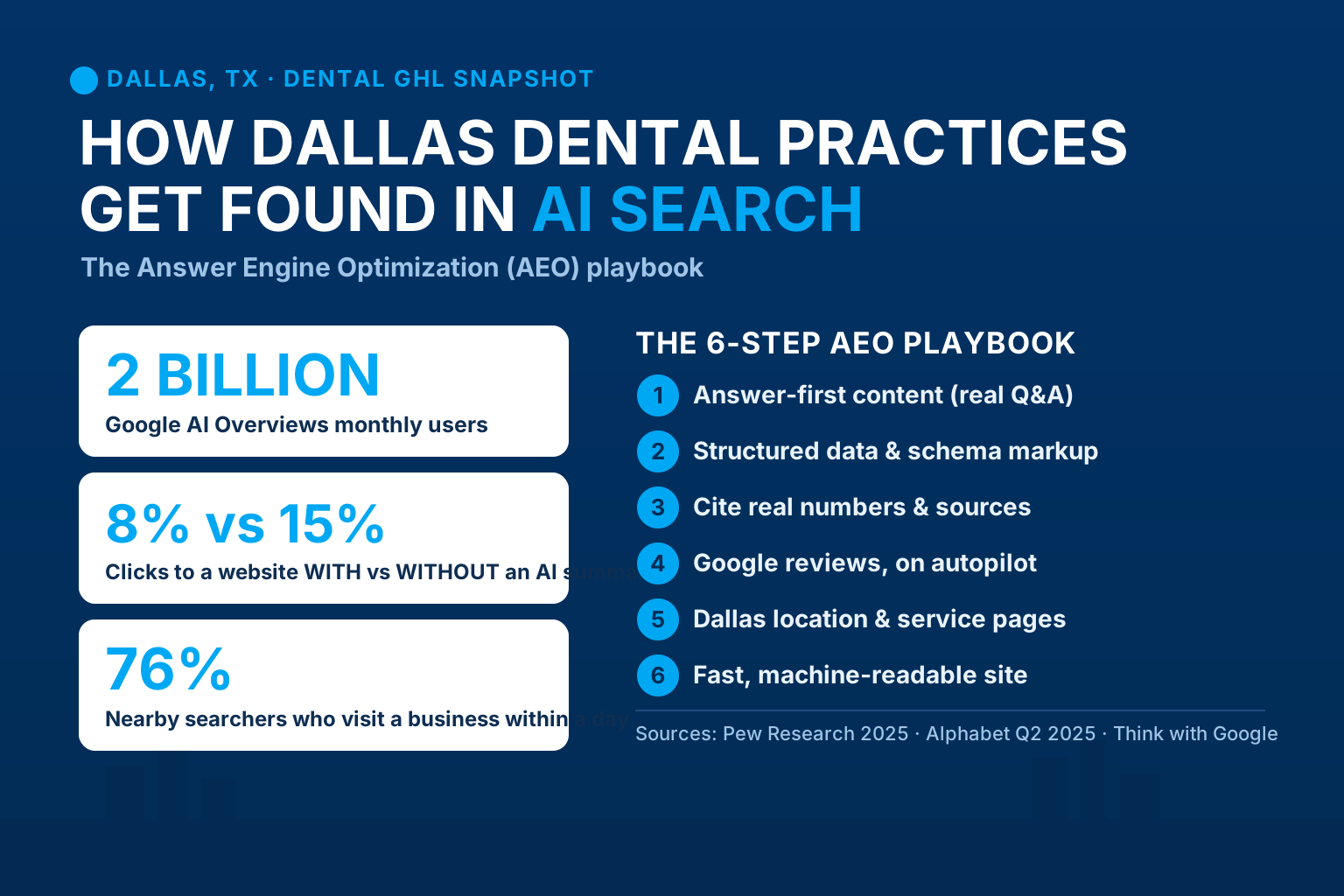
Table of contents
- What “AI search” and AEO actually mean
- Why AI search matters for a Dallas dental practice
- The reality check: don’t torch your SEO
- The 6-step AEO playbook for Dallas dentists
- AEO-ready site vs. a typical dental site
- How to tell if it’s working
- FAQ
What “AI search” and AEO actually mean
AI search is any query answered by a generative engine instead of a plain list of blue links — Google’s AI Overviews and AI Mode, ChatGPT, Perplexity, and Microsoft Copilot. Instead of returning ten results and letting the patient choose, these tools read the web, synthesize an answer, and hand it back in a paragraph — sometimes naming a few sources, often naming none.
Answer Engine Optimization (AEO) — closely related to Generative Engine Optimization (GEO) — is the practice of structuring your website so those engines can find, understand, trust, and cite your practice as the answer. Traditional SEO asks “how do I rank #1?” AEO asks a sharper question: “when the AI writes the answer, is my practice the one it mentions?”
The stakes changed because the click is vanishing. Pew Research tracked the real browsing of roughly 900 U.S. adults and found that when a Google result page carried an AI summary, users clicked a traditional link on just 8% of searches — nearly half the 15% rate on pages without one. Clicks on the links inside the AI summary were rarer still, at 1%.
Percentage of Google searches where users click through to a website. When an AI summary appears, click-through nearly halves. Source: Pew Research Center, July 2025.
When fewer people click, the value of being the named answer skyrockets. If ChatGPT tells a Dallas parent “a well-reviewed family dentist in Lakewood is…” — you either are that sentence, or you’re invisible. That’s what AEO is fighting for.
Why AI search matters for a Dallas dental practice
Dallas is one of the most competitive dental markets in the country, and new patients overwhelmingly start their search online. Three forces make AI search a front-office issue, not a tech curiosity:
1. The audience is already there. Google’s AI Overviews reach 2 billion monthly users, AI Mode passed 100 million monthly users in the U.S. and India (Alphabet Q2 2025), and ChatGPT reports roughly 800 million weekly users (OpenAI, reported 2025). A meaningful share of the “dentist near me” and “how much does Invisalign cost in Dallas” questions your future patients ask are now getting answered by a machine first.
Reach of major AI answer engines, in millions of users. Sources: Alphabet Q2 2025 (AI Overviews, AI Mode) and OpenAI, reported 2025 (ChatGPT weekly users).
2. Local searches still end in a booked chair. AI hasn’t broken the local funnel — it’s moved where it starts. 76% of people who run a nearby search on their smartphone visit a business within a day, and 28% of those searches end in a purchase (Think with Google). When an AI names your Dallas practice as the answer, that high-intent visit is yours to lose.
3. Reputation is the AI’s tiebreaker. Answer engines lean on the same trust signals patients do — and patients are exacting: around 93% read online reviews for local businesses, and roughly 89% expect owners to respond to them (BrightLocal, 2025). A thin or unanswered review profile doesn’t just cost you human trust; it costs you the AI’s confidence in recommending you.
The reality check: don’t torch your SEO
Before you rip up your marketing plan, hear the honest counterweight: AI referral traffic is still tiny. BrightEdge found AI accounts for under 1% of search traffic, with organic search still driving the overwhelming majority of visits — and converting better (BrightEdge, Sept 2025).
More importantly, AEO and SEO are the same investment. BrightEdge also found that 54.5% of AI Overview citations overlap with pages already ranking organically (BrightEdge, 2025) — up from 32.3% a year earlier. In plain terms: the pages that rank on Google are the pages the AI tends to cite. You don’t choose between ranking and being cited; strong fundamentals earn you both.
So the goal isn’t to abandon local SEO for your practice — it’s to extend it so machines can parse it. Everything in the playbook below makes your site better for Google’s ten blue links and simultaneously readable by the answer engines. Nothing here is a gamble on a channel that might not pan out; it’s foundational work that pays off no matter how the search box evolves.
The 6-step AEO playbook for Dallas dentists
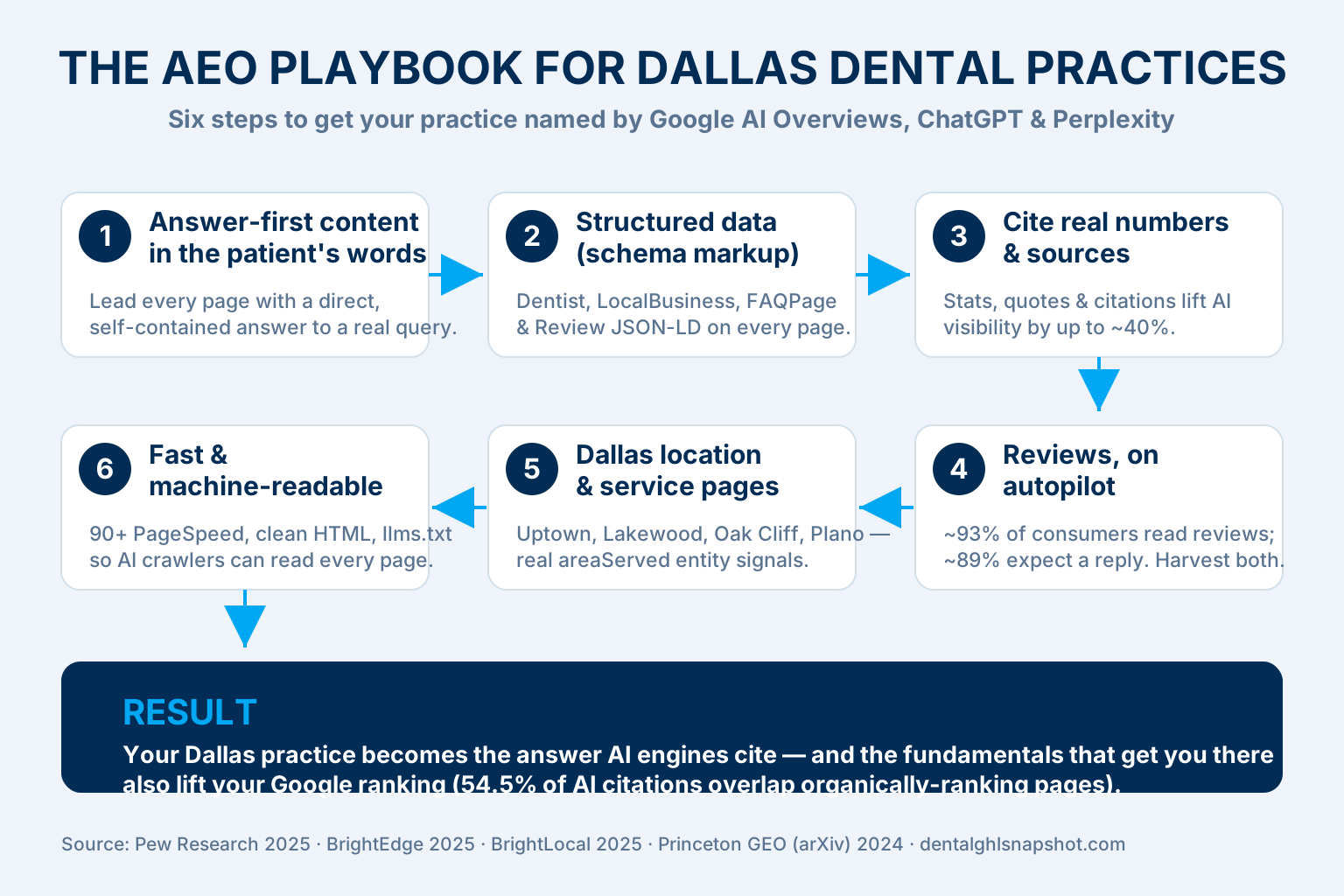
Here’s the exact sequence we use when we build an AEO-ready dental site. Work top to bottom — the early steps make the later ones matter more.
Step 1 — Write answer-first, in the patient’s words
AI engines extract answers from passages that stand on their own. Lead every important page and blog section with a direct, self-contained answer to a real question, then explain. Instead of a hero that says “Welcome to our practice,” write the sentence a patient actually searched: “A same-day emergency dental appointment in Dallas is available at our Uptown office, typically within 24 hours.”
Structure content as questions and answers — the exact shape of “how much is a dental cleaning in Dallas?” or “does this dentist take my insurance?” This is the single highest-leverage habit, because it hands the engine a citable passage on a plate.
Step 2 — Mark it up with structured data (schema)
Structured data is how you tell a machine, unambiguously, “this is a dentist, in Dallas, open these hours, with these reviews.” Yet it’s far from universal: only about a third of pages carry Schema.org markup, with JSON-LD present on roughly 41% of pages across the web (HTTP Archive Web Almanac, 2024). Getting it right is a genuine edge.
For a dental practice, prioritize:
Dentist/LocalBusinesswith your NAP (name, address, phone), geo-coordinates, and hours.FAQPageon service and location pages — this is the schema most directly aligned with how answer engines lift Q&A content.Review/AggregateRatingto surface your reputation.ServiceandareaServedto declare exactly which Dallas neighborhoods and procedures you cover.
Schema won’t force a citation, but it removes every excuse for an engine to misunderstand who and where you are.
Step 3 — Cite real numbers and sources
There’s genuine research on what makes generative engines cite a page. The Princeton-led “Generative Engine Optimization” study tested tactics across thousands of queries and found that adding citations, quotations, and statistics were among the highest-impact moves — lifting a source’s visibility in AI answers by up to roughly 40%, with the biggest gains for pages that weren’t already dominant (Aggarwal et al., arXiv 2024).
The takeaway for your site: don’t write vague marketing fluff. Back claims with named, linked sources (“the ADA reports…”, “per the CDC…”), quote credible authorities, and use concrete figures. Content that reads like a trustworthy reference is content the AI treats as one.
Step 4 — Win the Google Business Profile and reviews
For local dental queries, your Google Business Profile is often the entity the AI trusts most. Keep it complete and consistent: correct categories, Dallas address, hours, photos, and services. Then run reviews as a system, not an afterthought — because ~93% of consumers read reviews and ~89% expect a response (BrightLocal, 2025).
Automating Google review requests after each visit — and replying to every review — feeds both the humans deciding and the machines summarizing. A steady stream of recent, responded-to 5-star reviews is one of the loudest “recommend this practice” signals you can send an answer engine.
Step 5 — Build real Dallas location and service pages
Entity clarity beats keyword stuffing. Give each major service and each real service area its own page: “Invisalign in Dallas,” “Emergency Dentist in Uptown Dallas,” “Family Dentist serving Plano & Frisco.” Each page answers the specific questions for that intent and carries its own FAQPage and LocalBusiness/areaServed schema. This is how you become the obvious answer to a specific local question instead of a vague regional maybe.
Step 6 — Make the site fast and machine-readable
None of the above matters if crawlers and AI bots struggle to read your site. Bloated, slow, JavaScript-heavy pages are harder for engines to parse and slower for patients — and only 43% of mobile sites pass all of Google’s Core Web Vitals. A fast, static-first site with clean HTML, editable meta and schema on every page, and an llms.txt file that maps your content for AI crawlers is the machine-readable foundation the other five steps sit on. (That’s a core reason we build on Astro — see Astro vs. WordPress for dental websites.)
AEO-ready site vs. a typical dental site
Most dental websites — especially older WordPress or template builds — were never structured for machines to read. Here’s the practical difference between an AEO-ready build and a typical one:
| Plan | AEO-ready site (our Get a Website build)Recommended | Typical dental website |
|---|---|---|
| Price | $497 one-time + $97/mo | Varies / plugin fees |
| Feature 1 | Answer-first content structured as real Q&A | Marketing copy, not answer-first passages |
| Feature 2 | Valid JSON-LD schema (Dentist, LocalBusiness, FAQPage, Review) on every page | Little or no structured data (only ~41% of pages have JSON-LD) |
| Feature 3 | Editable meta titles, descriptions & schema per page | Meta and schema hard or impossible to edit |
| Feature 4 | Per-neighborhood Dallas location & service pages | One generic 'service area' page |
| Feature 5 | llms.txt + clean, static HTML for AI crawlers | No llms.txt; heavy JavaScript slows crawlers |
| Feature 6 | 90+ Google PageSpeed, Core Web Vitals green | Often fails Core Web Vitals on mobile |
| Feature 7 | Automated review harvesting built in | Reviews collected manually, if at all |
| Feature 8 | Managed hosting, domain & SSL included | Hosting, SSL & updates billed piecemeal |
How to tell if it’s working
AEO is measurable — you just have to look in new places alongside your usual analytics:
- Ask the engines directly. Run your key queries (“best family dentist in Dallas,” “emergency dentist near Uptown Dallas”) in Google AI Mode, ChatGPT, and Perplexity. Note whether you’re named and what source the engine cites. Re-check monthly.
- Watch AI referral traffic. In your analytics, segment referrals from
chatgpt.com,perplexity.ai, and Google AI surfaces. It’ll be small today — remember, AI is under 1% of search traffic — but the trend is what matters. - Track organic rankings anyway. Because more than half of AI citations overlap organic results, your Google ranking is still the leading indicator of AI visibility. Rising ranks usually precede rising citations.
- Watch the front desk. The clearest proof is new patients saying “I found you when I asked ChatGPT” or “Google recommended you.” Ask, and log it — pair it with a fast website chat widget or AI receptionist so the moment they arrive, they can book.
AEO isn’t a one-time project; it’s a posture. Keep your content answer-first, your schema valid, your reviews flowing, and your site fast, and you compound visibility across every way patients search — the ten blue links and the AI paragraph alike.
Frequently asked questions
What is AEO for a dental practice?
AEO (Answer Engine Optimization) is structuring your website so AI engines — Google's AI Overviews and AI Mode, ChatGPT, Perplexity, and Copilot — can read, trust, and cite your practice as the answer to a patient's question. It builds on traditional SEO with answer-first content, valid structured data (Dentist, LocalBusiness, FAQPage, Review schema), cited sources, strong reviews, and a fast, machine-readable site. It's closely related to GEO (Generative Engine Optimization).
Is AI search really replacing Google for finding a dentist?
Not replacing — reshaping. AI referral traffic is still under 1% of search traffic, and organic search still dominates. But Google's AI Overviews already reach 2 billion monthly users, and when an AI summary appears, click-through to websites nearly halves (8% vs. 15%, Pew 2025). So the search box is increasingly answering questions itself — which is why being the practice it names matters.
Do I have to choose between SEO and AEO?
No — they're the same investment. BrightEdge found 54.5% of AI Overview citations overlap pages already ranking organically. The content, schema, reviews, and site speed that earn Google rankings are also what earn AI citations. AEO extends your local SEO; it doesn't compete with it.
How does schema markup help my Dallas practice get cited by AI?
Structured data (JSON-LD) tells machines unambiguously what your business is, where it's located, its hours, services, and reviews. Only about 41% of pages carry JSON-LD, so proper Dentist, LocalBusiness, FAQPage, and Review schema is a real edge. It doesn't guarantee a citation, but it removes any ambiguity that would stop an engine from confidently naming you as the Dallas answer.
What does an AEO-ready dental website cost?
Our Get a Website build is $497 one-time plus $97/month, which covers a fast Astro site with answer-first pages, valid schema, Dallas location pages, review harvesting, an llms.txt for AI crawlers, managed hosting, domain, and SSL. It's built to rank on Google and get named by AI answer engines. See full pricing or book a 20-minute demo.
Written by Devin Okafor, GoHighLevel Automation Specialist based in Austin, Texas. Devin builds and ships GoHighLevel snapshots and fast, AEO-ready dental websites for practices and the agencies that serve them. This article is educational and does not constitute a guarantee of specific rankings, AI citations, traffic, or revenue; outcomes depend on your market, configuration, and execution. Dental GHL Snapshot is a GoHighLevel automation and website product — not a dental provider, clinician, or insurer.
Related posts: Astro vs WordPress for Dental Websites · Local SEO for Dentists · Automating Google Reviews for Your Practice · Dental Website Chatbots · AI Receptionist for Dental Practices