

Short answer: In a market growing as fast as Phoenix, most of your new patients meet your practice for the first time on a phone screen — and they decide in seconds whether to wait for your site to load or bounce back to Google. The data is blunt: 53% of mobile visits are abandoned if a page takes longer than 3 seconds to load (Google), and as load time climbs from 1 to 3 seconds the probability of a bounce rises 32% — to 90% by 5 seconds (Think with Google). For a Phoenix dental practice, a slow website isn’t a technical footnote — it’s the quiet, daily leak of new-patient calls to the faster office down Camelback Road. This is what that leak actually costs, and how to close it.
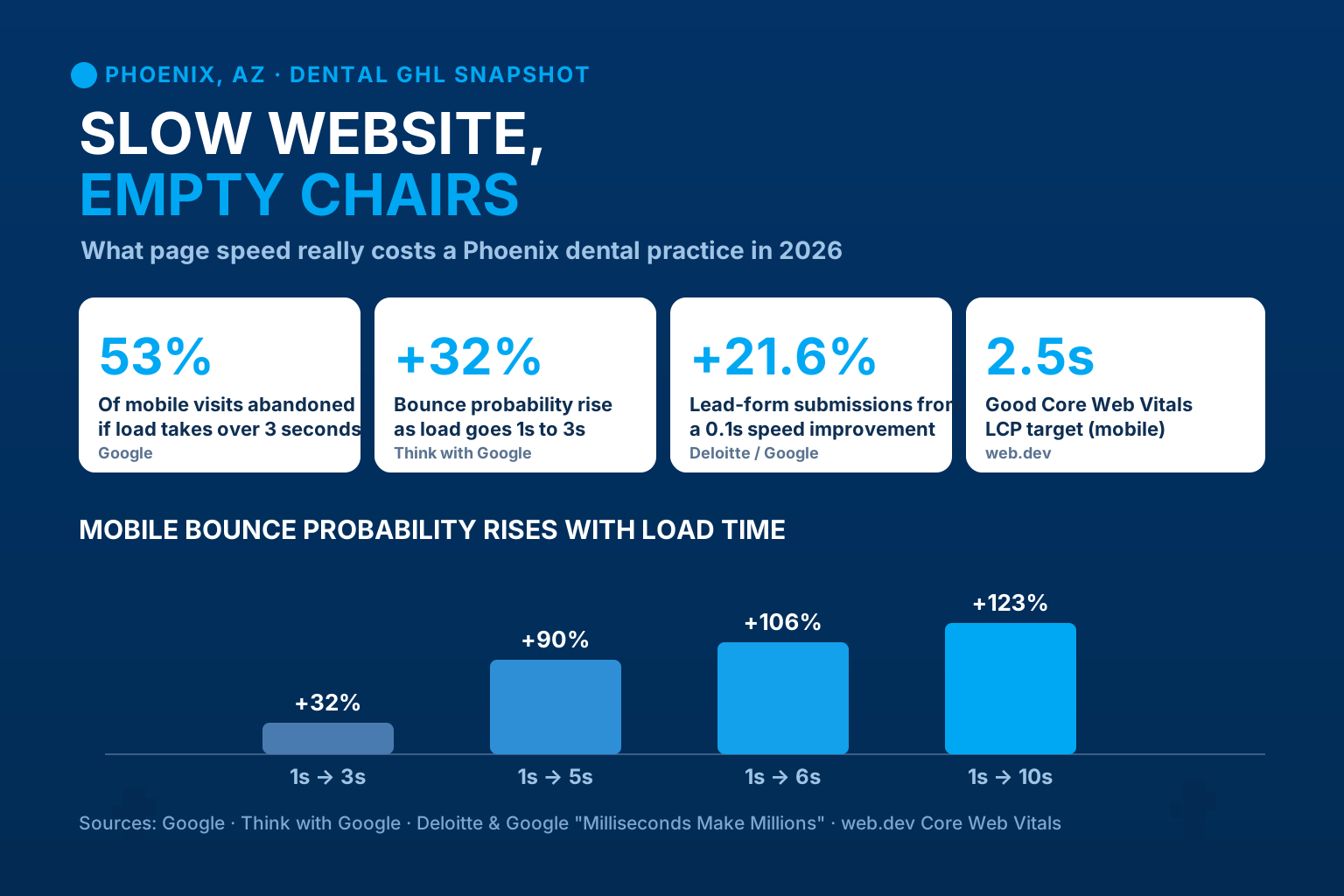
Table of contents
- Why website speed decides whether a Phoenix patient books or bounces
- The real cost of a slow dental website
- Why dental websites get slow in the first place
- The Phoenix angle: a fast-growing, mobile-first, competitive market
- Core Web Vitals: the scoreboard Google and AI search now grade you on
- The fix: a fast, Astro-built dental website
- How to tell if your website is too slow
- FAQ
Why website speed decides whether a Phoenix patient books or bounces
Picture the actual moment a new patient finds you. A family that just moved to Ahwatukee searches “dentist near me” on their phone between errands. Google hands them a map pack and a few websites. They tap yours. And then they wait.
That wait is where practices lose patients they never knew they had. Google’s own research is unambiguous: 53% of mobile site visits are abandoned if the page takes longer than three seconds to load (Google). Not “get annoyed” — leave. And because a bounce back to the search results usually means the next tap is a competitor’s number, a slow homepage doesn’t just cost you a visit. It hands a booked appointment to the office down the street.
The relationship isn’t linear, either — it accelerates. Analyzing over 900,000 mobile pages, Google found that as page load time grows, the probability of a bounce rises 32% from 1 to 3 seconds, 90% from 1 to 5 seconds, 106% from 1 to 6 seconds, and 123% from 1 to 10 seconds (Think with Google).
Increase in the probability that a mobile visitor bounces, as page load time grows from 1 second. Source: Think with Google.
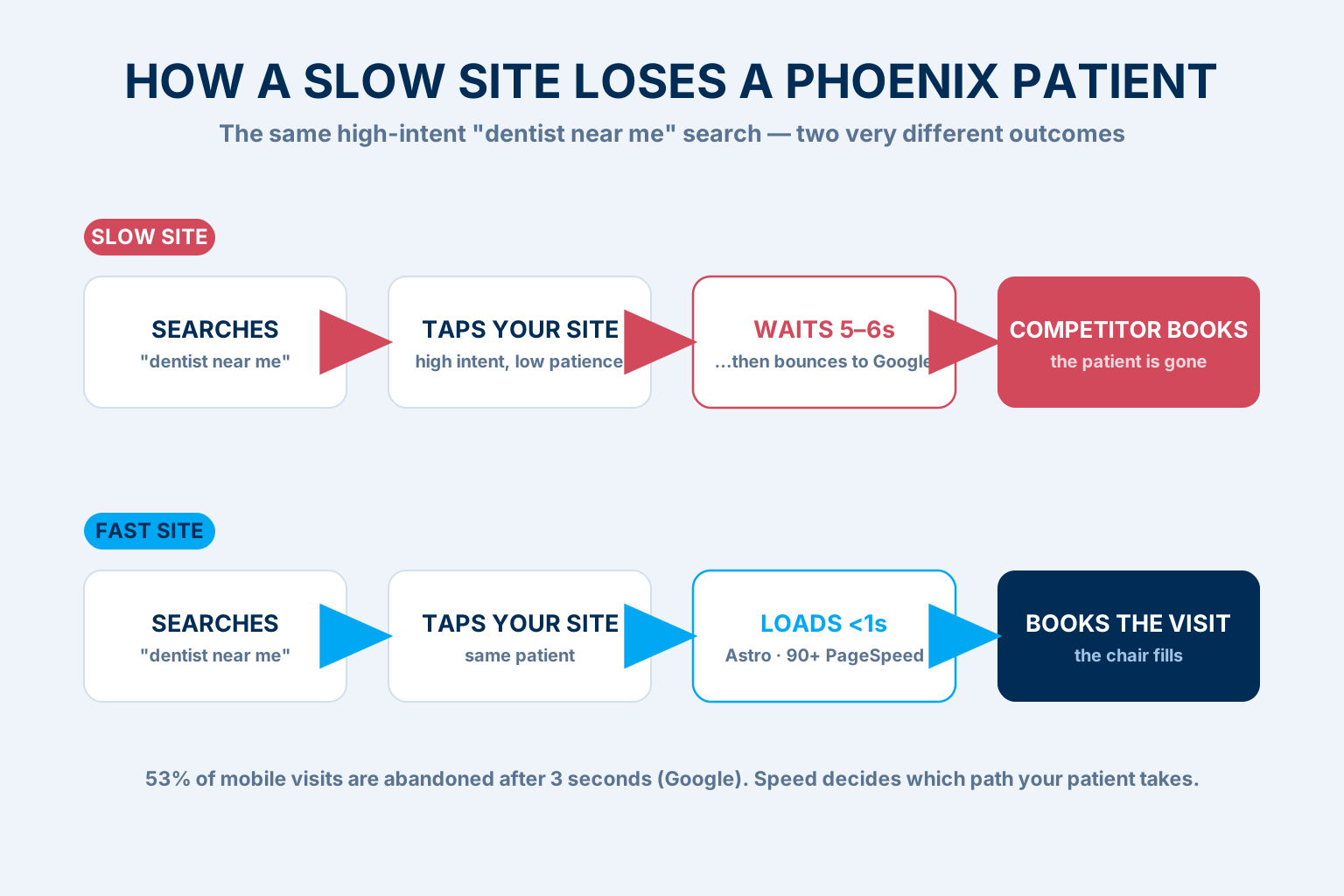
Here’s why this matters more for dentists than for almost any other local business: the patient searching for you is rarely browsing. They have a toothache, a broken crown, a new-in-town to-do list, or a kid who needs a cleaning before school starts. That’s high intent and low patience. The practice that loads instantly gets the call. This is the same speed-to-lead logic behind answering missed calls with an instant text-back — except here, the “response time” is your website loading before the patient gives up.
The real cost of a slow dental website
Speed doesn’t just prevent bounces; it directly moves conversions — the form fills and appointment requests that pay for the chair. The most-cited study on this, “Milliseconds Make Millions,” commissioned by Google and run by Deloitte across 30 million mobile sessions, found that a mere 0.1-second improvement in mobile load time increased retail conversions by 8.4% and travel conversions by 10.1% — and, most relevant to a dental practice, lifted lead-generation form submissions by 21.6% (Deloitte/Google). A dental website is a lead-gen site: its whole job is to turn a visitor into a booked appointment request.
Percentage lift from a single 0.1-second improvement in mobile site speed, by sector. Lead generation — the closest analog to a dental appointment request — gained 21.6%. Source: Deloitte & Google, “Milliseconds Make Millions”.
Independent data tells the same story from the other direction. Portent’s analysis of tens of millions of sessions found the highest conversion rates occur between 0 and 2 seconds of load time, that conversion rate drops an average of 4.42% for every additional second between 0 and 5 seconds, and that a site loading in 1 second converts roughly 3× better than one loading in 5 seconds (Portent).
Why dental websites get slow in the first place
If speed is this valuable, why are so many dental sites slow? Because of how they’re built. The three most common platforms for dental websites each carry structural weight:
- WordPress. The average WordPress dental site is a stack of themes and plugins — page builders (Elementor, Divi), booking widgets, chat scripts, sliders, analytics tags — each adding JavaScript, database calls, and render-blocking requests. It’s flexible, but it bloats fast, and every plugin update is another chance to slow down.
- Wix / Squarespace. Easy to launch, but you inherit a heavy, one-size-fits-all rendering engine and little control over what loads. Good enough for a brochure; rarely fast on mobile.
- GoHighLevel-built sites. GHL is superb for automations and CRM — it runs the AI chatbot, reminders, and follow-up beautifully — but its page builder was designed for funnels, not for a fast, crawlable, 40-page practice website. Pages built in it tend to score poorly on mobile speed and are awkward to optimize for schema and meta.
The common thread is overhead: code and assets that ship to the patient’s phone whether they’re needed or not. On a fast desktop with fiber, you may never notice. On a mid-range Android phone on a Phoenix cellular network in July, that overhead becomes the three seconds that lose the patient. For a fuller side-by-side on framework choice, see our deep dive on Astro vs WordPress for dental websites.
The Phoenix angle: a fast-growing, mobile-first, competitive market
Phoenix is one of the worst places to run a slow website — and one of the best places to run a fast one.
It’s growing fast, which means a constant stream of new patients who don’t have a dentist yet. Phoenix is among the fastest-growing large cities in the country, and the whole Valley — Scottsdale, Mesa, Chandler, Gilbert, Tempe, Ahwatukee — keeps adding residents. Every one of those newcomers eventually searches “dentist near me.” They have no loyalty and no referral; the search result is the decision. Speed is how you win a first impression you’ll never get twice.
Demand outpaces supply. Arizona sits below the national average for dentists per capita (ADA Health Policy Institute), so patient intent is high — but the Phoenix metro is also crowded with practices competing for those searches. Being findable and fast is what separates the practice that books the new mover from the one that doesn’t.
It’s mobile-first and local-first. Local mobile searches carry real urgency: Google has found that 76% of people who search for something nearby on their phone visit a related business within a day (Think with Google). That’s the patient you want — ready to act today — and the one most likely to bounce from a slow page. If you’re serious about local visibility, pair a fast site with the fundamentals in our guide to local SEO for dentists.
Core Web Vitals: the scoreboard Google and AI search now grade you on
Speed used to be a “nice to have.” It’s now a measured, named part of how Google ranks you. Google’s Core Web Vitals are three real metrics with published “good” thresholds:
- Largest Contentful Paint (LCP) — how fast the main content loads. Good: under 2.5 seconds.
- Interaction to Next Paint (INP) — how fast the page responds when tapped. Good: under 200 milliseconds.
- Cumulative Layout Shift (CLS) — how much the layout jumps around while loading. Good: under 0.1.
These are part of Google’s page experience signals and are evaluated mobile-first — Google now judges your site by how it behaves on a phone, not a desktop (Google). A dental site that fails LCP on mobile is fighting an uphill ranking battle before a single backlink or review is counted.
There’s a second, newer reason speed matters: AI answer engines. When ChatGPT, Perplexity, and Google’s AI Overviews assemble an answer about “best dentist in Phoenix for implants,” they favor pages that are fast, cleanly structured, and easy to crawl. A slow, script-heavy site is harder for those systems to read and cite. We cover this shift in detail in how to get your practice found in AI search — but the foundation underneath it is the same: a fast, well-structured page.
The fix: a fast, Astro-built dental website
The good news is that page speed is one of the most fixable problems in dental marketing. You don’t need to keep bolting speed plugins onto a slow platform — you rebuild on a foundation that’s fast by default.
That foundation is Astro, the framework we use for our Get a Website service. Astro ships almost no JavaScript, renders static-first pages, and serves them from Cloudflare’s global edge — so pages open in a blink on both mobile and desktop. We guarantee a 90+ Google PageSpeed score (often a perfect 100), which is a different universe from the 40–60 mobile scores typical of plugin-heavy WordPress or GHL-built dental sites.
| Plan | Typical WordPress / Wix / GHL site | Fast Astro dental website (ours) |
|---|---|---|
| Price | Slow by construction | From $497 + $97/mo |
| Feature 1 | Mobile PageSpeed commonly 40–60 | Guaranteed 90+ PageSpeed — often 100 — mobile & desktop |
| Feature 2 | Plugin & page-builder overhead loads on every visit | Static-first, edge-served: near-instant load |
| Feature 3 | LCP often 4s+ on mobile — fails Core Web Vitals | Built to pass Core Web Vitals (LCP under 2.5s) |
| Feature 4 | Schema, meta & location pages hard to control | Proper location pages, schema, sitemap, robots & llms.txt |
| Feature 5 | Hosting, SSL & plugin fees stack up; edits get quoted | Free domain + managed Cloudflare hosting, no surprise bills |
Speed is the headline, but it’s not the only thing a slow, dated site is costing you. The rebuild also fixes the leaks after the page loads: a fast site with no way to capture the visitor still loses them. That’s why the build includes an AI chat widget that answers questions and books appointments 24/7, review-collection automation, and CRM integration so every lead is captured — the same prebuilt-website approach behind the snapshot. It’s the difference between a brochure and a booking machine.
What changes when the site is fast
Mobile PageSpeed in the 40s. Homepage takes 5–6 seconds on a phone. High-intent 'dentist near me' visitors bounce back to Google before it loads. No location pages, weak schema, invisible in AI answers. New patients quietly go to the faster office.
Guaranteed 90+ PageSpeed, often 100. Pages open near-instantly on mobile. Core Web Vitals pass. Real Phoenix-neighborhood location pages, clean schema, AI-readable. An AI chat widget captures and books visitors 24/7. First impressions convert.
How to tell if your website is too slow
You don’t need to guess. Run these three checks in ten minutes:
- Test it on Google PageSpeed Insights. Search “PageSpeed Insights,” enter your URL, and read the mobile score and Core Web Vitals. Under 50 on mobile is a red flag; a passing LCP is under 2.5 seconds. This is the same benchmark Google uses to rank you.
- Load your own site on your phone, on cellular, cold. Turn off Wi-Fi, clear the tab, and open your homepage as a new patient would. Count the seconds until you can actually read and tap. If it’s more than three, you’re inside the 53% abandonment zone.
- Watch what happens after it loads. Is there a fast, obvious way to book or chat? A fast page that dead-ends is still a lost patient. Speed gets them in the door; the booking path and chat widget close the appointment.
If any of those checks fail, the fix isn’t another plugin — it’s a faster foundation. To sanity-check the economics for your practice, our pricing page and a quick walkthrough call will get you concrete numbers.
Frequently asked questions
Frequently asked questions
How much does website speed actually affect getting new dental patients?
A lot, and it's measurable. Google found that 53% of mobile visits are abandoned if a page takes longer than 3 seconds to load (Google), and bounce probability rises 32% from 1 to 3 seconds and 90% from 1 to 5 seconds (Think with Google). Because most 'dentist near me' searches are high-intent and on mobile, a slow homepage sends ready-to-book patients back to a competitor before they ever see your practice.
What is a good website speed for a dental practice?
Aim to pass Google's Core Web Vitals: a Largest Contentful Paint (LCP) under 2.5 seconds, Interaction to Next Paint under 200ms, and Cumulative Layout Shift under 0.1 (web.dev), measured on mobile. On Google PageSpeed Insights, a mobile score of 90+ is the target. Our Astro-built sites guarantee 90+ (often 100); many WordPress and GHL-built dental sites score 40–60 on mobile.
Why is my WordPress or GoHighLevel dental site slow?
Overhead. WordPress sites accumulate themes, page builders, and plugins that each ship JavaScript and make database calls on every visit. GoHighLevel is excellent for CRM and automations, but its page builder is designed for funnels, not fast 40-page practice websites, so those pages tend to score poorly on mobile speed. The fix is a static-first framework like Astro that ships almost no JavaScript — see our Astro vs WordPress comparison.
Does page speed affect my Google ranking?
Yes. Core Web Vitals are a confirmed part of Google's page-experience ranking signals, evaluated mobile-first (Google). A site that fails LCP on mobile is at a ranking disadvantage. Fast, cleanly structured pages are also easier for AI answer engines like ChatGPT, Perplexity, and Google AI Overviews to crawl and cite.
Why does website speed matter specifically for a Phoenix practice?
Phoenix is one of the fastest-growing large U.S. cities, so there's a constant flow of new residents searching for a dentist with no existing loyalty — the search result is the decision. Arizona also sits below the national average for dentists per capita (ADA HPI), so intent is high and competition for those searches is fierce. A fast, mobile-first site with real Phoenix-neighborhood location pages is how you win the first impression.
How long does it take to build a faster dental website?
Our Get a Website build goes live within about 10 working days of the onboarding call, on the Astro framework with a guaranteed 90+ PageSpeed score. Pricing is $497 one-time + $97/month (managed hosting, domain, SSL and maintenance included), and you only pay the one-time build fee after the site is live and you're happy.
About the author
Marisa Velez is a Dental Practice Growth Strategist based in Scottsdale, Arizona. She has spent more than a decade helping general and cosmetic dental practices fill the hygiene column and turn one-time patients into lifelong recare, focusing on the numbers that actually move production — new-patient cost, no-show rate, and treatment acceptance — and translating them into systems a busy front desk can live with.
Related posts
- Astro vs WordPress for Dental Websites: Speed, SEO, and Cost Compared
- How to Get Your Dental Practice Found in AI Search
- Local SEO for Dentists: How to Rank in the Google Map Pack in 2026
- Dental Website Chatbot: Turn Website Visitors Into Booked Appointments
- Missed-Call Text-Back for Dental Practices: Stop Losing Patients to Voicemail