

Short answer: Yes — a Sacramento dental practice should reply to every Google review, positive and negative. 89% of consumers expect businesses to respond to reviews, and 89% say they’d use a business that responds to all of its reviews, versus just 44% for a business that responds to none (BrightLocal, 2025). Responding isn’t just etiquette: a Harvard study found that when businesses started replying, they earned 12% more reviews and a 0.12-star higher rating (Harvard Business Review, 2018), and Google names managing and responding to reviews as one of the ways to improve your local ranking (Google Business Profile Help). The problem is doing it consistently while running a practice — which is exactly what automated GMB reply automation solves.
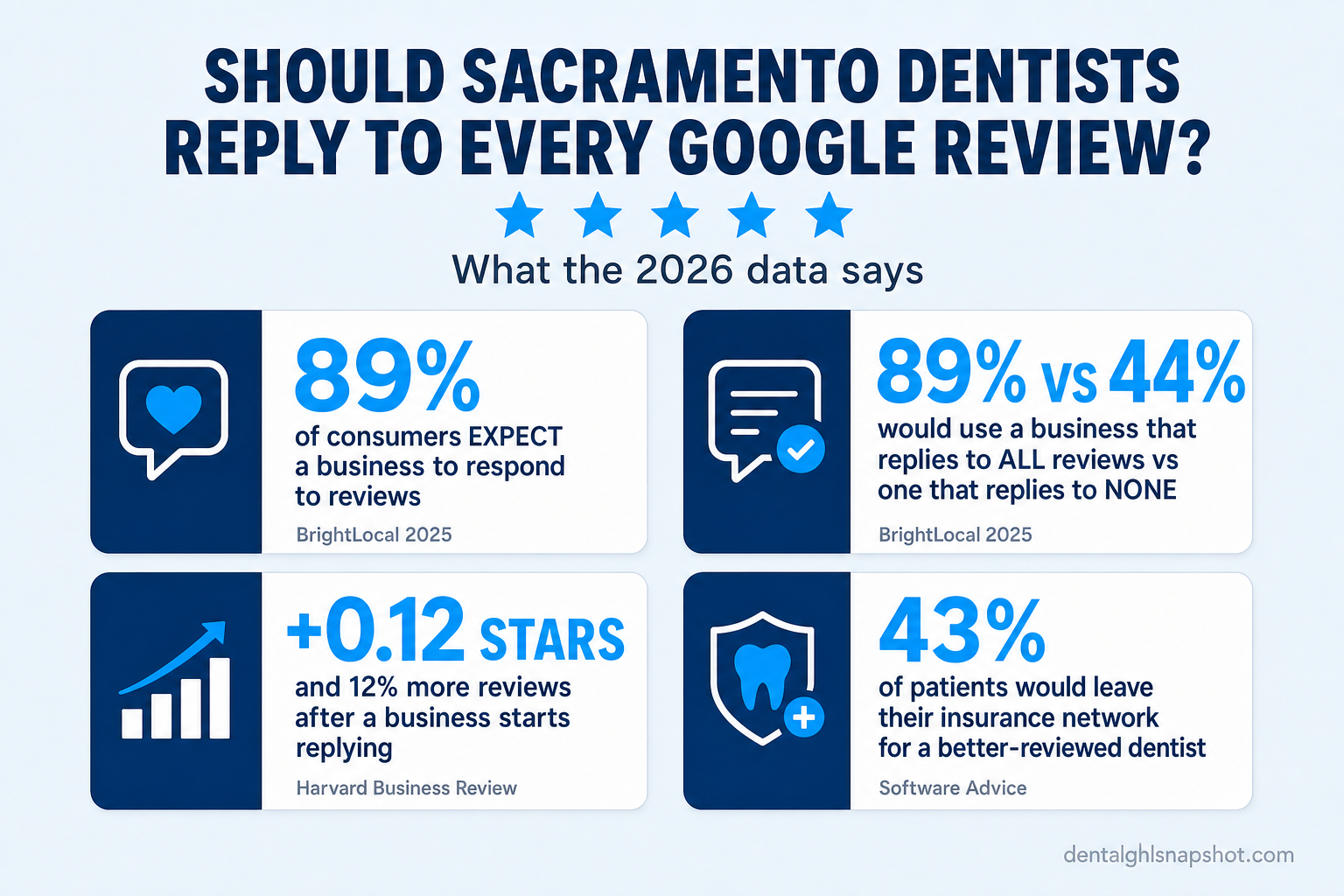
Table of contents
- Why Google reviews decide which Sacramento dentist patients pick
- Does replying to reviews actually help? What the data shows
- The Sacramento review-response gap — and why it’s an opening
- How to reply to positive reviews (without sounding like a robot)
- How to reply to negative reviews — the HIPAA trap dentists must avoid
- Reply to every review vs. leave them unanswered
- How Sacramento practices automate review responses
- FAQ
Why Google reviews decide which Sacramento dentist patients pick
Sacramento is a dense, competitive dental market — from Midtown and East Sac to Elk Grove, Roseville, and Folsom, a patient searching “dentist near me” sees a Google map pack of three practices and a wall of star ratings before they see a single website. That first screen is where the decision starts, and reviews dominate it.
The behavior is well documented. Patients now treat online reviews the way they once treated a friend’s referral, and the trust runs deep enough to override insurance: 43% of patients say they’d leave their insurance network to see a provider whose reviews were better than an in-network option (Software Advice). For a Sacramento practice, that means a strong, actively managed Google profile can pull patients away from the practice down the street — and a neglected one quietly hands them over.
Here’s the part most owners underestimate: patients don’t just count your stars, they read the room. They scroll your recent reviews to see how you handle feedback — especially the critical ones. A practice that answers thoughtfully looks like one that will answer them thoughtfully when they’re in the chair. That’s why response behavior, not just star count, shapes the choice.
Does replying to reviews actually help? What the data shows
It’s easy to assume a reply is a nicety with no measurable payoff. The research says otherwise — responding changes both how many reviews you get and what your rating becomes.
The clearest evidence comes from a large academic study covered by Harvard Business Review. Researchers Davide Proserpio and Giorgos Zervas analyzed tens of thousands of hotels and their review responses on TripAdvisor. When a business started responding to reviews, it received 12% more reviews and its average rating rose by 0.12 stars (Harvard Business Review, 2018). A tenth of a star sounds trivial until you remember platforms round to the nearest half-star — the difference between showing as 4.5 and 4.7 can be exactly this kind of movement, and it’s the movement that happens without asking anyone for a new review.
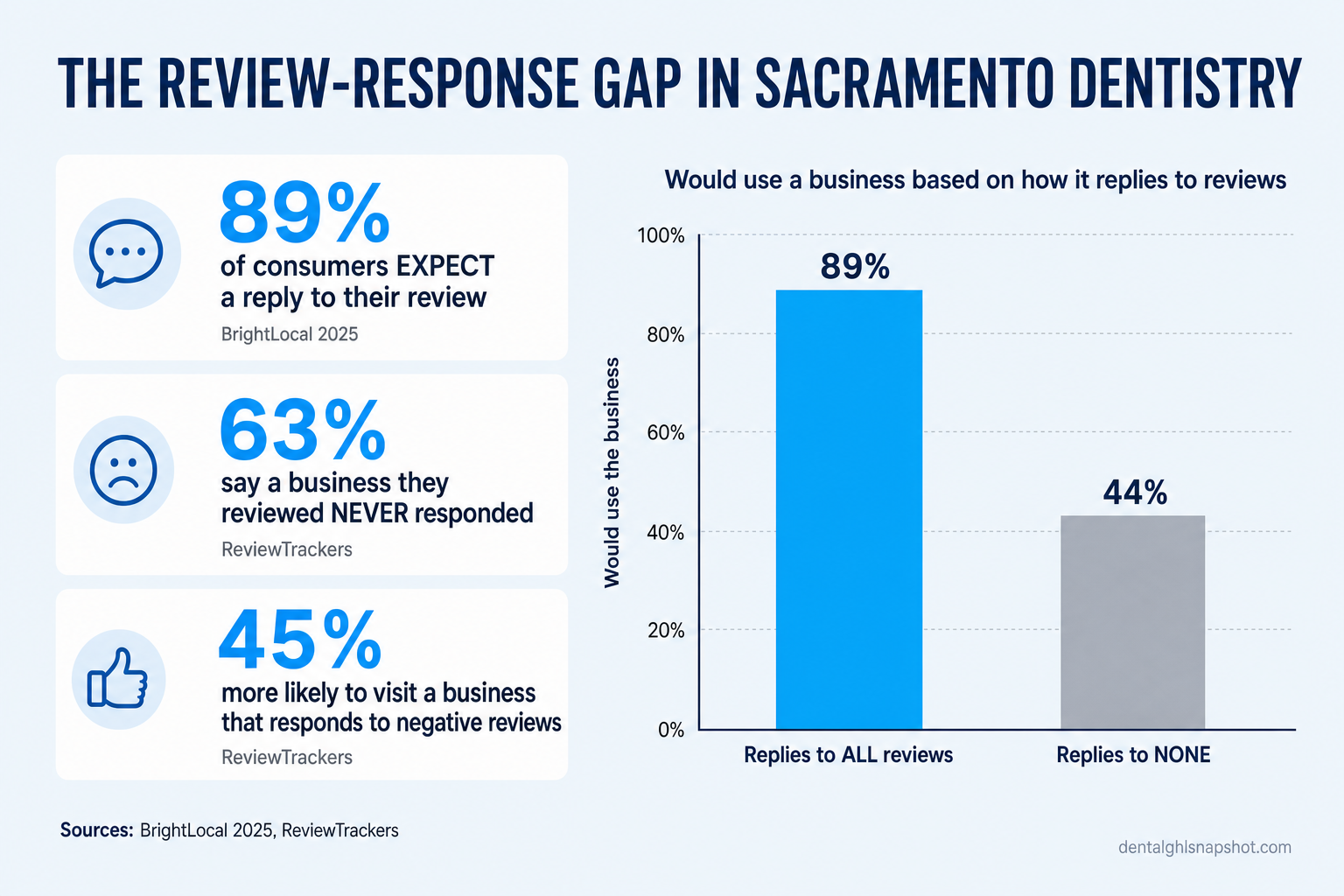
Then there’s consumer preference, which is lopsided. In BrightLocal’s 2025 survey, 89% of consumers said they’d use a business that responds to all of its reviews, compared with just 44% for a business that responds to none of them (BrightLocal, 2025). Silence roughly halves your appeal to the person reading.
Share of consumers who would use a business, by how it handles review replies. Source: BrightLocal Local Consumer Review Survey 2025.
Negative reviews are where responses earn the most. Counterintuitively, a well-handled negative can win the reader: 45% of consumers say they’re more likely to visit a business that responds to its negative reviews (ReviewTrackers). The one-star isn’t the deal-breaker — the unanswered one-star is. A calm, professional reply reframes the whole thread for the next prospective patient scrolling by.
The Sacramento review-response gap — and why it’s an opening
If responding works this well, why doesn’t everyone do it? Because doing it consistently is genuinely hard when you’re running a practice — and that gap is your competitive opening.
Consumers expect a fast, universal reply, but most businesses don’t deliver one. 89% of consumers expect businesses to respond to reviews, yet 63% say at least one business they reviewed never responded at all (BrightLocal, 2025; ReviewTrackers). Expectations have also sped up — a growing share of people now expect a same-day reply, and roughly four in five expect to hear back within a week (BrightLocal, 2025).
The expectation-versus-reality gap in review responses. Sources: BrightLocal 2025, ReviewTrackers.
For a Sacramento practice, that gap is money on the table. If most of your local competitors reply sporadically — or not at all — then being the practice that answers every review, quickly and in your own voice, is a durable differentiator that shows up on the exact screen where patients decide. You don’t have to out-spend anyone; you have to out-respond them.
How to reply to positive reviews (without sounding like a robot)
Positive reviews are the easy 80% — and the place practices waste the opportunity by pasting the same “Thanks for the 5 stars!” under every one. A good positive reply does three quick things:
- Thank them by name and reference something specific (the visit type, the team member, the milestone — “glad Dr. Nguyen got you comfortable for the crown”).
- Reinforce a keyword naturally. A reply that mentions “family dentistry in Sacramento” or “same-day crowns” gives Google fresh, relevant text tied to your profile — without keyword-stuffing.
- Invite the next step gently — a reminder that you’re there for their next cleaning, or that referrals are always welcome.
The goal is a reply that reads like a human wrote it for that patient, because the next prospective patient can tell the difference between a template and a person. This is the same “ask happy patients at the right moment” muscle behind review harvesting — see our Charlotte review-automation playbook and how practices earn more 5-star reviews for the front half of the loop.
How to reply to negative reviews — the HIPAA trap dentists must avoid
Negative reviews are where responses matter most and where dental practices carry a risk other businesses don’t: HIPAA. A restaurant can reply “Sorry your table wasn’t ready.” A dental practice cannot confirm that someone is even a patient, name a procedure, or discuss any treatment detail in a public reply — doing so can disclose protected health information, and the U.S. Department of Health and Human Services has penalized providers for exactly this kind of review response.
Done right, a negative-review reply isn’t damage control — it’s a demonstration. The reader sees a practice that stays calm, takes ownership, and protects privacy. That’s persuasive precisely because it’s under pressure, which is why responding to negatives is the single highest-leverage reply you’ll write.
Reply to every review vs. leave them unanswered
Here’s the honest side-by-side for a Sacramento practice weighing whether a universal response habit is worth the effort:
| Leave reviews unanswered | Reply to every review | |
|---|---|---|
| Consumer preference | 44% would still use you | 89% would use you (BrightLocal) |
| Rating trajectory | Flat; no lift from engagement | +0.12★ and ~12% more reviews on average (HBR) |
| Negative reviews | Last word goes to the upset patient | 45% more likely to visit when you respond (ReviewTrackers) |
| Local ranking | Missing a signal Google names | Reinforces a factor Google rewards (Google) |
| Effort (manual) | None — until you lose the patient | 5–15 min per review, every day, forever |
| Effort (automated) | — | Drafted + posted for you within hours |
The takeaway isn’t subtle: replying wins on every axis that affects new-patient flow. The only real cost is the manual effort — the daily, forever discipline of writing thoughtful, compliant replies while three phones are ringing. That’s the line item automation erases.
How Sacramento practices automate review responses
You don’t fix a consistency problem with more willpower — you fix it with a system that runs whether or not anyone remembers. That’s what GMB reply automation inside the Dental GHL Snapshot does. In practice, the loop looks like this:
- New review detected. A new Google review posts; the system picks it up automatically — nights and weekends included.
- Smart drafting. It drafts a reply matched to the sentiment and star rating: warm and specific for positives, calm and PHI-free for negatives, in your practice’s tone of voice.
- Guardrails for anything sensitive. Low-star or flagged reviews route to your office manager for a quick human check before anything goes public — so a HIPAA line is never crossed.
- Posted fast. Approved replies post within hours, hitting the response-speed window patients now expect — no review left sitting unanswered for weeks.
Because it’s part of the broader GoHighLevel automation system, the same platform is already harvesting new reviews from happy patients, so you’re compounding on both sides: more reviews coming in, every one of them answered. If you’d rather a person own it end to end, that’s a fit for a dental-trained assistant too — but the automation is what makes “reply to every review” realistic for a busy Sacramento office.
Frequently asked questions
Should a dental practice respond to every single Google review?
Yes. 89% of consumers expect businesses to respond to reviews, and they favor businesses that reply to all reviews over those that reply to none by 89% to 44% (BrightLocal, 2025). Responding also correlates with a higher rating and more reviews (Harvard Business Review), and Google names it as a way to improve local ranking (Google Business Profile Help). Reply to positives and negatives alike.
Does replying to Google reviews help my Sacramento practice rank higher?
It contributes. Google's guidance on improving local ranking explicitly includes managing and responding to reviews, alongside review quantity, quality, and recency (Google Business Profile Help). No one can guarantee a specific ranking, but responses are a signal Google rewards and a trust signal patients read — both feed visibility in the local map pack. See our local SEO guide for dentists for the full picture.
How do I respond to a negative dental review without violating HIPAA?
Never confirm the person is a patient or mention any treatment detail in a public reply — that can disclose protected health information. Keep it short and empathetic, apologize for the experience (not the care), and move it offline: 'We're sorry to hear this and want to make it right — please call our office manager at [phone].' Then handle specifics privately. HHS has penalized providers for disclosing PHI in review responses, so this rule is non-negotiable.
How fast do patients expect a reply to their review?
Faster than most practices manage. In BrightLocal's 2025 survey a growing share of consumers expect a same-day response and roughly four in five expect to hear back within a week (BrightLocal, 2025). Since reviews post at any hour, automation is the reliable way to hit that window — our GMB reply automation drafts and posts within hours, day or night.
Can review responses really be automated for a dental practice?
Yes — with human guardrails. Our GMB reply automation in the Dental GHL Snapshot detects each new review, drafts a reply matched to its sentiment in your voice, posts positives automatically, and routes sensitive or low-star reviews to your team for a quick human check before anything goes public. It pairs with review harvesting so new reviews keep coming in and every one gets answered.
Written by Marisa Velez, Dental Practice Growth Strategist based in Scottsdale, Arizona. Marisa has spent more than a decade helping general and cosmetic dental practices fill the hygiene column and turn one-time patients into lifelong recare, focusing on the numbers that actually move production — new-patient cost, no-show rate, and treatment acceptance. This article is educational and does not constitute legal, HIPAA-compliance, or clinical advice, or a guarantee of specific rankings, review outcomes, or revenue.
Related reading: How Charlotte Dental Practices Get More Google Reviews on Autopilot · Earn More 5-Star Reviews Without Begging · Local SEO for Dentists: Win the Map Pack · Get Found in AI Search · GoHighLevel for Dentists