
Short answer: For most San Antonio dental practices, the honest answer is off-the-shelf. A solid practice-management system plus a done-for-you GoHighLevel setup covers the vast majority of what you need to fill chairs, cut no-shows, and follow up fast — for a tiny fraction of a custom build. Custom software only earns its place at three specific breakpoints: (1) you run multiple locations or a growing group and need reporting or portals no product provides; (2) a workflow that drives real production has no off-the-shelf tool that fits it; or (3) staff are re-keying data between disconnected systems and it’s quietly eating hours. Building bespoke software typically runs $50,000–$400,000+ (industry estimates), while integration and data-silo problems already cost the average organization $6.8 million a year (MuleSoft / Salesforce). This is the framework: when to buy, when to build, and the middle path most Texas practices actually need.
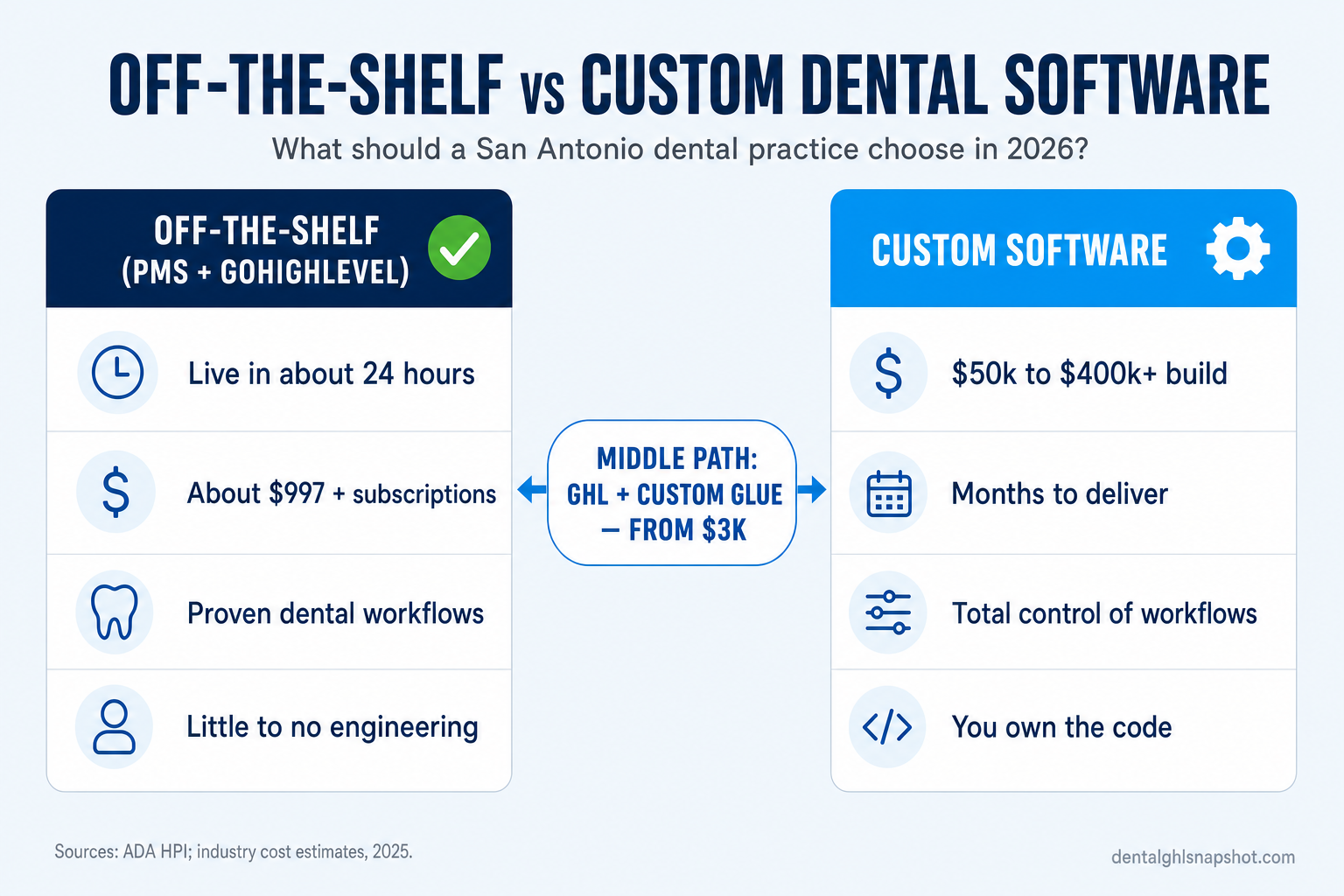
Table of contents
- Off-the-shelf vs custom software, defined for a dental practice
- The real question isn’t “which is better” — it’s “where’s the breakpoint”
- When off-the-shelf wins (most San Antonio practices)
- When custom software actually pays off — the three breakpoints
- The middle path most practices need: GHL + light custom glue
- The San Antonio angle: a big, fast-growing, competitive market
- A build-vs-buy decision checklist
- FAQ
Off-the-shelf vs custom software, defined for a dental practice
Before you can choose, it helps to be precise about what each term actually means in a dental context.
Off-the-shelf software is a product someone else built, that you configure rather than code. Your practice-management system (Open Dental, Dentrix, Eaglesoft, Curve) is off-the-shelf. So is GoHighLevel — and so is a pre-built dental snapshot that ships reminders, recall, review harvesting, an AI chatbot, and CRM workflows already wired up. You turn features on, adjust settings, and go live. You’re renting a proven platform.
Custom software is built for you, from the workflow up — a bespoke patient portal, a group-wide reporting dashboard, an AI agent trained on your intake process, or a piece of middleware that makes two systems talk. You own the result. You also own the timeline, the cost, and the maintenance.
The trap is treating this as a status contest — “real practices build custom.” They don’t. The best-run offices we work with are ruthless about buying everything they can and building only what they must. The question was never which is more sophisticated. It’s which one fits the job in front of you, at the price and timeline you can live with.
The real question isn’t “which is better” — it’s “where’s the breakpoint”
Off-the-shelf and custom sit at opposite ends of a single trade-off: speed and cost on one end, control and fit on the other.
Off-the-shelf gets you live in days for hundreds or low thousands of dollars, but you accept the product’s opinions about how a practice should run. Custom bends the software to your exact process — but you pay for every hour of that fit, in money and in months.
For the overwhelming majority of San Antonio practices, the off-the-shelf end of that trade-off is the right one, because dental front-office work is mostly standardized: someone requests an appointment, you respond fast, you confirm and remind, you recall them, you ask for a review, you follow up on treatment. Proven tools already do all of that. You don’t need a custom build to answer the phone faster.
The moment to consider custom is when you hit a breakpoint — a place where the standard product stops fitting and the misfit starts costing real money. The rest of this guide is about spotting those breakpoints honestly, so you neither overspend on a build you don’t need nor limp along on tools that are quietly capping your growth.
When off-the-shelf wins (most San Antonio practices)
If you’re a single-location general, cosmetic, or specialty practice with reasonably standard workflows, off-the-shelf almost always wins. Here’s why.
It’s a fraction of the cost. A pre-built GoHighLevel snapshot plus your existing PMS covers new-patient capture, speed-to-lead follow-up, reminders, no-show recovery, recall, reviews, and reporting — for roughly the price of a single custom feature’s discovery phase. Custom development, by contrast, typically runs $50,000 to $400,000 or more for a real platform, at U.S. rates of $50–$250+ an hour (industry estimates).
It’s live in a day, not a year. A snapshot installs within 24 hours. A custom build is measured in months — discovery, design, development, testing, deployment — during which your competitors keep booking patients.
The whole industry is moving your way. The market is shifting away from writing bespoke code toward configuring assembled systems. Gartner projects that by 2025, 70% of new applications will be built with low-code or no-code tools — up from less than 25% in 2020 (Gartner). A dental snapshot is exactly that philosophy applied to a practice: proven building blocks, assembled and tuned, instead of hand-coded from zero.
It’s proven. A snapshot deployed across hundreds of practices has already had its edge cases found and fixed. Your custom v1 hasn’t. For standard workflows, “boring and battle-tested” beats “bespoke and brand-new” almost every time.
When custom software actually pays off — the three breakpoints
Custom earns its cost at specific, recognizable moments. If none of these describe you, you probably don’t need it yet. If one or more do, it’s time to talk to a developer.
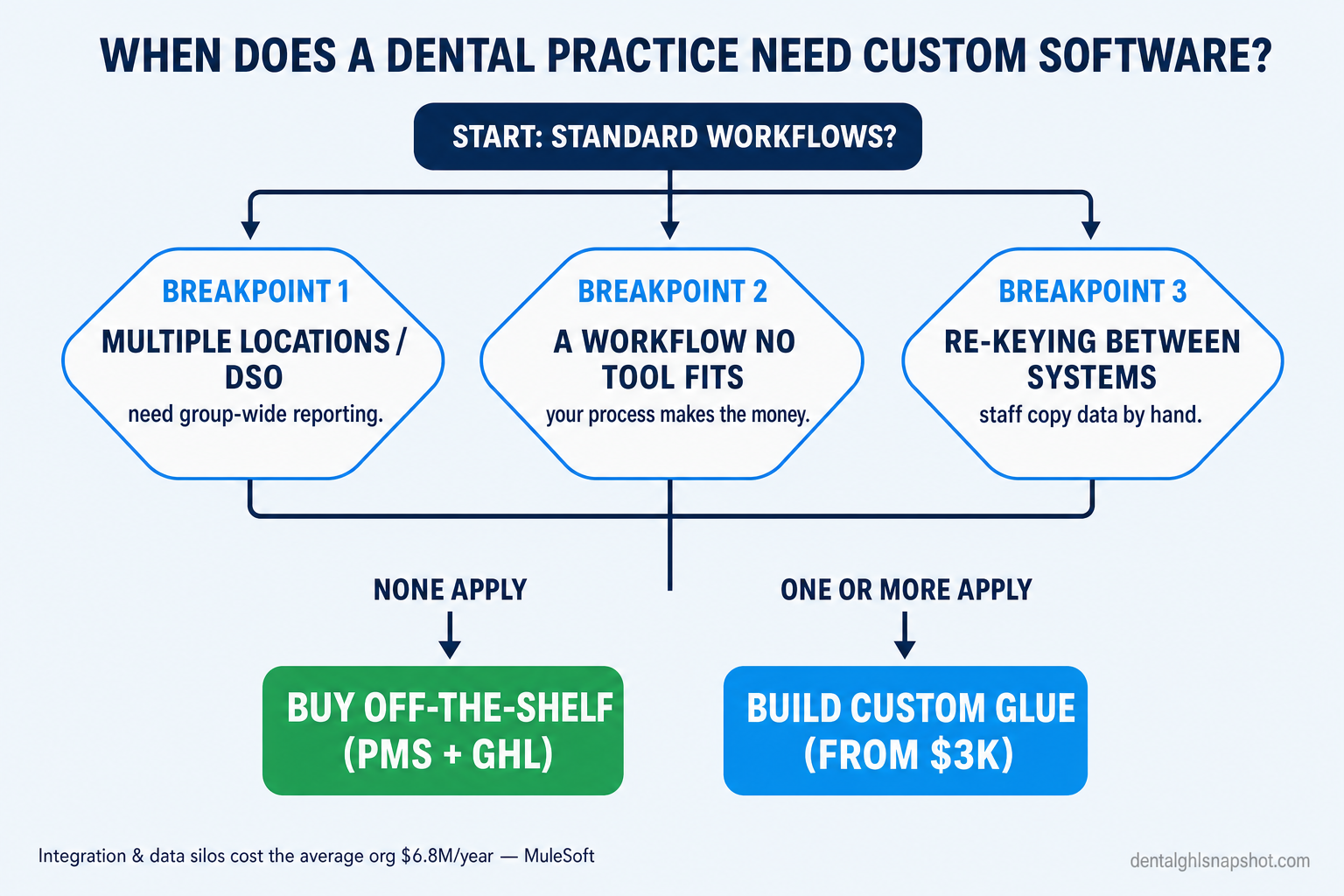
Breakpoint 1: You’re scaling to multiple locations or a group
The single biggest driver of custom software in dentistry right now is consolidation. DSO affiliation has climbed steadily — from 8.8% of U.S. dentists in 2017 to about 16% in 2024, and among dentists fewer than ten years out of school it’s roughly 27% (ADA Health Policy Institute).
Share of U.S. dentists affiliated with a Dental Service Organization (DSO), 2017–2024. Source: ADA Health Policy Institute.
Off-the-shelf tools are built for one practice at a time. The moment you run two, three, or ten locations, you need answers a single-office product can’t give: production by provider across locations, recare compliance and hygiene fill-rate rolled up for the group, new-patient source and cost compared site by site. A custom reporting dashboard that pulls from every location’s PMS and GHL into one owner’s-eye view is often the first custom build a growing San Antonio group commissions — and it pays for itself the first time it catches an underperforming location.
Breakpoint 2: A money-making workflow has no tool that fits
Sometimes the way you make money doesn’t match how any product thinks. A practice with an in-house membership plan, a surgical-referral network, a same-day CEREC funnel, or an unusual financing process can spend more time fighting a generic tool than the tool saves. When bending your process to fit the software starts costing production, building the process you actually run becomes the cheaper option — a custom patient portal, an intake agent, or a workflow engine shaped to your practice instead of the average one.
Breakpoint 3: Staff are re-keying data between disconnected systems
This is the quiet one, and it’s everywhere. Every tool you add that doesn’t talk to the others creates a seam where a human has to copy data across by hand. The cost is real and measurable: integration challenges and data silos cost the average organization $6.8 million a year in lost productivity, and only about 28% of an organization’s applications are actually connected to each other (MuleSoft / Salesforce Connectivity Benchmark).
It shows up in your own building as time your team never gets back. The average knowledge worker loses close to 9.3 hours a week — nearly a fifth of the workweek — just searching for and gathering information (McKinsey Global Institute), and burns roughly 209 hours a year on duplicated work while toggling among about ten apps (Asana Anatomy of Work).
How the average knowledge worker’s week splits — only ~39% goes to core role work; nearly one hour in five is spent just searching for information. Source: McKinsey Global Institute.
When your front desk is re-typing the same patient into the PMS, the CRM, the booking widget, and a spreadsheet, that’s the seam. The fix usually isn’t a full custom platform — it’s a targeted integration that makes the systems you already own pass data automatically. Which brings us to the option most practices actually need.
The middle path most practices need: GHL + light custom glue
Here’s the part the “buy vs build” framing misses: it’s rarely all-or-nothing. The highest-ROI move for most San Antonio practices is to keep GoHighLevel and your PMS off-the-shelf, then commission only the small custom pieces you’re missing.
That’s “light custom glue” — targeted development on top of proven platforms rather than a ground-up rebuild:
- Integrations that kill the re-keying: a PMS ↔ GoHighLevel sync so a booking or status change flows automatically, a Dentrix/Open Dental connector, or an insurance-eligibility portal that pulls benefit status into the contact record instead of a manual login.
- Group dashboards: the DSO/multi-location reporting view from Breakpoint 1, built once on top of the data you already have.
- Call tracking and attribution: piping VoIP call data and outcomes into GHL so you can finally see which marketing actually books patients.
- AI agents: a custom intake or AI receptionist agent tuned to your exact scripts and services.
This is the sweet spot: you get custom fit exactly where it moves production, without paying for a $200k platform to replace tools that already work. It’s also far faster — fixed-price integration and dashboard builds are measured in weeks, and start at a fraction of a full custom platform. If you’re already on another system, a clean migration to GoHighLevel is often step one.
Off-the-shelf vs middle path vs fully custom
| Plan | Off-the-shelf (PMS + GHL snapshot) | GHL + light custom glueRecommended | Fully custom software |
|---|---|---|---|
| Price | ≈ $997 + subscriptions | From $3K, fixed-price | $50k–$400k+ build |
| Feature 1 | Live in about 24 hours | Everything off-the-shelf — plus what you're missing | Bespoke patient portals & platforms |
| Feature 2 | Proven dental workflows out of the box | Custom integrations (PMS ↔ GHL, insurance, VoIP) | Total control of every workflow |
| Feature 3 | Reminders, recall, reviews & AI chat included | Group / DSO reporting dashboards | You own the code and the IP |
| Feature 4 | Little to no engineering required | Weeks to deliver, not months | Months to build, plus ongoing maintenance |
| Feature 5 | You configure it — you don't own the code | Keep GHL; add only the custom you need | Right for unique, large-scale needs |
We build both ends of this spectrum — custom software (patient portals, group dashboards, AI agents) with fixed-price quotes from $3K, and GoHighLevel development for the integrations and dashboards that extend the platform. Both are delivered fast with Claude Code, carry a 30-day bug-fix warranty, and leave you owning the code.
The San Antonio angle: a big, fast-growing, competitive market
Why does getting this decision right matter more in San Antonio than in a sleepy market? Because the margin for wasted time and money is thinner here.
Texas is one of the most competitive dental markets in the country. The state has 16,522 active dentists — second only to California (ADA HPI, via Becker’s), and supply sits at about 54.2 dentists per 100,000 residents, just under the U.S. average of 59.5 (ADA HPI). Patients have real choice, and the practice with tighter systems answers first.
San Antonio is big and growing fast. It’s the 7th-largest city in the United States, with about 1.53 million residents, and it added nearly 24,000 people in a single year — a 1.5% gain, one of the largest raw increases in the nation (U.S. Census Bureau). Every one of those newcomers eventually searches for a dentist with no existing loyalty — the practice that captures and responds first wins them.
That’s where systems, not software status, decide the outcome. The classic Harvard Business Review audit of 2,241 companies found the average business takes 42 hours to respond to a web lead and 23% never respond at all — yet contacting a lead within the first hour makes you about 7× more likely to qualify it (HBR). You don’t need custom software to hit that window; you need a working off-the-shelf follow-up system. Build custom only where it removes a bottleneck that the standard system can’t.
Staffing makes the math sharper still. Front-office labor is the #1 challenge dental practices report, with the vast majority of open administrative roles rated hard to fill (ADA HPI). When you can’t easily add people, every hour your systems don’t automate is an hour you can’t get back — which is exactly the calculus behind buying proven tools and building targeted glue instead of hiring around broken workflows. When you do need hands to run it, a dedicated GoHighLevel VA is usually cheaper than another front-desk salary.
A build-vs-buy decision checklist
Run your situation down this table. If you land mostly in the left column, buy. If real money sits in the right column, it’s time to scope a build.
| Your situation | Off-the-shelf (PMS + GHL) | Custom software |
|---|---|---|
| Single location, standard workflows | ✅ Best fit — fastest, cheapest | ❌ Overkill |
| 2+ locations / a growing group or DSO | ⚠️ Reporting gaps appear | ✅ Centralized dashboards pay off |
| A money-making workflow no tool supports | ❌ You bend your process to the tool | ✅ Build the process you actually run |
| Staff re-key data between 3+ systems | ⚠️ Hidden labor cost | ✅ Integration removes the re-keying |
| Tight budget, results needed in weeks | ✅ Live in ~24 hours | ❌ Months and $50k+ |
| You want to own the code and IP | ❌ You rent the platform | ✅ You own it outright |
Most practices will see a mix — and that’s the signal for the middle path: buy the platform, build the one or two pieces where the right column is clearly true.
Frequently asked questions
Frequently asked questions
Is off-the-shelf or custom dental software better for a San Antonio practice?
For most single-location practices, off-the-shelf is better — a practice-management system plus a pre-built GoHighLevel snapshot covers new-patient capture, reminders, recall, reviews, and follow-up for a fraction of a custom build, and it's live in about 24 hours. Custom software is 'better' only at specific breakpoints: multi-location or DSO reporting, a money-making workflow no product supports, or manual re-keying between disconnected systems. It's a fit question, not a status contest.
How much does custom dental software cost to build?
Building a full custom platform from scratch typically runs $50,000 to $400,000 or more, at U.S. developer rates of $50–$250+ per hour (industry estimates, 2025). That's why most practices start off-the-shelf and add only targeted custom pieces. Our custom software and GHL development builds are fixed-price from $3K, so you know the number before you commit.
When is it worth building custom software instead of using GoHighLevel?
When you hit a breakpoint GoHighLevel and your PMS can't reach on their own: you're running multiple locations and need group-wide reporting; you have a unique, revenue-driving workflow no product fits; or your team is re-typing the same data across three or more systems. Integration and data-silo problems cost the average organization about $6.8M a year (MuleSoft) — when that friction is real in your building, custom glue pays for itself.
What is the 'middle path' between off-the-shelf and custom?
Keep GoHighLevel and your PMS off-the-shelf, then commission only the small custom pieces you're missing — a PMS ↔ GHL integration, a group/DSO dashboard, call tracking, or an AI agent tuned to your scripts. You get custom fit exactly where it moves production, in weeks rather than months, without paying for a full platform rebuild. It's the right answer for most growing practices.
Do I lose my data or workflows if I go custom later?
No — if it's done right. A clean migration into GoHighLevel moves contacts, pipelines, conversations, and calendars with nothing left behind, and custom builds sit on top of that data rather than replacing it. Starting off-the-shelf actually makes a future custom build easier, because your workflows are already documented and your data is already clean and centralized.
Who owns the custom software you build?
You do. Every custom build we deliver is yours — full ownership of the code and IP, deployable to your own infrastructure, with a 30-day bug-fix warranty included. For ongoing maintenance or feature additions you can hire a dedicated dental GHL VA or stay on an hourly retainer; you're never locked into us to keep your own software running.
About the author
Devin Okafor is a GoHighLevel Automation Specialist based in Austin, Texas. He builds and ships GoHighLevel snapshots, integrations, and custom software for dental practices and the agencies that serve them — and he’s opinionated about buying everything you can and building only what you must. His posts pull back the curtain on how these systems are built and why each one earns its place.
Related posts
- Custom Dental Software in Los Angeles: The Real Cost of Duct-Taping Generic Tools in 2026
- How to Connect Your Dental Practice Software to GoHighLevel in Houston
- How to Migrate Your Atlanta Dental Practice to GoHighLevel (Without Losing Data or Downtime)
- GoHighLevel for Dentists: The Complete 2026 Guide to Automating a Dental Practice
- Dental CRM: What It Is, Why Your Practice Needs One, and How to Choose in 2026