

It is renewal month, and the Eaglesoft number in front of you is bigger than you remembered. The Patterson rep wants a call before quoting the new one. The dentist asks what the practice actually pays for its software every year, all in, and you are not sure, because the cost is spread across a license you bought years ago, a monthly Service Club fee, a texting add-on, and the IT guy who babysits the server. You run the software, so you get to figure it out. Here is the whole bill.
Short answer: Eaglesoft is a capable, deeply entrenched practice management system, and one of the hardest in the industry to price before you sign. Patterson does not publish a number. The traditional model is a one-time license reported around $6,000 to $12,000 or more, plus a monthly support plan near $300 to $500, plus per-workstation costs and add-ons (CostBench). Patterson is now steering practices toward a subscription instead. Either way, the sticker is maybe half of what you spend in year one. Below is every line item, three budget scenarios, and the one competitor that prints its price.
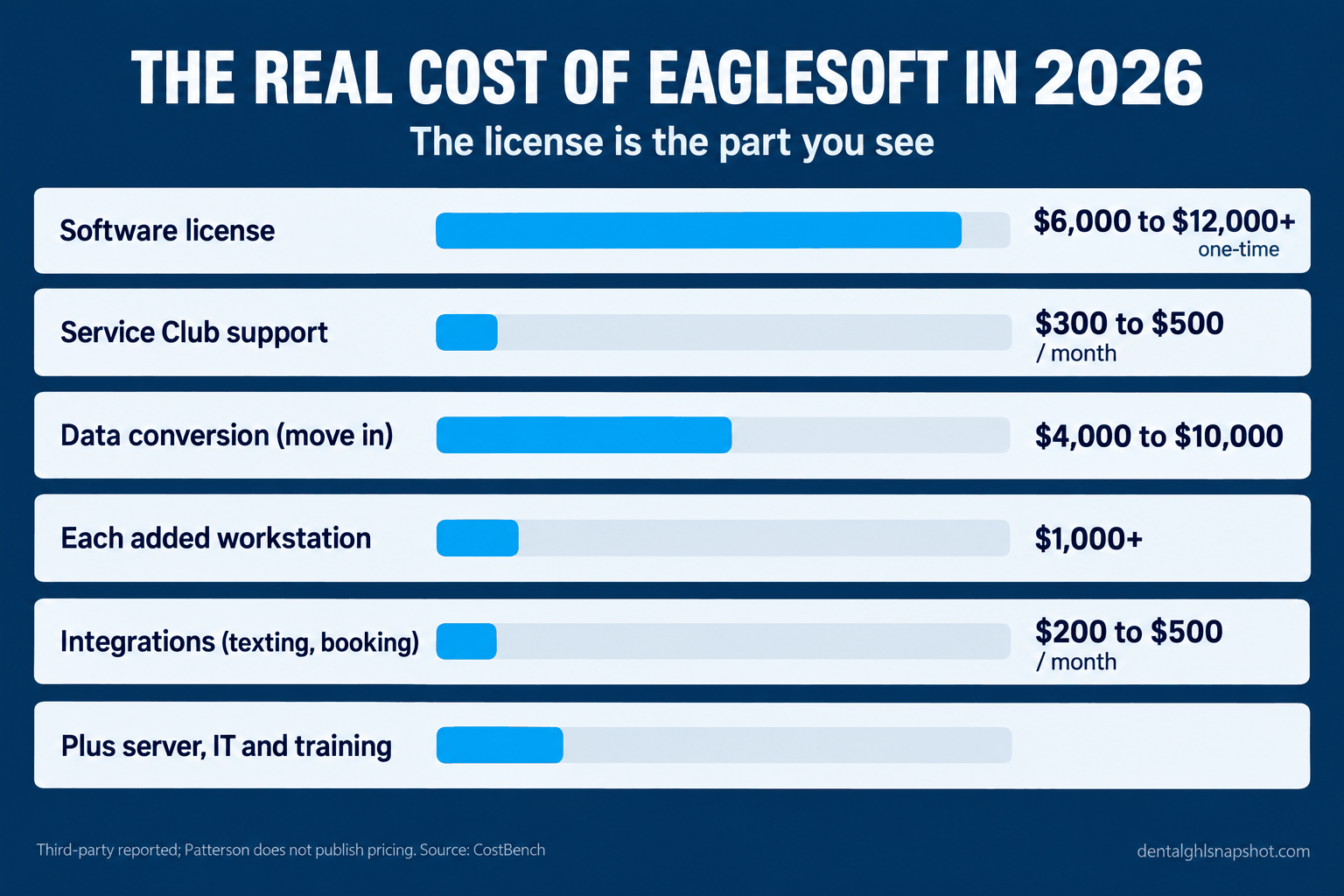
Table of contents
- Why you cannot find an Eaglesoft price
- The eight costs that make up the real bill
- Eaglesoft vs Open Dental at a glance
- What it actually costs: three scenarios
- The compliance line nobody quotes you
- Steal this: the quote-extraction script and switch checklist
- Objections, answered honestly
- FAQ
Why you cannot find an Eaglesoft price
Start with the thing that makes this hard: you cannot look up what Eaglesoft costs. Patterson sells it through a demo-and-quote process, so the price depends on your size, your rep, and the hardware you buy at the same time (Software Advice). That is not an accident. Opaque pricing lets the seller anchor you to the software’s value before you see a number, and keeps you from putting two vendors side by side on a spreadsheet.
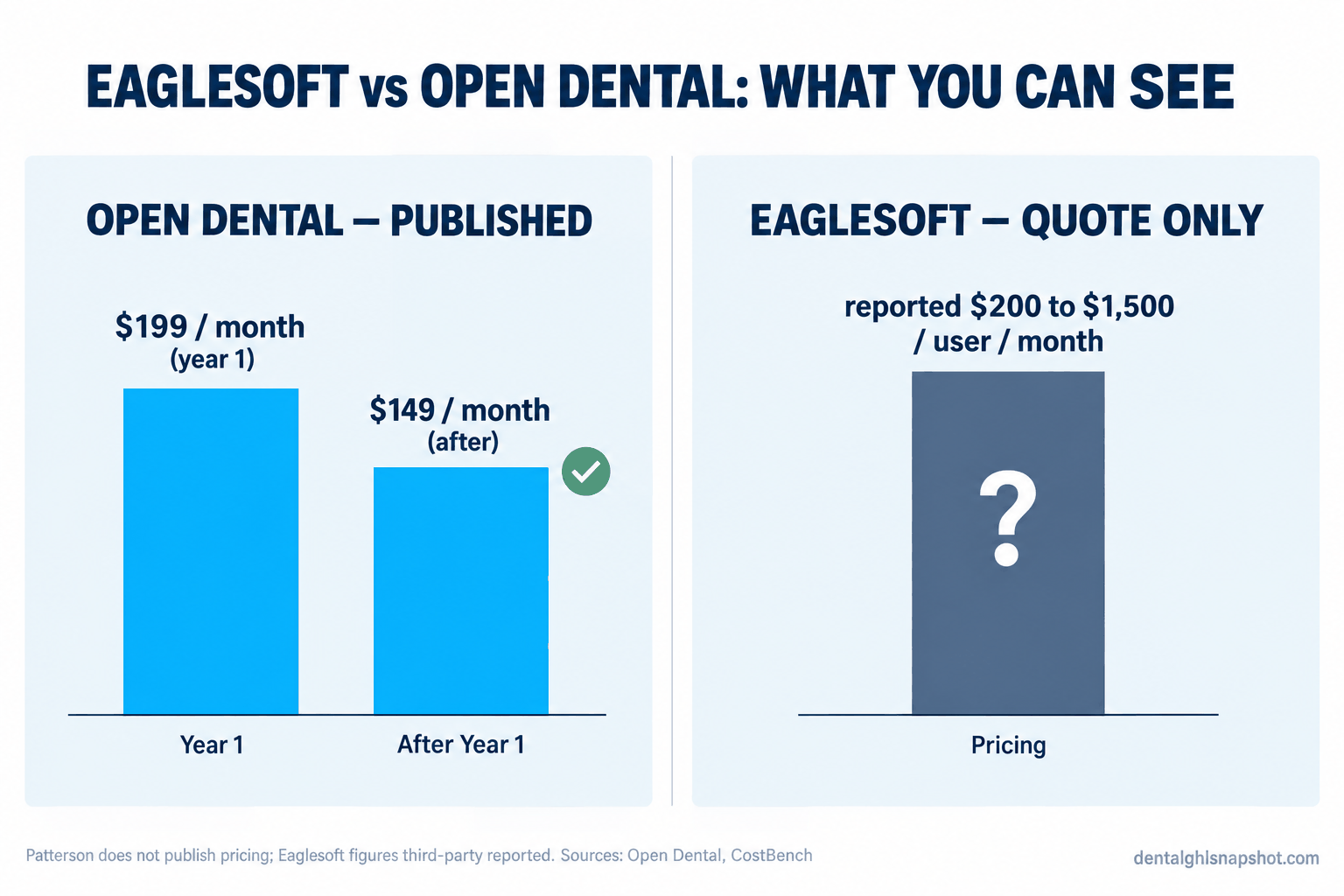
The numbers that do circulate come from review sites and user reports, not Patterson. They range widely: one aggregator lists plans from roughly $200 to $1,500 per user per month, which tells you less about the real cost than about how little public data exists (CostBench). When third-party sites disagree by that much, the lesson is not “find the right number.” It is “get your own quote in writing, itemized, and compare it against a vendor that prints its price.”
This matters more in a soft year. Roughly one in three dentists reported they were not busy enough in early 2026, per the ADA Health Policy Institute (ADA HPI). An unpredictable software bill is the last thing a front office needs when production is down.
The eight costs that make up the real bill
1. The license or subscription itself
Eaglesoft has historically been sold as a perpetual license you buy once, reported around $6,000 to $12,000 or more (CostBench). Patterson is now steering practices toward a monthly subscription instead, reported in the few-hundred-a-month range. The perpetual model front-loads a big one-time cost then bills you monthly to keep it alive; the subscription spreads it out but never stops, and over three to five years can easily cost more. Either way, treat it as the deposit, not the price.
How this breaks: The quote is usually for a base configuration. The rep knows you will add workstations, modules, and support, so the headline is the smallest honest number they can show you. Make them quote the five-year total for both models.
2. Per-workstation and per-provider scaling
Eaglesoft is priced per machine and per user, so every front-desk computer, every operatory, and every added provider pushes the cost up. Reported figures put additional workstations at upwards of $1,000 each (CostBench).
How this breaks: Per-seat pricing looks reasonable at three machines and ugly at twelve. If you plan to add an operatory, run the cost at next year’s size, not today’s.
3. The Service Club support plan
Here is the recurring fee practices forget when they say “we already own Eaglesoft.” The Service Club, reported around $300 to $500 a month, keeps the updates, patches, and phone support coming. It is a permanent line item, roughly $3,600 to $6,000 a year, that never shows up on the license quote.
How this breaks: Offices treat the license as “paid off” and forget the support plan is forever. To compare Eaglesoft fairly, add twelve months of Service Club to the license, or you are comparing half a price to a whole one.
4. Data conversion: the cost to move in
To start on Eaglesoft, your patient records, ledgers, and schedule have to be converted from your old system: a reported $4,000 to $10,000 one-time project and one of the most commonly underestimated items in the purchase (CostBench). The bigger and older your database, the higher it climbs.
How this breaks: Conversions fail quietly. A dropped ledger balance or a mismatched recall date surfaces weeks later as an angry patient or a missed hygiene visit. Never go live before you check a record-by-record sample.
5. Server and IT, because it lives in your office
Eaglesoft is traditionally on-premise, so it runs on a server in your building that is yours to buy, back up, secure, and replace, usually with an IT vendor on retainer. None of that is on the software quote.
How this breaks: The day the server dies, the practice stops. On-premise software puts backup and disaster recovery squarely on you. Price an IT plan and a backup as part of the decision, not a surprise later.
6. Integrations and eServices add-ons
Patient texting, automated reminders, online booking, e-prescribing, and payments are usually not in the base product. They are add-on subscriptions, reported at $200 to $500 a month for third-party integrations (CostBench). The features that fill your schedule live outside the core license and bill separately.
How this breaks: Practices assume the PMS “does texting” and find the real tool is a paid add-on with its own contract. Ask which patient-facing features are included and which bill separately.
7. Training and implementation
Implementation and onboarding are upfront fees not folded into the license, and easy to leave off the first quote. A system nobody is trained on reverts to sticky notes within a month.
How this breaks: Team adoption sinks more rollouts than the software ever does. If you switch, budget hands-on training and name one internal champion, or you paid for a product the front desk quietly refuses to use.
8. The export-out cost, and proprietary lock-in
This is the one almost nobody asks about on the way in, and the one that hurts most on the way out. Eaglesoft stores some data, imaging especially, in proprietary formats, and reports note export options can be limited (CostBench). Leaving later can require a vendor-assisted conversion, which is a big reason entrenched offices stay put even when the bill stings.
How this breaks: Lock-in feels abstract until the day you want to switch and learn your x-rays do not move cleanly. Get your export rights, imaging included, in writing before you sign.
Eaglesoft vs Open Dental at a glance
The industry gives you one PMS that publishes its price: Open Dental. Use it as the benchmark on your demo call.
| Eaglesoft (Patterson) | Open Dental | |
|---|---|---|
| Published price | No, quote only | Yes, on the website |
| Entry cost | ~$6k–$12k+ license, or subscription (reported) | $199/mo, then $149/mo per location |
| Support | Service Club ~$300–$500/mo (reported) | Phone, chat, email included in the fee |
| Providers covered | Priced per user and workstation | Up to 3 dentists, then $20/mo each |
| Deployment | On-premise server you own | Self-host or Open Dental Cloud |
| Data conversion in | ~$4k–$10k reported | A conversion project either way |
| Data out | Proprietary imaging, export can be limited | You hold the MySQL database, open API |
| Best for | Offices already deep in Patterson hardware | Cost-conscious, portability-minded practices |
Sources: Open Dental fees, Eaglesoft hidden costs (CostBench), Eaglesoft vs Open Dental (CostBench).
The chart below is the honest version of a price comparison.
Approximate monthly software cost per location. Open Dental figures are published; Eaglesoft figures are a conservative third-party reported range (perpetual-license and workstation costs are extra). Sources: Open Dental, CostBench.
What it actually costs: three scenarios
Ranges do not help when you are building next year’s budget. Here is the year-one shape for three practice sizes. Your Eaglesoft quote will differ, which is exactly why the transparent column matters: it is a fixed point to push the quote toward.
Estimated year-one software cost by practice size
| Plan | Solo (1 dentist, 2 ops) | Mid (3–4 providers, 5 ops)Recommended | Multi-location (3 sites) |
|---|---|---|---|
| Price | Quote vs ~$2,400 | Quote vs ~$2,600 | Quote vs ~$5,400 |
| Feature 1 | Eaglesoft: license + ~12 mo Service Club + conversion | Eaglesoft: per-workstation + per-user costs stack | Eaglesoft: quoted per site, per server, per user |
| Feature 2 | Open Dental: ~$2,388 yr one, ~$1,788 after, published | Open Dental: ~$2,388 + ~$240/yr for a 4th dentist | Open Dental: ~$149/mo x 3 = ~$5,364/yr after yr 1 |
| Feature 3 | Open Dental covers all 3 dentist slots free | Per-seat pricing is the swing factor on Eaglesoft | A flat fee vs a custom enterprise contract |
The Open Dental column turns an abstract “it depends” into a number you can hold a quote against: $199/mo per location year one, $149/mo after, up to three dentists, $20/mo per additional dentist, support and updates included (Open Dental). When your Patterson quote lands, the question is simple: what am I getting for the premium over a product that prints $149 a month?
The compliance line nobody quotes you
HIPAA is the hard line, and it does not care which PMS you run. The practice owns the protected health information, so two rules hold on any system.
First, any vendor that touches patient data needs a signed Business Associate Agreement: your PMS, your imaging host, your backup provider, and any communication tool you bolt on. A BAA is not optional paperwork, it is what puts the vendor on the hook with you (HHS). Eaglesoft on an in-office server also puts backup and breach responsibility largely on you.
Second, this is where offices slip: a text or email reminder may carry the appointment date, time, provider name, and a reschedule link, and nothing more. No procedure names, no balances, no treatment details, because a lock screen is a public screen. That rule is identical on every system, and the most common violation we see. The full playbook is in the dental patient texting compliance guide.
How this breaks: Practices assume the software is “HIPAA compliant” and stop thinking. Compliance is shared: the vendor provides safeguards; you sign the BAA, configure the settings, train the team, and keep protected information out of plain messages.
Steal this: the quote-extraction script and switch checklist
Because Patterson will not publish a price, you have to extract one. Use this on the sales call, close to word for word, with Open Dental’s published $149 a month as your anchor.
“Before we go further, I need these in writing so I can compare fairly against Open Dental’s published price. One: the all-in cost for [X providers] and [Y operatories], license and subscription quoted separately. Two: the Service Club or support fee as an annual number. Three: the one-time data conversion and training fee. Four: the per-workstation cost for our machines. Five: which patient-facing features (texting, reminders, online booking) are included versus add-on subscriptions, with prices. Six: what a complete data export, imaging included, costs if I ever leave. Can you email those six, itemized, today?”
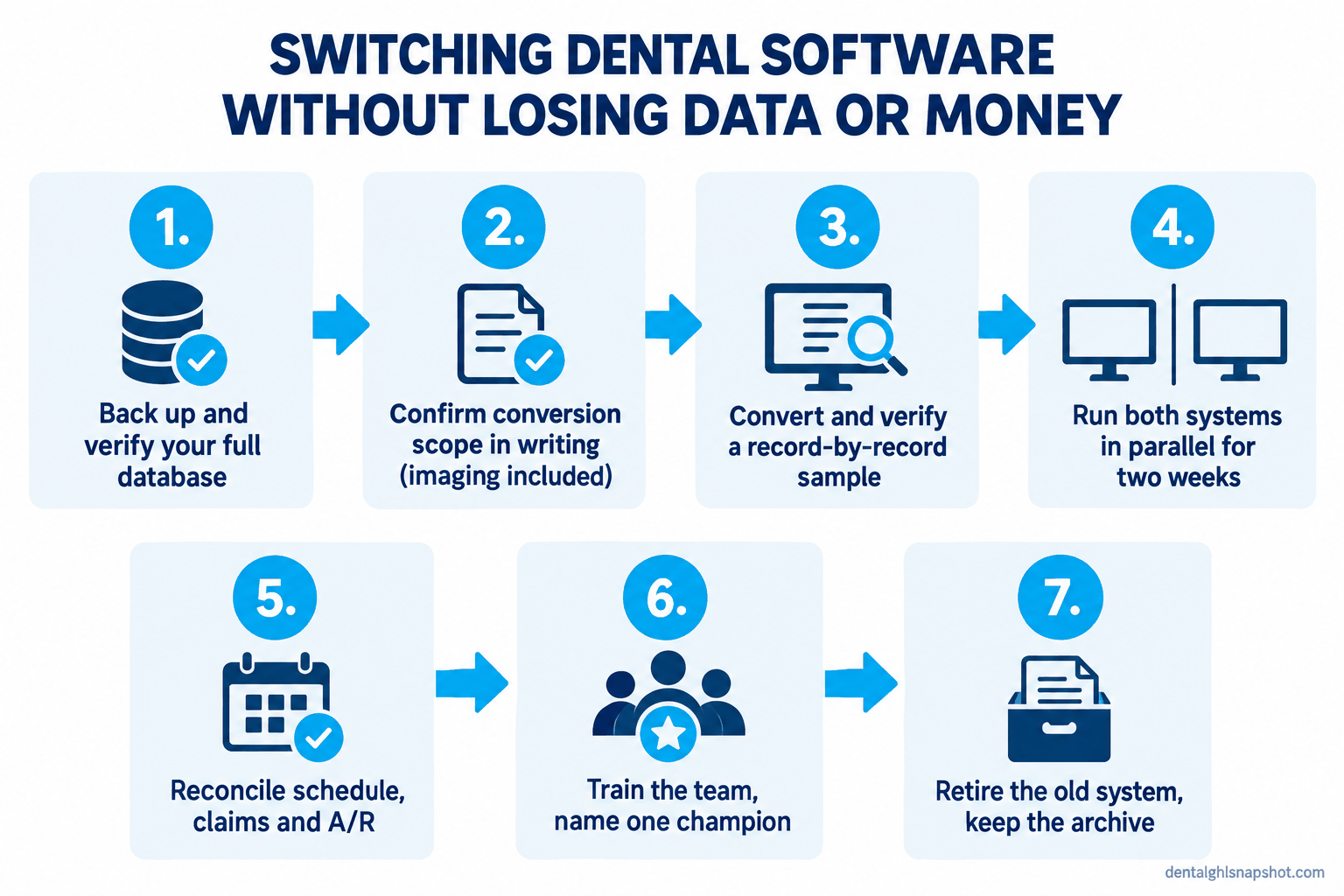
If the rep will not put those in writing, that is your answer about how the relationship will go. When you switch onto or off of Eaglesoft, run it as a project, not a weekend.
- Export and back up a full, verified copy of your current database before anyone touches anything.
- Confirm the conversion scope in writing: imaging, ledgers, A/R, and recall dates, not just demographics.
- Convert and verify on a record-by-record sample that patients, balances, imaging, and recall dates came across.
- Run both systems in parallel for at least two weeks so a conversion gap surfaces while the old system is live.
- Reconcile the schedule, open claims, and A/R, then train the team and name one internal champion.
- Retire the old system only after a clean reconciliation, and keep the archive somewhere you can reach for years.
Objections, answered honestly
“We already own Eaglesoft. Isn’t it basically free now?” No, and this is the most expensive misreading of the bill. You own the license, but the Service Club fee, reported at $300 to $500 a month, is permanent, with add-ons and IT on top. Add twelve months of support before you call it cheap.
“Isn’t Eaglesoft worth the premium because it is the standard?” Sometimes. If your team knows it cold, your Patterson imaging is tied to it, and the all-in quote is reasonable against the benchmark, staying is rational. The point here is not “switch,” it is “know the full number, then negotiate from facts.”
“Why compare it to Open Dental specifically?” Because Open Dental is the one major PMS that publishes its price, which makes it the only honest measuring stick in the category (Open Dental). We did the head-to-head on the other incumbent in Dentrix vs Open Dental and the broader market in what dental software actually costs in 2026.
The bottom line
Back to renewal month and the dentist waiting for a number. The honest answer: Eaglesoft is solid software with a genuinely hard-to-pin price, and your real annual cost is the license or subscription plus the Service Club plus workstations plus add-ons plus the IT that keeps the server alive. Add all of it, hold it against Open Dental’s printed $149 a month, and ask what the premium buys you. “A system my team knows cold and imaging I am invested in” is a fair reason to stay and negotiate hard. “I am not sure” is itself the finding.
Whichever PMS you run, remember the part none of them do: it will not text the no-show, answer the phone at lunch, or ask the happy patient for a review. That is the layer that fills the schedule, and it is a separate decision. If you want it handled for you, see what the done-for-you system includes.
Keep reading: Dentrix vs Open Dental in 2026, what dental software actually costs in 2026, and the best Weave alternatives for dental practices.
Frequently asked questions
How much does Eaglesoft cost in 2026?
Patterson does not publish Eaglesoft pricing, so every figure is third-party reported. The traditional model is a one-time license around $6,000 to $12,000 or more plus a monthly Service Club support fee near $300 to $500, with per-workstation and add-on costs on top. Patterson is also moving practices toward a monthly subscription. Get an itemized written quote to know your real number.
Why won't Patterson publish an Eaglesoft price?
Eaglesoft is sold through a demo-and-quote process, so the price depends on your size, your rep, and any hardware you buy at the same time. Quote-only pricing lets the vendor anchor you to the software's value before showing a number and makes side-by-side comparison harder, which is why a published-price benchmark like Open Dental matters.
What are the hidden costs of Eaglesoft beyond the license?
The recurring Service Club fee (reported $300 to $500 a month), per-workstation costs (upwards of $1,000 each), data conversion ($4,000 to $10,000 reported), server and IT for the on-premise setup, patient-facing add-ons like texting and online booking ($200 to $500 a month), and training. The license is often the smallest part of the bill.
Is Eaglesoft or Open Dental cheaper?
Open Dental is the more transparent and usually lower-entry option, publishing $199 a month per location year one and $149 after, for up to three dentists. Eaglesoft is quote-based, so a direct comparison is hard, but once you add the Service Club, workstations, and add-ons, the all-in Eaglesoft cost is typically higher and far less predictable.
Can I move my data off Eaglesoft to another system?
Yes, but it is a conversion project, not a one-click export, and Eaglesoft stores some data, imaging especially, in proprietary formats that can limit a clean export. Negotiate your right to a complete export, imaging included, in writing before you sign, then run both systems in parallel and reconcile before retiring Eaglesoft.
Does Eaglesoft handle patient texting and recall marketing?
Only at a basic level. Full two-way texting, missed-call recovery, review requests, and lifecycle recall usually come from paid add-ons or a separate tool that connects to the PMS and bills on its own. Eaglesoft is a system of record for charting, billing, and scheduling, not a complete communication layer.