

Short answer: In a fast-growing, competitive market like Austin — Texas already runs 54.2 dentists per 100,000 residents (ADA Health Policy Institute, 2024), and metro Austin adds thousands of new households a year — the practices that win the next new patient are the ones patients can actually watch before they call. YouTube is where that watching happens: 84% of U.S. adults use YouTube, more than any other online platform (Pew Research Center, 2025), and its Shorts feed alone now averages 200 billion views a day (YouTube, 2025). To turn that into booked chairs, an Austin practice needs a repeatable system: pick patient questions worth answering, film short vertical Shorts plus a few evergreen long-form explainers, optimize each for local search, publish consistently, and — the step most practices skip — follow up on every comment and inquiry instantly. This playbook walks through all seven steps, with the data behind each one.
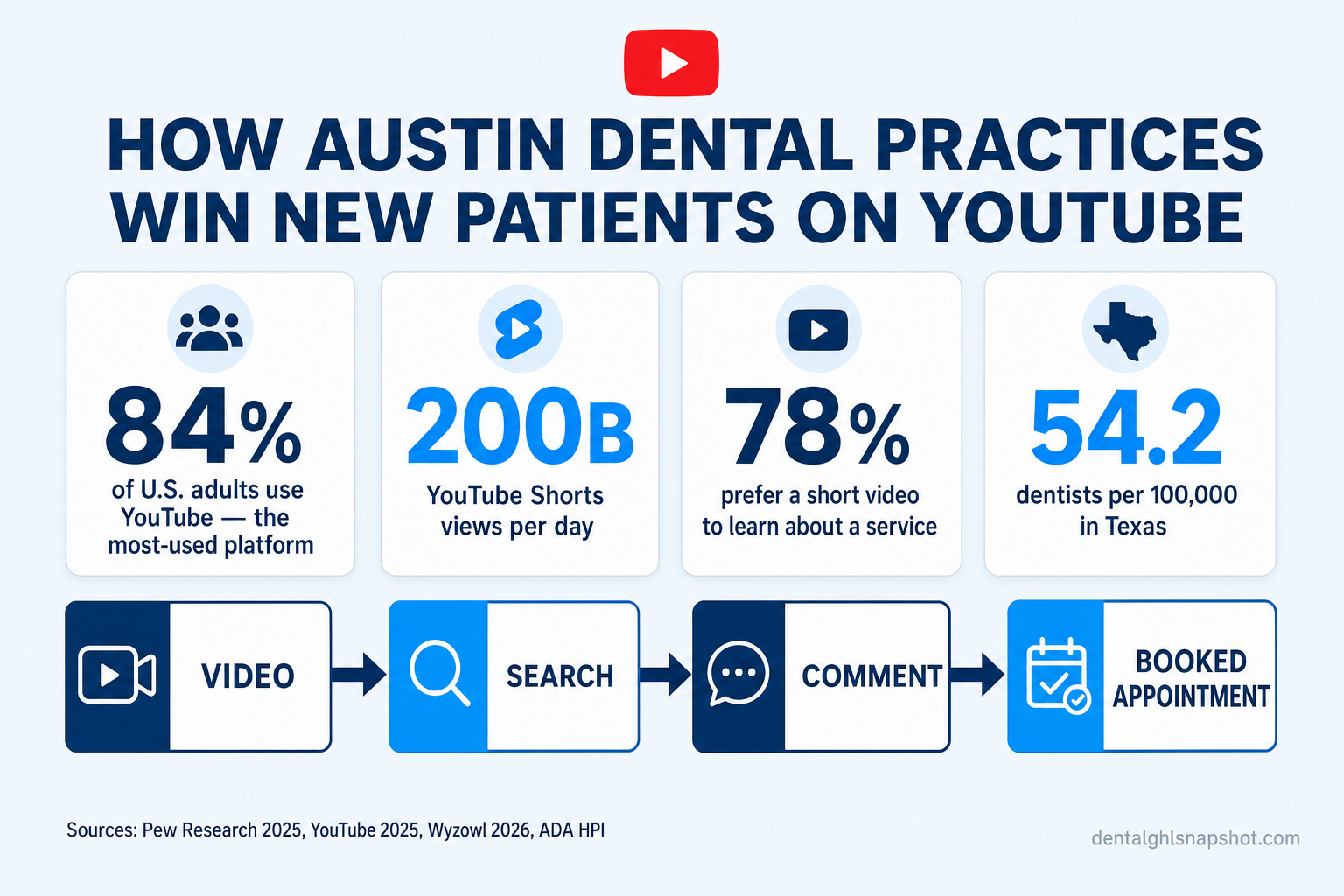
Table of contents
- Why YouTube is a new-patient channel Austin dentists overlook
- What “YouTube marketing” actually means for a dental practice
- The Austin context: a growing, competitive market
- How to set up YouTube marketing: 7 steps
- What to actually publish (dental video ideas that rank)
- In-house vs. done-for-you: the honest math
- Views don’t fill chairs — instant follow-up does
- How to tell if it’s working
- FAQ
Why YouTube is a new-patient channel Austin dentists overlook
Most Austin practices think of YouTube — if they think of it at all — as the place they parked one grainy office-tour video in 2019. Meanwhile, their future patients are on the platform every day. 84% of U.S. adults use YouTube, the single most-used online platform in the country, ahead of Facebook at 70% and Instagram at 50% (Pew Research Center, 2025).
The reason YouTube matters more than any other channel for a dental practice is intent. YouTube is the world’s second-largest search engine. When an Austinite types “does a root canal hurt,” “Invisalign vs braces cost,” or “emergency dentist near me,” a growing share of those searches surface video — and the practice whose face and voice answer the question earns a head start on trust before a single call is made. That is the exact moment a nervous patient decides who to book with.
Share of U.S. adults who use each platform. Source: Pew Research Center, 2025.
There’s a second reason YouTube is undervalued: its videos don’t expire the way a Facebook post does. A well-made explainer keeps ranking and collecting views for years, and it can be embedded on your website, linked from your Google Business Profile, and repurposed as Shorts. One good filming session becomes a compounding asset — the opposite of the disappearing-content treadmill most social feeds put you on.
What “YouTube marketing” actually means for a dental practice
“YouTube marketing” isn’t one thing. For a dental practice it’s three complementary formats, and you want all three working together:
- Shorts (vertical, under 60 seconds). The reach engine. Shorts now average 200 billion views a day (YouTube, 2025), and the algorithm pushes them to brand-new local viewers who don’t follow you yet. This is where a quick “what to do if you knock out a tooth” clip finds thousands of Austinites for free.
- Long-form explainers (2–8 minutes). The trust and search engine. These are the “does it hurt,” “what to expect at your first visit,” and “how much does X cost” videos that rank in search and quietly close the fearful patient who watches three of them at 11 p.m. before booking.
- Local SEO video. The map engine. Location-tagged, keyword-titled videos (“Emergency Dentist in Austin — What to Do Tonight”) reinforce your relevance for “near me” searches and can be embedded across your site and profile.
Patients overwhelmingly prefer this format to reading. 78% say they’d most like to learn about a product or service from a short video, and 96% have watched an explainer video to understand one (Wyzowl, 2026). Dentistry — where anxiety and cost confusion cause people to delay care — is one of the highest-fit categories for video there is. Seeing a calm, human explanation removes the exact friction that keeps a patient from picking up the phone.
The Austin context: a growing, competitive market
Austin is one of the fastest-growing large metros in the country, which cuts two ways. On one hand, a steady stream of new residents means a steady stream of people choosing a dentist for the first time — no incumbent loyalty to overcome. On the other, Texas already carries 54.2 dentists per 100,000 residents (ADA Health Policy Institute, 2024), and Austin’s desirable urban core is dense with practices competing for those same newcomers.
In that environment, the deciding factor is rarely clinical skill — every practice claims it. It’s visibility and trust before the first appointment. A newcomer to South Congress or Mueller doesn’t know your reputation. But if your face keeps showing up answering their exact question — “is Invisalign worth it,” “what does a dental cleaning actually involve” — you become the familiar, safe choice. Video is the cheapest way to manufacture that familiarity at the scale a growing city demands.
How to set up YouTube marketing: 7 steps
You don’t need a studio. You need a phone, a repeatable process, and consistency. Here’s the seven-step system.
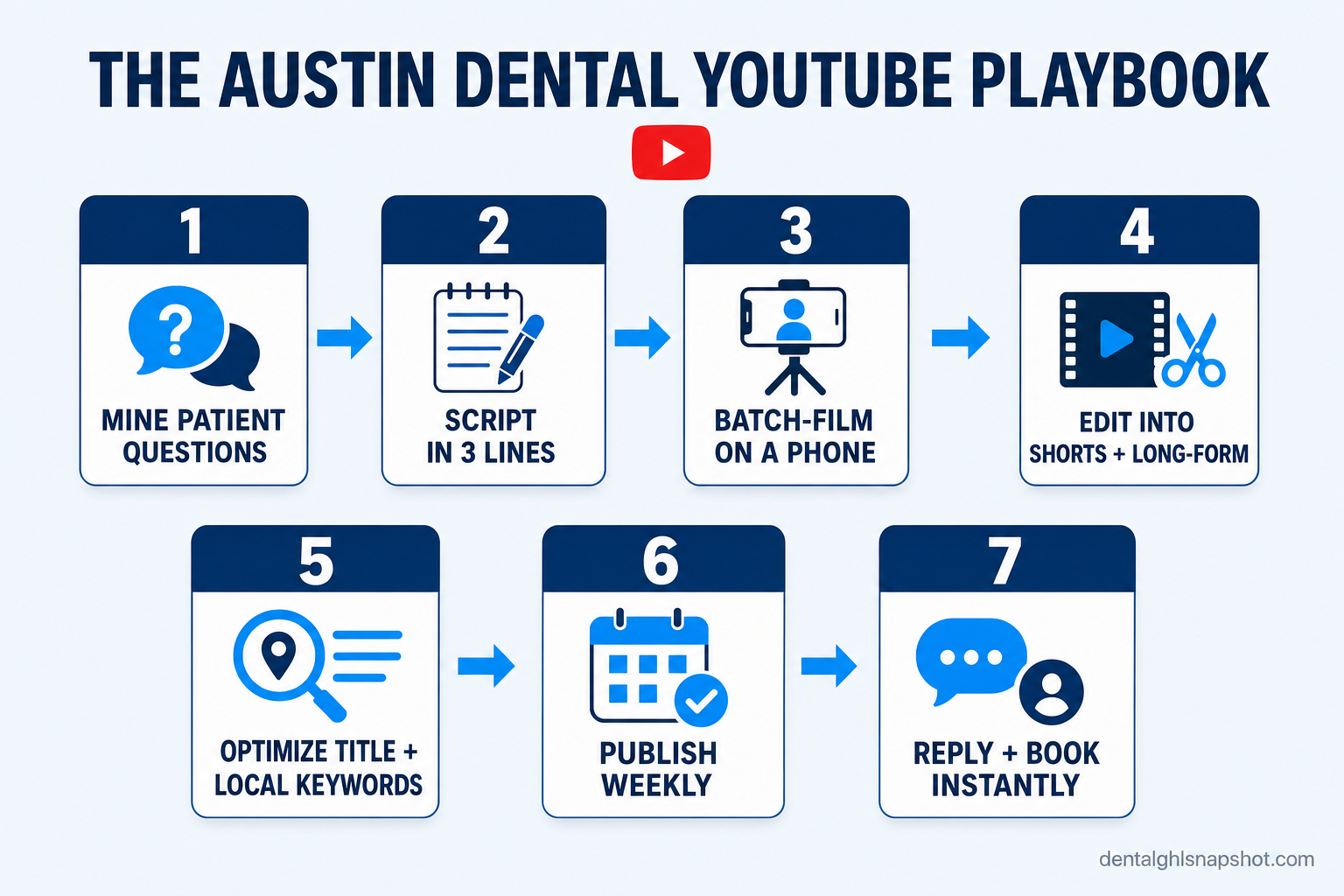
- Mine the questions your front desk already answers. The best dental videos aren’t creative — they’re answers. Sit with your team for 20 minutes and list the 30 questions patients ask most: cost, pain, insurance, “how long does it take,” “what’s that noise.” Each question is a video.
- Script each one in three lines. Hook (the question, said out loud), answer (the honest 20-second version), and a soft next step (“if you’re in Austin and it’s been a while, we’re happy to take a look”). No teleprompter monologue — just clarity.
- Batch-film on a phone. Block one hour a month, stand near a window for light, and shoot 8–12 clips vertically in one sitting. Batching is what makes this sustainable for a chairside team.
- Edit into Shorts and long-form. Cut the punchy 30–45 second version as a Short for reach, and, where the topic deserves it, keep a longer 2–5 minute cut for search and trust. Add captions — most people watch muted.
- Optimize for local + search. Put the real question and the city in the title (“Emergency Dentist in Austin: What to Do Tonight”), write a description with a couple of natural keywords and a link to book, and add end screens pointing to your next video.
- Publish on a schedule you can keep. Consistency beats volume. Two Shorts a week that never stop will out-perform a burst of ten that dies. The algorithm rewards steady uploads.
- Reply and book — instantly. Every comment and DM is a warm lead. The practices that win are the ones that answer in seconds and move the conversation toward a booked appointment, 24/7. This is the step humans can’t sustain by hand, and where automation earns its place (more below).
What to actually publish (dental video ideas that rank)
Blank-page paralysis kills most practice channels. Here’s a starter slate mapped to real patient intent — mix Shorts and long-form:
- Fear-reducers: “Does a root canal actually hurt?” · “What that suction noise is” · “Your first visit, start to finish.”
- Cost & insurance: “What a crown costs and why” · “Invisalign vs. braces: the honest comparison” · “How to read your dental benefits.”
- Emergency / high-intent: “Knocked-out tooth — the next 30 minutes” · “Cracked a tooth on the weekend?” · “When a toothache is an emergency.”
- Cosmetic curiosity: “Whitening: what works and what wrecks your enamel” · “Veneers vs. bonding” · a tasteful before/after with consent.
- Local & human: “Meet the team” · “Why we moved to [Austin neighborhood]” · behind-the-scenes of a same-day crown.
Why does this work so reliably? Because video moves people to act. 85% of people say they’ve been convinced to buy a product or service by watching a video (Wyzowl, 2026). In dentistry, “buy” is “finally book the appointment I’ve been putting off.”
How consumers use video to decide. Source: Wyzowl, State of Video Marketing 2026.
In-house vs. done-for-you: the honest math
Every practice can start filming today. The question is whether you can keep filming, editing, publishing across platforms, and answering every comment — every week, forever. That’s where most channels quietly die. Here’s the honest comparison.
Running dental YouTube yourself vs. a done-for-you system
| Plan | In-house / DIY | Done-for-you dental socialRecommended |
|---|---|---|
| Price | Staff time | From $397/mo |
| Feature 1 | You film, edit, caption, and upload — every week | We script, film-direct, edit, and publish for you |
| Feature 2 | Front desk answers comments between patients (or not) | AI agents reply to comments & DMs in seconds, 24/7 |
| Feature 3 | Publishing to YouTube only; other channels ignored | One video repurposed across all 9 channels, not just YouTube |
| Feature 4 | Consistency depends on how busy the schedule is | 5 days a week, in your practice voice — hands-free |
| Feature 5 | You learn the algorithm, titles, and local SEO yourself | Local SEO titles, captions, and a monthly report included |
| Do it yourself | See the service → |
The in-house route is genuinely doable for a motivated practice — our Instagram playbook for dentists walks through the DIY version. But most owners find that the filming is the easy 20%, and the editing, cross-posting, and instant follow-up are the 80% that never happens once the schedule gets busy. Our done-for-you dental social service is $397/mo for one brand and $997/mo for up to four locations, white-label, and it publishes YouTube (Shorts and long-form) plus eight other channels five days a week — with AI agents answering the comments those videos create.
Views don’t fill chairs — instant follow-up does
Here’s the trap: a practice finally makes a Short, it gets 4,000 views, twelve people comment “how much is Invisalign?” or “do you take my insurance?” — and nobody answers until Tuesday. By then those patients have booked with someone who replied first.
Speed is the whole game. The average business takes 42 hours to answer an inbound lead, and 23% never respond at all (HBR). Yet contacting a lead within 5 minutes makes you 21× more likely to qualify it than waiting 30 (MIT / Lead Response Management). A chairside Austin team — gloved, with a patient in the chair — physically cannot hit that window by hand.
That’s the job automation is built for. An AI agent replies to each comment publicly in seconds, moves the person into a private DM (“just sent you the details!”), answers common questions in your practice voice, and books the appointment straight into your calendar — around the clock. The video creates the demand; the automation makes sure none of it leaks. It’s the same instant-response principle we cover in speed-to-lead for dental practices and put to work in Instagram and Facebook comment automation and DM automation.
How to tell if it’s working
Subscriber count is a vanity metric. Track the numbers that connect video to production:
- Views from non-subscribers. On Shorts especially, this tells you the algorithm is pushing you to new Austin audiences — the whole point.
- Watch time on long-form. Are the fear-reducer and cost explainers holding attention? That’s trust being built with your highest-intent viewers.
- Comments and DMs captured → replied to. How many inquiries the videos generated, and how fast each got a real answer. This is where views become conversations.
- Booked appointments from video. The only metric that pays the bills — appointments tagged in your CRM back to a YouTube view, comment, or DM.
- After-hours share. What percentage of inquiries arrived nights and weekends? That’s the volume a manual process was silently losing.
Read those five monthly and you’ll know exactly what your channel is worth. To model the economics for your own practice, the pricing page and a quick walkthrough call are the fastest way — and if reviews and local search are also on your list, our guides on local SEO for dentists and earning more Google reviews pair naturally with a video program.
Frequently asked questions
Frequently asked questions
Do dental patients really find their dentist on YouTube?
Increasingly, yes. 84% of U.S. adults use YouTube — the most-used online platform, ahead of Facebook and Instagram (Pew, 2025). Because YouTube doubles as the world's second-largest search engine, patients researching a procedure, a cost, or an 'emergency dentist near me' often land on video first — and 78% say they'd rather learn about a service from a short video than read about it (Wyzowl, 2026).
Shorts or long-form videos — which should an Austin dental practice make?
Both, working together. Shorts are the reach engine — the feed averages 200 billion views a day (YouTube, 2025) and pushes your clips to brand-new local viewers. Long-form explainers are the trust and search engine — they rank for 'does it hurt' and 'how much does it cost' questions and quietly close fearful patients. Start with Shorts for reach, and add a few evergreen long-form videos for the topics that deserve depth.
How often do I need to post to see results?
Consistency beats volume. Two Shorts a week that never stop will out-perform a burst of ten that dies. YouTube's algorithm rewards steady uploads, and video compounds — a good explainer keeps ranking and collecting views for years, unlike a disappearing social post. Expect meaningful local reach to build over roughly 3–5 months of consistent posting.
Is dental video content compliant with Texas advertising rules?
It can be, and educational video is a strong fit. Keep clips informational — explain procedures, set expectations, answer FAQs — and avoid guaranteeing clinical outcomes, specific results, or insurance benefits, which keeps you clear of Texas dental-board advertising rules. Don't show identifiable patient information without written consent, and keep protected health information out of public comments and DMs, consistent with HIPAA best practice.
We're too busy to film and edit every week. What are our options?
That's the most common reason practice channels stall — the filming is easy, but the weekly editing, cross-posting, and instant follow-up rarely survive a busy schedule. You can run it in-house with a set batch-filming routine, or hand it to a done-for-you system. Our dental social service scripts, edits, and publishes YouTube plus eight other channels five days a week and answers your comments and DMs with AI agents — from $397/mo, white-label.
What happens to the views and comments my videos generate?
That's the make-or-break step. The average business takes 42 hours to answer an inbound lead and 23% never respond (HBR), while replying within 5 minutes makes you 21× more likely to qualify it (MIT / Lead Response Management). An AI agent replies to comments in seconds, moves the person into a DM, and books the appointment into your calendar 24/7 — so the demand your videos create doesn't leak.
About the author
Devin Okafor is a GoHighLevel Automation Specialist based in Austin, Texas. He builds and ships GoHighLevel snapshots for dental practices and the agencies that serve them, and has wired up hundreds of workflows for appointment reminders, speed-to-lead, review harvesting, and social automation. He is opinionated about keeping automations simple enough for a busy front desk to actually live with.
Related posts
- Social Media Marketing for Miami Dental Practices — the short-form video system that feeds your whole channel.
- Instagram & Facebook Comment Automation for Seattle Dental Practices — how to answer every comment your videos create, in seconds.
- Instagram & Facebook DM Automation for NYC Dental Practices — the private-message side of the same follow-up system.
- Speed-to-Lead for Dental Practices — the five-minute rule that turns views into booked chairs.
- Local SEO for Dentists — how video, reviews, and your profile reinforce each other in local search.