

Short answer: In a market as affluent and competitive as Scottsdale — median household income around $110,886 (U.S. Census Bureau), inside a Maricopa County that added 57,471 residents in a single year (U.S. Census Bureau, 2024) — the practices winning implant and full-arch cases aren’t the ones with the biggest ad budget. They’re the ones that respond first. The data is brutal: you are 100× more likely to reach a new lead if you contact them within five minutes rather than thirty (MIT/InsideSales Lead Response Management Study), yet the average business takes 42 hours to respond to an online inquiry, and 23% never respond at all (Harvard Business Review, 2011). For a practice where a single case can be worth $3,000 to $50,000 or more, every slow follow-up is production walking down Scottsdale Road to a competitor. This is what the leak costs — and the done-for-you follow-up system that closes it.
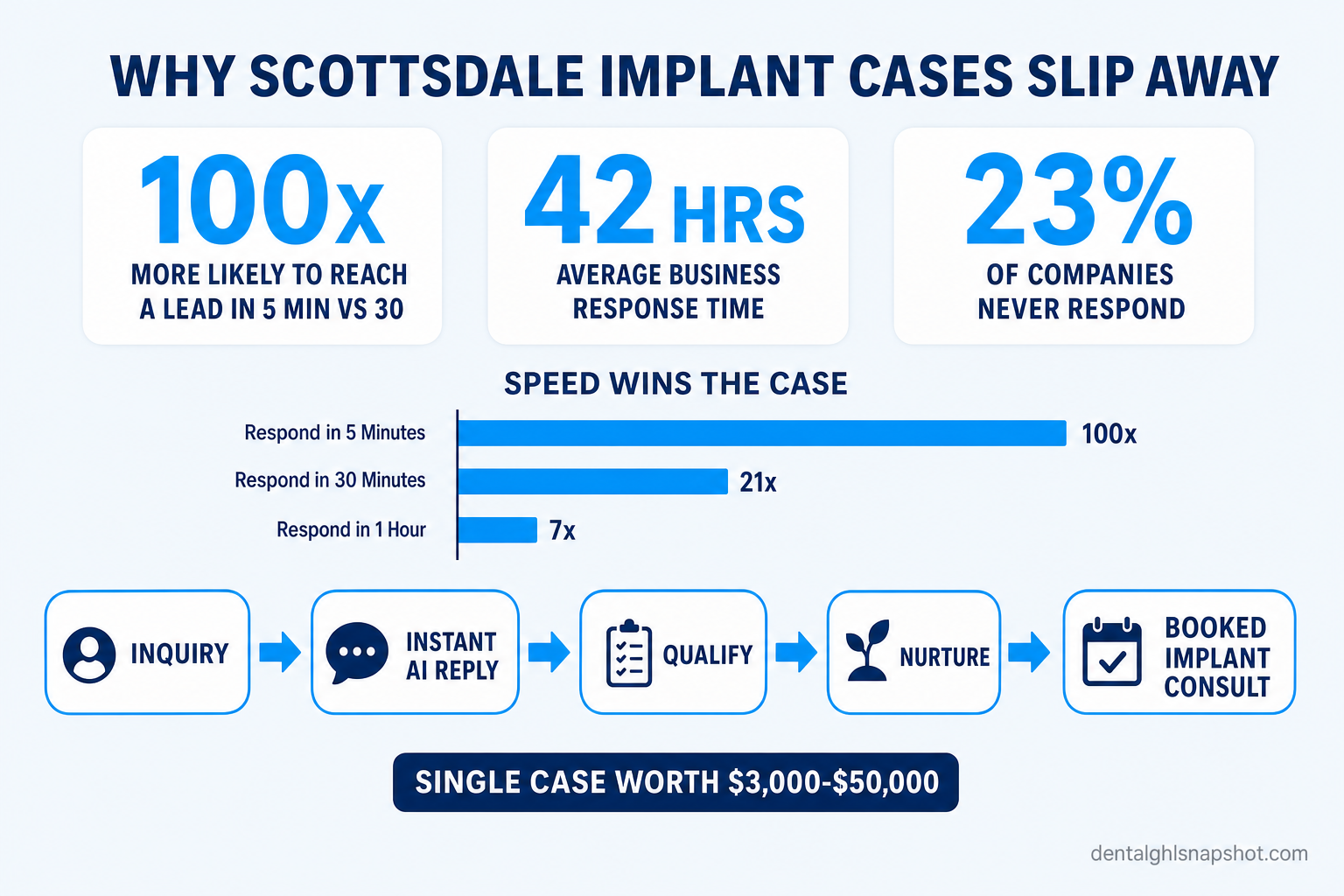
Table of contents
- Why implant cases are won or lost in the first five minutes
- What a slow follow-up actually costs a Scottsdale practice
- The five leaks that lose high-value dental cases
- The Scottsdale angle: affluent, competitive, fast-growing
- From inquiry to booked consult: the follow-up system
- Manual follow-up vs. an automated system
- How to tell if your follow-up is leaking
- FAQ
Why implant cases are won or lost in the first five minutes
An implant inquiry is not like a hygiene call. Someone weighing a $20,000 full-arch decision is anxious, comparison-shopping, and — crucially — impatient. They fill out a form on your website at 8:47 p.m., then open three more tabs and message two other Scottsdale practices while they wait. Whoever calls back first doesn’t just get a head start; they usually get the case.
The most-cited research on this is unforgiving. In the MIT/InsideSales Lead Response Management Study — which analyzed roughly 15,000 leads and more than 100,000 call attempts — the odds of contacting a new lead were 100× greater when the first call was placed within five minutes rather than thirty minutes, and the odds of qualifying that lead were 21× greater (MIT/InsideSales). Not 20% better. One hundred times more likely to even reach the person.
How much more likely you are to reach and qualify a lead by responding within 5 minutes instead of 30. Source: MIT / InsideSales Lead Response Management Study.
Now hold that against how businesses actually behave. Harvard Business Review’s audit of 2,241 U.S. companies found the average first response to an online lead was 42 hours. Only 37% responded within an hour, 24% took more than a full day, and 23% never responded at all. Firms that made contact within an hour were ~7× more likely to qualify the lead than those that waited just one hour longer — and ~60× more likely than the companies that waited 24 hours or more (HBR, 2011).
How fast 2,241 U.S. companies actually responded to online leads — nearly half took over a day or never replied. Source: Harvard Business Review, 2011.
This isn’t a decade-old problem that fixed itself, either. A 2024 test of 1,000 B2B companies found 63% never responded to a demo request at all, and among those that did, the average response time was one day, five hours (RevenueHero, 2024). The gap between what converts (minutes) and what practices deliver (hours or never) is the single biggest, cheapest opportunity in your marketing. You’ve already paid to generate the lead. The only question is whether you reach them before the practice down the street does. It’s the same principle we’ve written about for speed-to-lead in dental and missed-call text-back — implants just raise the dollar value of every second.
What a slow follow-up actually costs a Scottsdale practice
Do the arithmetic in dollars, because implants make the leak visible in a way a $150 cleaning never does. A single implant tooth commonly runs $3,000–$5,000, and a full-arch or All-on-4 case can run $15,000–$50,000 or more (Authority Dental). Those are the exact cases most likely to be shopped across multiple providers — and therefore most likely to reward the practice that answers first.
The demand behind those numbers is enormous and durable. Roughly 178 million Americans are missing at least one tooth, and about 40 million are missing all of them (American College of Prosthodontists). That standing need is why the U.S. dental-implant market is projected to grow from about $1.54 billion in 2024 to roughly $3.22 billion by 2033 — an 8.6% compound annual growth rate (Grand View Research).
That’s the reframe. Most practices respond to a soft schedule by buying more ads — more Google, more Facebook, more directory listings. But if inquiries are already arriving and dying in a 42-hour void, more leads just means more waste. Fixing response speed multiplies the return on every marketing dollar you’re already spending.
The five leaks that lose high-value dental cases
High-value cases don’t slip away for one dramatic reason. They leak out through five small, ordinary gaps in a busy practice’s day.
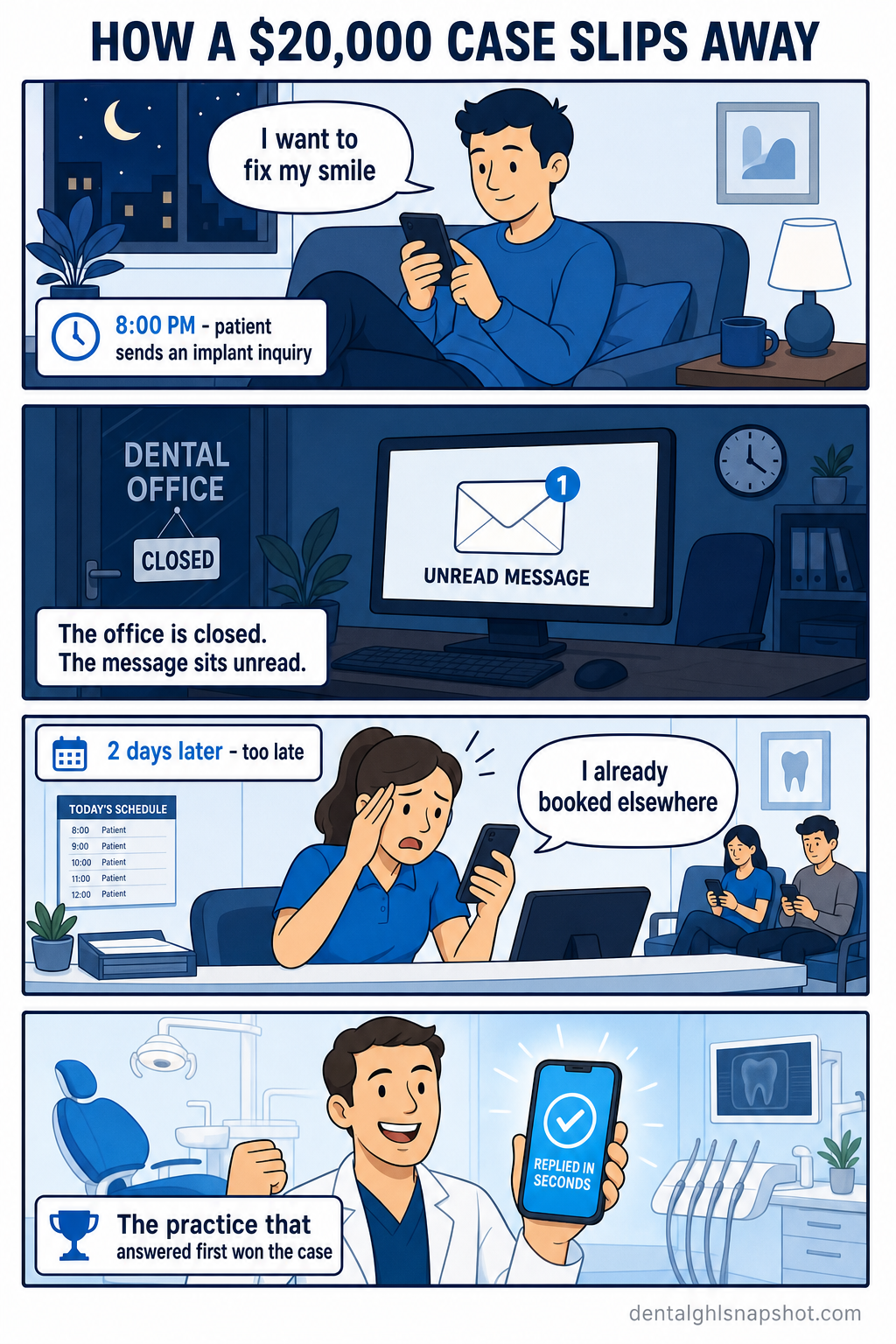
- The five-minute window closes. The front desk is chairside, verifying insurance, or handling a waiting room. By the time anyone sees the form, the 100×-to-1 advantage of a five-minute response is long gone (MIT/InsideSales).
- After-hours inquiries die overnight. Affluent professionals research big decisions on evenings and weekends — precisely when your office is dark. A message that lands at 8 p.m. Friday and sits until Monday has already lost the patient.
- One touch, then silence. Someone leaves a voicemail, gets no answer, and never hears back. High-value cases need persistent, multi-touch follow-up — call, text, email, repeat — not a single attempt that quietly gives up.
- No nurture for a weeks-long decision. An implant patient rarely books on day one; they compare, think, and consult a spouse. Without an automated sequence that stays gently in front of them, a warm lead cools into a lost one. This is the same discipline behind recall and reactivation and treatment-plan acceptance.
- The handoff drops. Even when someone does reply, the details live in a sticky note or a personal text thread instead of a system — so the consult never gets booked, confirmed, or reminded, and a no-show finishes the job.
Every one of these is a process failure, not an effort failure. Your team isn’t lazy; they’re outnumbered by the phone. That’s exactly the kind of gap automation is built to close.
The Scottsdale angle: affluent, competitive, fast-growing
Scottsdale is close to an ideal implant market — which is exactly why the follow-up bar is so high.
It’s affluent. Scottsdale’s median household income is about $110,886 (U.S. Census Bureau), well above the national figure. High-income households are the ones most able to say yes to elective, out-of-pocket full-arch and cosmetic-implant cases — the treatments insurance rarely fully covers.
It’s growing fast. Maricopa County added 57,471 residents between mid-2023 and mid-2024 — one of the largest numeric gains of any county in the nation — reaching about 4.67 million people (U.S. Census Bureau, 2024). Many are retirees and relocating professionals actively shopping for a new dentist, implants often top of mind.
It’s competitive. That opportunity is not a secret. Arizona is home to 4,368 practicing dentists (ADA Health Policy Institute), and the Scottsdale–Phoenix corridor is thick with implant and cosmetic providers. When a prospective patient searches “dental implants near me,” they’re handed a wall of options and they contact several. In that environment, the differentiator isn’t a marginally better ad — it’s being the practice that responds first, every time, day or night.
From inquiry to booked consult: the follow-up system
The fix isn’t hiring three more front-desk staff to stare at a phone. It’s a system that responds instantly, follows up relentlessly, and hands your team a booked consult instead of a cold lead. Here’s what that looks like end to end.
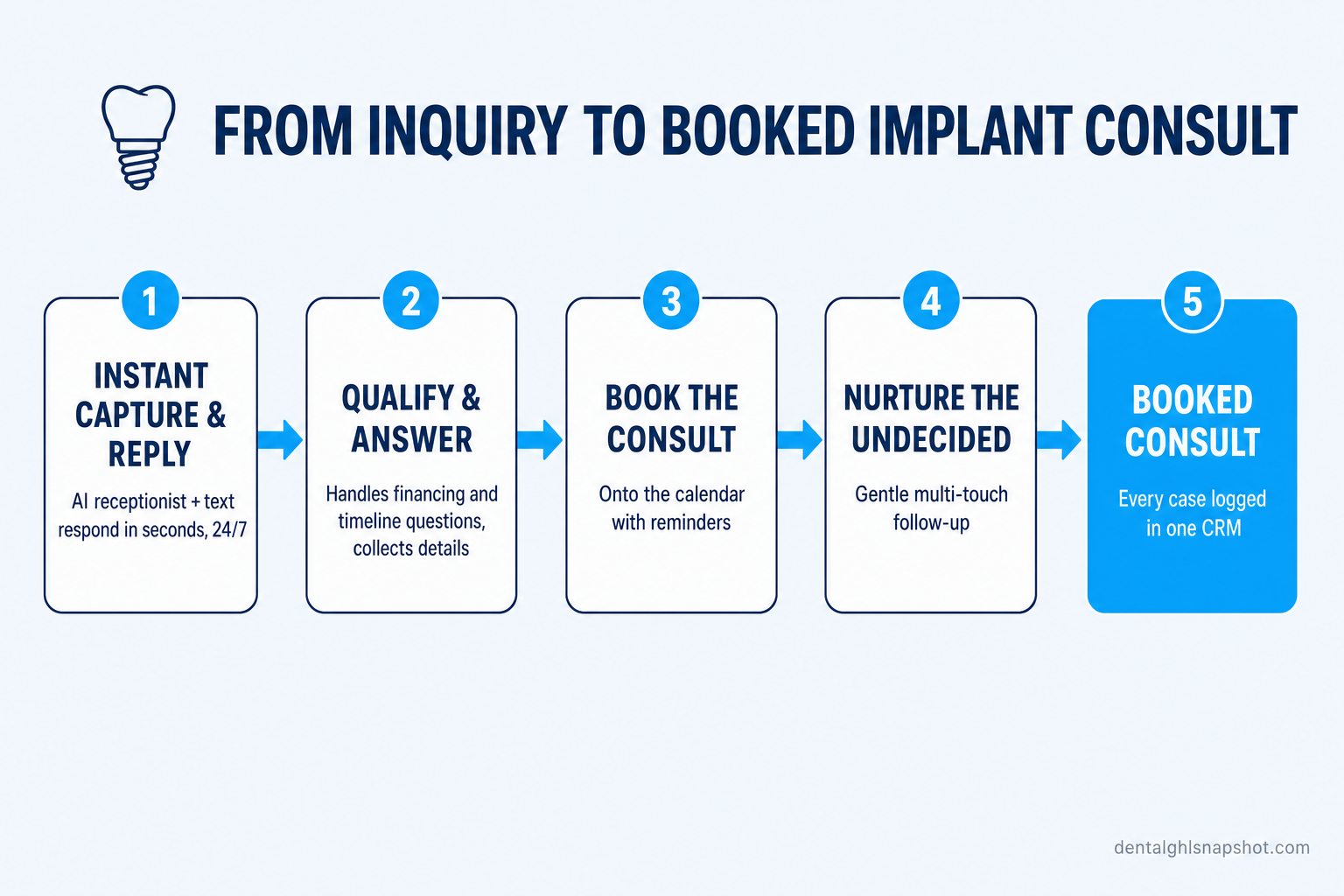
- Instant capture and reply. The moment a patient submits a form, calls, or DMs — from your website, Google, or social — an AI receptionist and instant text-back respond in seconds, 24/7. No inquiry waits for business hours.
- Qualify and answer, in your voice. The AI answers the common implant questions (financing, timeline, “am I a candidate?”), collects name and contact details, and gauges urgency — the way a great treatment coordinator would, without tying one up.
- Book the consult automatically. Qualified patients are offered real openings and booked straight onto the calendar, then sent confirmations and reminders so the consult actually happens. See online scheduling for dental practices for why this step alone lifts show rates.
- Nurture the undecided. Patients who aren’t ready get a gentle, multi-touch sequence — helpful, compliant, no pressure — that keeps you top of mind through a weeks-long decision instead of letting the lead go cold.
- Everything in one CRM. Every inquiry, reply, and booking is logged in one place, so nothing lives in a sticky note and your team can see exactly where each high-value case stands.
What changes when follow-up becomes a system
An implant form arrives at 8 p.m. and sits until someone has a free minute two days later. One voicemail, no answer, no second attempt. The details live in a text thread. The patient — who messaged three practices — books with whoever called back first.
The inquiry gets an instant AI reply and text in seconds, day or night. Common questions answered, urgency gauged, a consult booked onto the calendar with reminders. Undecided patients get a steady, compliant nurture sequence. Every case tracked in one CRM.
This is precisely what the Dental GHL Snapshot is built to do: a done-for-you GoHighLevel system with the AI caller, SMS automation, appointment booking, and CRM nurture already wired together and tuned for dental — installed within 24 hours, no workflow-building on your end.
How to tell if your follow-up is leaking
You don’t need a consultant to diagnose this — you need to time yourself honestly. Track these five numbers for a month:
- Speed to first response. From inquiry to first live contact (not an auto-email). Anything over five minutes is leaving cases on the table (MIT/InsideSales).
- After-hours response rate. What share of inquiries that arrive outside office hours get answered before the next business day? For an affluent, evening-researching market like Scottsdale, this is often where the biggest leak hides.
- Number of follow-up attempts. Are high-value leads getting one touch or five? Persistence is what separates a booked consult from a lost one.
- Inquiry-to-consult rate. Of implant inquiries, how many become a booked, showed-up consult? This is the number that pays the bills.
- Time to book. How long from first contact to a consult on the calendar? Friction here quietly kills warm leads.
If you can’t answer these quickly, that is the answer — the follow-up is running on memory and goodwill, not a system. To model the upstream economics for your own case values, our pricing page and a short walkthrough call are the fastest way to sanity-check the numbers for your practice.
Frequently asked questions
Frequently asked questions
Why does response speed matter so much for dental implant leads?
Because implant patients are high-intent and comparison-shopping. Research on lead response finds you're 100× more likely to reach a new lead by responding within five minutes instead of thirty, and 21× more likely to qualify them (MIT/InsideSales). Yet the average business takes 42 hours to respond and 23% never do (HBR). For a $3,000–$50,000 implant case, the practice that answers first usually wins it.
How much is a lost implant case actually worth in Scottsdale?
A single implant tooth commonly runs $3,000–$5,000 and a full-arch case $15,000–$50,000+ (Authority Dental). In an affluent market like Scottsdale — median household income ~$110,886 per the U.S. Census Bureau — those elective, out-of-pocket cases are common, so losing even one or two a month to slow follow-up can mean six figures of production a year.
Isn't more advertising the answer to filling my implant schedule?
Usually not first. If inquiries are already arriving and dying in a multi-hour response gap, more ads just generate more wasted leads. A 2024 test found 63% of companies never responded to an inbound request at all (RevenueHero). Fixing response speed multiplies the return on the marketing you're already paying for — it's the cheaper, higher-leverage move before scaling spend.
Can automation handle a sensitive, high-value conversation like implants?
It handles the speed and the logistics — the parts humans lose to a busy schedule. An AI receptionist answers instantly 24/7, responds to common questions about financing and timelines, captures details, and books the consult. Your treatment coordinator still has the in-depth, human conversation at the consult. Automation makes sure that consult actually gets booked instead of lost overnight.
What does a done-for-you follow-up system include?
The Dental GHL Snapshot bundles a 24/7 AI receptionist, instant SMS text-back, automatic appointment booking with reminders, multi-touch nurture sequences, and a single CRM — pre-built in GoHighLevel and tuned for dental. It installs within 24 hours for $997, so there's no workflow-building on your end. You can also see it live on a 20-minute walkthrough.
Is automated patient follow-up compliant?
It can be, and it must be. Get consent for messaging and honor opt-outs (reply STOP) to stay consistent with TCPA, keep protected health information out of plain SMS and public channels per HIPAA, and follow Arizona dental-board advertising rules — no guaranteed clinical outcomes. A well-built system bakes these guardrails in; compliance is a setup choice, not a reason to keep answering leads by hand.
About the author
Marisa Velez is a Dental Practice Growth Strategist based in Scottsdale, Arizona. She has spent more than a decade helping general and cosmetic dental practices fill the hygiene column and turn one-time patients into lifelong recare, focusing on the numbers that actually move production — new-patient cost, no-show rate, and treatment acceptance — and translating them into systems a busy front desk can live with.
Related posts
- Speed to Lead for Dental Practices: Why the First Five Minutes Decide the Case
- Missed-Call Text-Back for Dental Practices: Recover the Patients Your Phone Drops
- Treatment Plan Acceptance: How to Turn Diagnosed Care Into Scheduled Production
- Dental Recall & Reactivation: The Automated System That Refills the Hygiene Column
- Online Scheduling for Dental Practices: Book More Consults, Cut No-Shows