

Short answer: A Philadelphia dental practice’s most expensive daily loss isn’t its marketing budget or its supply costs — it’s the phone ringing out while the team is chairside, at lunch, or gone for the night. Every unanswered new-patient call in a metro with roughly 7,000 dentists (ADA Health Policy Institute) is a motivated patient who simply dials the next name on Google. The fix is not another front-desk hire in one of the country’s pricier labor markets — Philadelphia’s mean wage runs $34.49/hr vs. $33.54 nationally (BLS, May 2025). It’s a 24/7 AI receptionist that answers every call instantly and books the appointment inside the call — so the patient never has a reason to keep dialing.
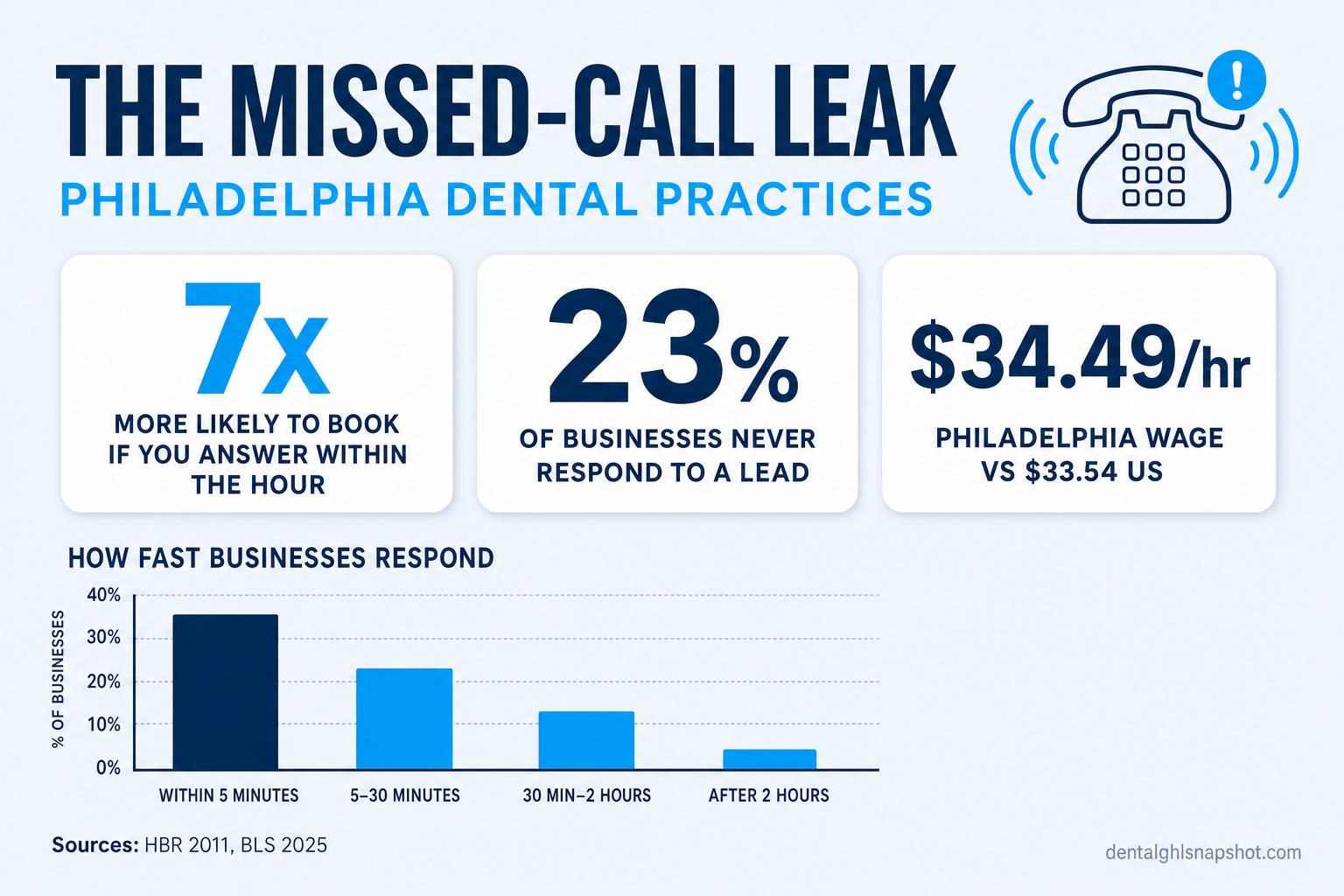
Table of contents
- The problem: Philadelphia’s phones ring out
- The five moments your practice leaks calls
- What a missed call actually costs a Philly practice
- Why “we’ll call them back” doesn’t work
- Why hiring your way out is the expensive fix
- The fix: a 24/7 AI receptionist that books inside the call
- Voicemail vs. answering service vs. AI receptionist
- What an AI receptionist can’t (and shouldn’t) do
- How to roll it out in a Philadelphia practice
- Frequently asked questions
The problem: Philadelphia’s phones ring out
Walk into almost any dental front office in Philadelphia at 10:30 a.m. and you’ll see the same picture: one or two people trying to check in a patient, verify a plan on hold with a carrier, restock the operatory sheet, and answer a ringing phone — all at once. Something has to give, and it’s almost always the phone. The call rolls to voicemail, or rings a second line nobody can reach, and a would-be new patient hangs up.
That patient has options. Pennsylvania is home to about 7,036 dentists as of 2023 (ADA Health Policy Institute), a large share of them concentrated in the Philadelphia–Camden–Wilmington metro. From Center City to the Main Line to South Jersey, a patient searching “dentist near me” with a cracked molar has a dozen practices one tap away. The one that answers — not the one with the nicest website — gets the appointment.
This is what makes the unanswered phone so costly in a market like Philadelphia specifically. In a rural county with one dentist for miles, a missed call comes back; the patient has nowhere else to go. In a dense, competitive metro, a missed call is gone for good. The abundance of choice that makes Philadelphia a great place to practice is the same thing that punishes a slow phone.
The five moments your practice leaks calls
Missed calls aren’t random. They cluster around five predictable moments every Philadelphia front desk knows by heart:
- Chairside crunch (mid-morning and mid-afternoon). Your team is helping the patient in the chair — exactly when they can’t grab a ringing phone. The busier the schedule, the more calls leak.
- The lunch hour. Coverage thins right when working patients use their own lunch break to call and book.
- After 5 p.m. The office closes, but the patient’s toothache and their free time both start at 6. Roughly 73% of online dental bookings happen after hours (NexHealth) — a strong proxy for when call demand actually peaks.
- Weekends. Saturday and Sunday are when people finally deal with the tooth they’ve ignored all week — and when most practices are completely dark.
- The second line. Even a fully staffed desk can only hold one conversation at a time. Call number two, during a rush, rings out.
Industry call-analytics reports put the average dental office’s business-hours miss rate at roughly a quarter to a third of inbound calls (Peerlogic, an industry estimate, not a peer-reviewed figure). Whatever your exact number, the pattern is the same: the calls leak when you’re busiest and when you’re closed — and those are precisely the windows a human front desk can never fully cover.
What a missed call actually costs a Philly practice
Here’s where it stops being abstract. Let’s build a deliberately conservative, illustrative model from public inputs — not a promise, just arithmetic you can re-run with your own numbers.
Say your practice takes 200 inbound calls a month and, like many busy front desks, misses about 25% — that’s 50 missed calls. Assume just 8 of those were prospective new patients (the rest are existing patients, vendors, and wrong numbers), and that half of those eight would have booked. That’s 4 new patients lost every month to the phone alone.
Dental-marketing analyses estimate a new patient is worth on the order of $1,000 in first-year production, and often several thousand dollars in lifetime value once you count hygiene recall, restorative treatment, and referrals (Delmain and Wonderist Agency, industry estimates). At just the first-year figure:
4 lost new patients/month × $1,000 ≈ $4,000/month → roughly $48,000/year walking out the door as voicemail.
And that’s before lifetime value, before the referrals those patients would have brought, and before the marketing you already paid to make the phone ring — an estimated $150–$400 to acquire each new patient (Delmain, industry estimate). You spend the ad budget to generate the call, then lose the call to a busy signal. It’s the most expensive line item that never appears on the P&L.
How fast businesses actually respond to an inbound lead (% of 2,241 U.S. companies audited). Nearly 1 in 4 never respond at all. Source: Harvard Business Review, “The Short Life of Online Sales Leads” (2011).
Why “we’ll call them back” doesn’t work
Every practice tells itself the same comforting story: if we miss a call, we’ll just call them back. The data says that patient is already gone.
The landmark Harvard Business Review study “The Short Life of Online Sales Leads” audited 2,241 U.S. companies and found that firms attempting contact within an hour were 7× more likely to qualify the lead than those who waited just one hour longer — and 60× more likely than those who waited 24 hours or more. Yet the average company took 42 hours to respond, and 23% never responded at all. The MIT/InsideSales Lead Response Management study, built on 15,000+ leads and 100,000+ call attempts, found the decay is even sharper minute-to-minute: reaching out in 5 minutes instead of 30 makes you about 21× more likely to qualify the person (MIT/InsideSales, via Forbes).
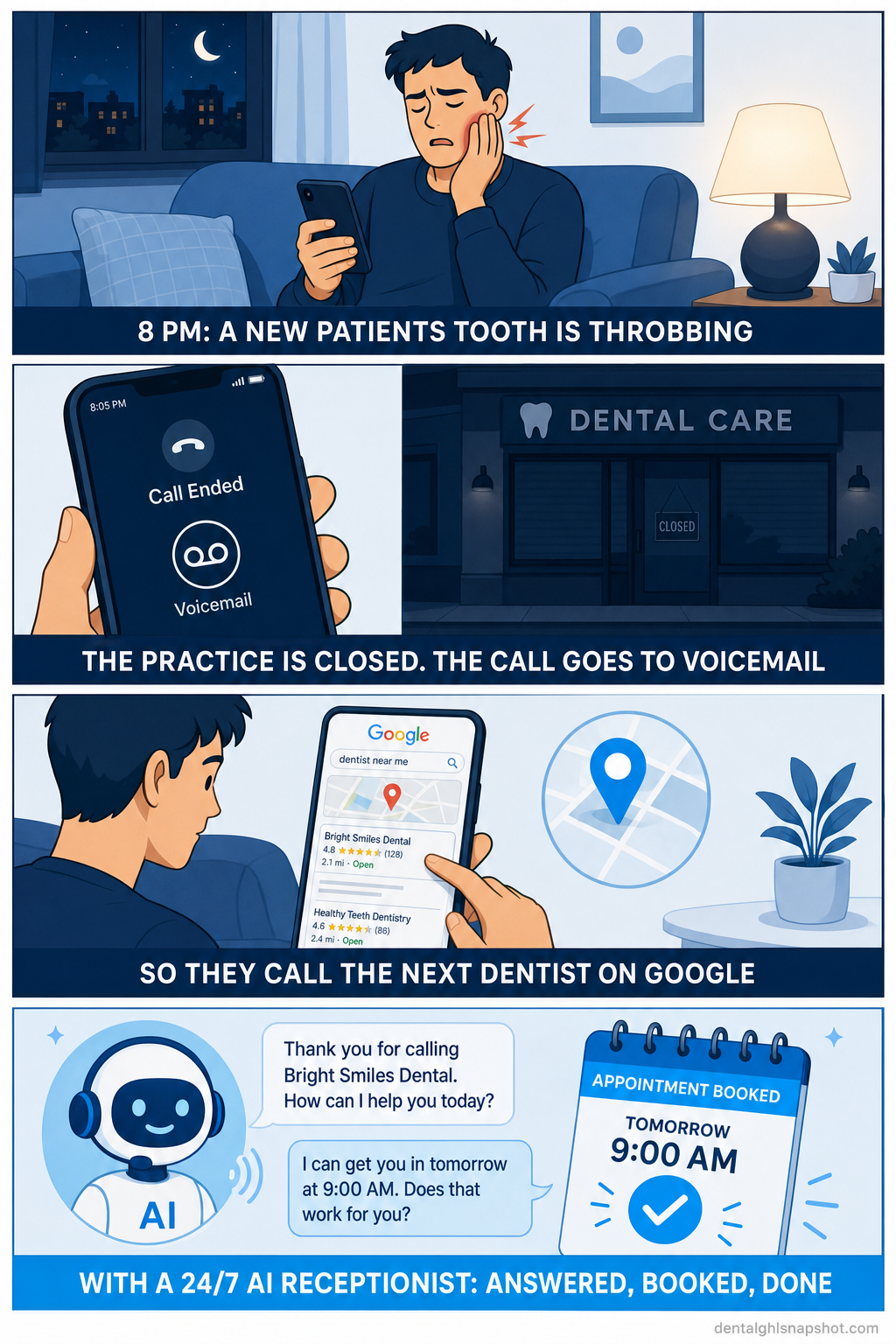
A patient with a chipped tooth at 8 p.m. isn’t leaving one voicemail and waiting patiently. They’re calling the next practice, and the one after that, until someone picks up. By the time you return the call at 9 a.m., they’re already in someone else’s chair. “We’ll call them back” isn’t a safety net — it’s a slow way of confirming the loss. We break this down further in our guide to speed-to-lead for dental practices and the simplest first fix, missed-call text-back.
Why hiring your way out is the expensive fix
The obvious answer — “just hire another front-desk person” — is the slow and costly one in Philadelphia. The metro’s mean wage sits at $34.49/hr, above the U.S. average of $33.54 (BLS OEWS, May 2025), and office-and-administrative roles make up the single largest slice of metro employment — meaning you’re competing hard for every good hire.
Mean hourly wage, all occupations — Philadelphia metro vs. national (USD/hr). Philadelphia labor runs above the U.S. average. Source: U.S. Bureau of Labor Statistics, OEWS (May 2025).
Even if you find someone, staffing is fragile. The ADA Health Policy Institute reports that roughly 3 in 5 dentists name staffing their top challenge, and about a third of practices recruiting administrative staff call it “extremely challenging” (ADA HPI, Economic Outlook). And a second hire still doesn’t cover 6 p.m. to 8 a.m., weekends, or two calls at once. You’d need multiple shifts to blanket the hours where demand actually lives — an enormous cost to plug a leak that automation closes for a flat fee. (If you do want a human in the loop, a trained GoHighLevel virtual assistant is a far cheaper lever than another local salary.)
The fix: a 24/7 AI receptionist that books inside the call
An AI receptionist is not a fancier voicemail or a “press 1 for appointments” phone tree. It’s a conversational voice agent that answers your phone on the first ring, understands what the caller wants in plain language, and — the part that matters — completes the booking during the call: it reads your live calendar, offers real open slots by provider and appointment type, creates the appointment, fires a confirmation text, and tags the patient in your CRM.
That last point is the whole game. An AI that “sounds amazing” but only takes a message just recreates the callback list you were trying to eliminate. The booking has to happen inside the conversation. Done right, a capable AI receptionist in 2026 can:
- Answer every call instantly, 24/7 — no hold music, no “high call volume,” no after-hours dead zone.
- Hold a natural conversation — understand “I chipped a tooth and I’m kind of panicking,” not just menu keywords.
- Book, confirm, or reschedule into your real calendar, by provider and visit type.
- Answer routine FAQs — hours, parking, location, “do you take my insurance,” new-patient paperwork.
- Qualify and route — recognize a true emergency and escalate, or capture a new-patient lead with full context.
- Trigger follow-up — send the confirmation SMS and drop the patient into a reminder sequence so nothing slips.
For patients who’d rather type than talk, the same booking engine powers a website AI chat widget that captures the after-hours visitor who won’t pick up the phone. For the deeper technical picture — what the technology can and can’t do, and how patients actually respond to it — see our full guide, AI Receptionist for Dental Practices.
Voicemail vs. answering service vs. AI receptionist
Most practices already pay for some after-hours coverage — usually voicemail or a traditional answering service that takes a message. Here’s how the three stack up on the thing that matters: turning a call into a booked appointment.
| Voicemail | Traditional answering service | AI receptionist | |
|---|---|---|---|
| Hours covered | 24/7 (but passive) | After hours / overflow | 24/7/365 |
| Answers instantly | No — patient talks to a machine | Often queues / holds | Yes, first ring |
| Books into your calendar | No | Rarely — usually takes a message | Yes, in real time |
| Knows your practice | No | Generic script | Trained on your FAQs, hours & rules |
| What the patient gets | A beep | A promised callback | A confirmed appointment |
| Cost model | Cheap, but loses patients | Per-minute / per-call | Flat platform cost |
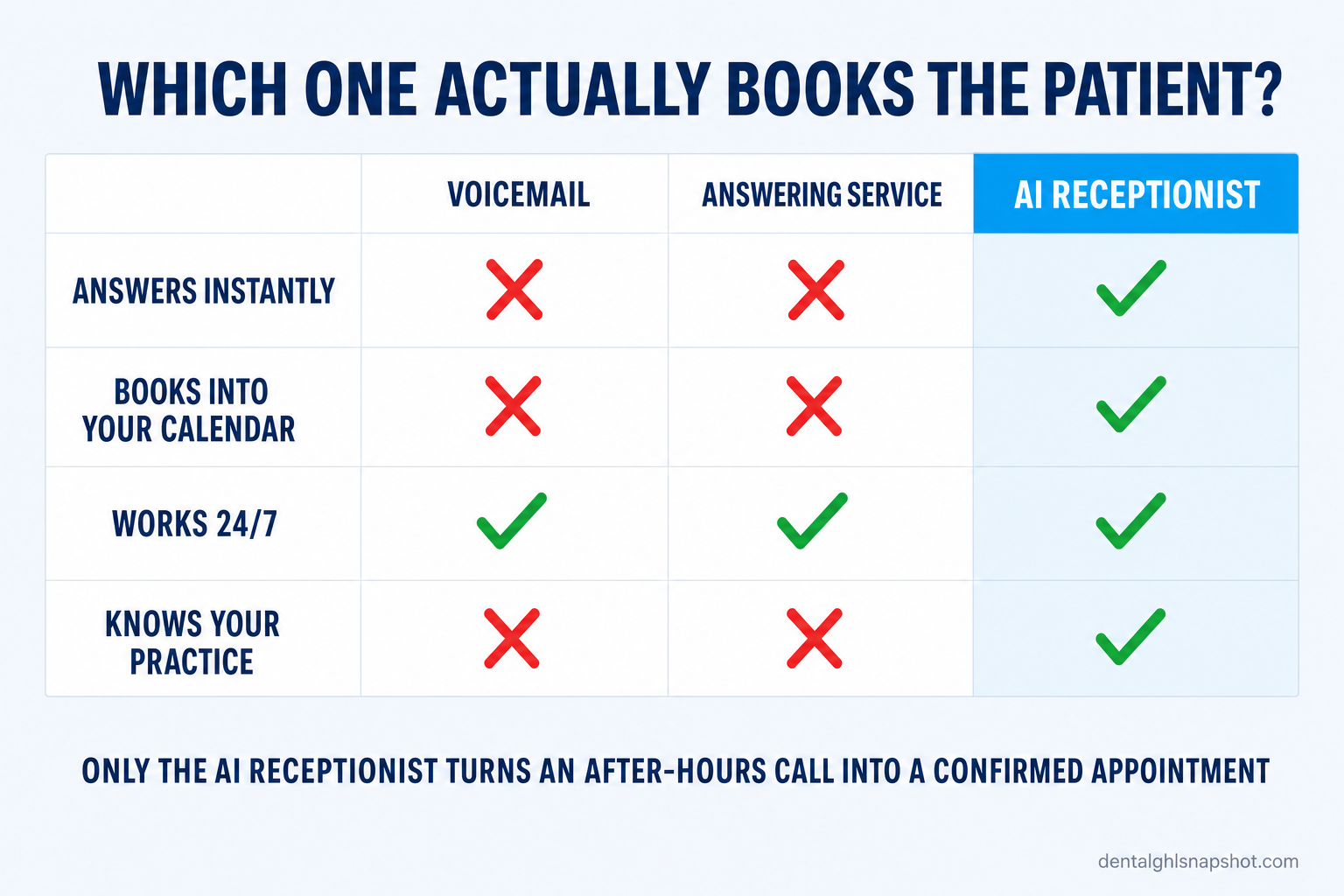
The point isn’t that AI replaces your front desk — it’s that AI replaces the gaps: the chairside rush, the lunch hour, the 6 p.m.–8 a.m. dead zone, the weekend, and the second line. Your team keeps the work humans are uniquely good at — warmth, judgment, chairside reassurance — and the AI absorbs the volume that used to become voicemail.
What an AI receptionist can’t (and shouldn’t) do
Being honest about the limits is what separates a system patients trust from one they resent. A responsible deployment respects a few hard boundaries:
- It doesn’t practice dentistry. No diagnosis, no clinical advice, no triage beyond “this sounds urgent — let me get you to the right person or tell you to call 911.”
- It doesn’t mishandle PHI. Confirmations avoid sensitive clinical detail, and the practice stays responsible for HIPAA-compliant handling and TCPA-compliant messaging (reply STOP to opt out). A vendor doesn’t own your compliance — you do.
- It doesn’t trap the patient. The handoff to a human must be seamless and obvious: “I can book that right now, or have Dr. Nguyen’s coordinator call you first thing — which do you prefer?” A patient should never feel walled off from a person.
- It doesn’t replace judgment. Complex treatment conversations, billing disputes, and anxious patients still belong with your team. AI owns the routine so your people are free for the sensitive.
How to roll it out in a Philadelphia practice
You don’t need to rip out your phone system or retrain your team for a week. A clean rollout looks like this:
- Map your leaks first. Pull a month of call logs and note where the misses cluster — chairside, lunch, after 5, weekends. That’s your baseline.
- Start with after-hours and overflow. Point the AI at the calls you’re already losing — nights, weekends, and the second line — so it only ever adds booked appointments. Nothing to lose.
- Train it on your real practice. Your hours, providers, appointment types, insurance list, parking, and the three questions every new patient asks. Generic scripts are what make AI sound robotic; specifics are what make it sound like your office.
- Wire it to your calendar and CRM. This is non-negotiable — the AI must book, confirm, and tag in real time, or you’re back to a callback list.
- Set the human handoff. Define exactly when a call escalates to your team, and make that path frictionless.
- Measure the recovery. Track after-hours bookings and answer rate month over month. The number that used to be voicemail is now on the schedule.
Inside the Dental GHL Snapshot, this is pre-built: the AI Caller and AI Chatbot answer and qualify, the appointment automation layer books into your calendar, and SMS reminders keep the chair filled — one system, installed in your GoHighLevel account, no per-minute fees to stitch together.
Frequently asked questions
How many calls does the average dental practice actually miss?
Independent call-analytics vendors estimate a busy dental office misses roughly a quarter to a third of its inbound calls during business hours — the misses cluster around chairside rushes, the lunch hour, and any time a second call comes in at once. That's an industry estimate, not a peer-reviewed figure, but it matches what most Philadelphia front desks see: the phone leaks exactly when the team is busiest, and it's completely dark after 5 p.m. and on weekends.
Why can't we just call missed callers back the next day?
Because the patient has usually already booked elsewhere. Harvard Business Review's audit of 2,241 companies found firms that respond within an hour are 7× more likely to qualify a lead than those who wait one hour longer, and 60× more likely than those who wait a day. A new-patient call in a competitive metro like Philadelphia goes to whoever answers first — a callback tomorrow is, statistically, a confirmation that you lost them.
Will Philadelphia patients actually talk to an AI?
For routine tasks — booking, hours, rescheduling, 'do you take my insurance' — most patients are fine with it, especially at 9 p.m. when the alternative is voicemail. The winning design lets the AI handle the routine and hands off to a real person for anything sensitive or clinical, so the patient never feels trapped. The AI isn't a wall between the patient and your practice; it's what keeps a human from being the bottleneck for an after-hours caller.
Isn't hiring another receptionist the safer option?
It's the more expensive one. Philadelphia's mean wage runs above the national average (BLS, May 2025), about 3 in 5 dentists name staffing their top challenge (ADA HPI), and even a great new hire doesn't cover nights, weekends, or two simultaneous calls. You'd need multiple shifts to blanket the hours where demand actually lives. An AI receptionist covers all of them for a flat fee and never calls in sick.
Is an AI receptionist HIPAA-compliant?
It can be, configured correctly — but compliance is the practice's responsibility, not the vendor's. The AI should never expose protected health information in plain SMS, confirmations should avoid sensitive clinical detail, and messaging must honor TCPA (reply STOP to opt out) and Pennsylvania dental-board advertising rules. Set those boundaries from day one so the system books and routes without mishandling patient data.
How much does an AI receptionist cost, and how fast can we launch?
The most cost-effective path is bundling it with the rest of your booking system rather than paying per-minute for a standalone tool. The Dental GHL Snapshot includes the AI caller, AI chatbot, SMS booking, and appointment automation for a one-time $997, installed in your GoHighLevel account within 24 hours. The cleanest way to start is to point it at your after-hours and overflow calls first, so it only ever adds booked appointments.
About the author
Hannah Prescott is a Dental Front-Office & Operations Expert based in Minneapolis, Minnesota. She ran the front office for multi-provider dental practices for years — juggling a ringing phone, a full waiting room, and an insurance-verification backlog at the same time — before moving into operations consulting. She writes practical, on-the-ground guides on schedule control, no-show recovery, and getting a team to actually use the systems you put in front of them.
Related posts
- AI Receptionist for Dental Practices: Can It Answer Your Phones in 2026?
- Speed-to-Lead for Dental Practices
- Missed-Call Text-Back for Dental Practices
- Why Chicago Dental Practices Are Hiring GoHighLevel VAs
- Online Scheduling for Dental Practices
This article is educational and does not guarantee specific revenue, booking volume, or results; the cost model shown is an illustrative example built from public industry estimates, not a promise — actual outcomes depend on your market, call volume, fee schedule, and execution. Dental GHL Snapshot is a GoHighLevel automation product — not a dental provider, clinician, or insurer. An AI receptionist does not provide medical or dental advice. Practices are responsible for HIPAA-compliant handling of patient data, TCPA-compliant messaging (reply STOP to opt out), and their own Pennsylvania state dental-board advertising rules.